

Nov 4, 2026: the Texas vote, then the beat and raise
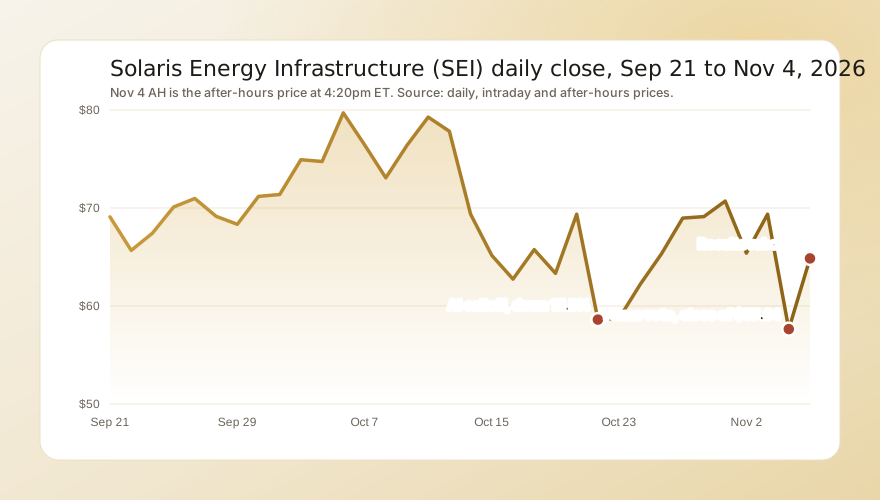
Solaris closed Nov 3 at $69.37. Overnight, Democrats won both houses of Congress and Hinojosa defeated Gov. Greg Abbott in Texas. She had said she would ban all data center approvals until the legislature passes laws giving Texans a say in whether and how they are built, Reuters reported. Premarket trading ranged from $61.90 to $69.68. The stock opened at $63.64, made its high of $65.25 in the first minute and fell to $54.90 at 11:21am. It closed at $57.64, down 16.9%, on about 8.3 million shares.
What pushed it down:
- Texas is where much of the build is planned. Wells Fargo estimates Texas holds 27% of planned U.S. data center gigawatts, CNBC reported, and Dan Ives of Yorkville Ives & Co. called the Texas result the night's "biggest worry" for tech investors.
- AI power names fell together. Vistra fell 13.8%, GE Vernova 9.3%, Constellation Energy 6.7% and Bloom Energy 6.4%. Sterling Infrastructure, which builds data center sites, fell 21.5%, while the S&P 500 fund SPY rose 1.7%.
- Oil fell too. Brent and West Texas Intermediate crude dropped as investors weighed the election and Iran diplomacy, StockStory reported, and Texas Pacific Land fell 13.4%, Kodiak Gas Services 11.3% and the energy fund XLE 4.7%. Solaris still earns part of its revenue from oilfield logistics.
What lifted it after the close:
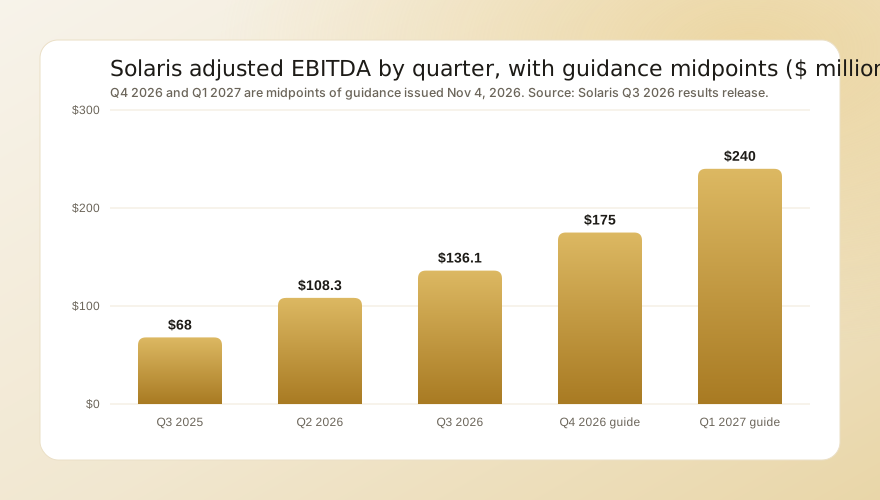
- A clean beat. Adjusted EBITDA of $136.1 million rose 26% from the second quarter and beat the top of the guide by $6 million.
- Higher guidance. The fourth-quarter guide rose to $165 million to $185 million from $145 million to $180 million, and the first-quarter 2027 guide to $220 million to $260 million from $200 million to $240 million.
- More contracted power. Beyond the 900 MW deal it signed on Oct 29, Solaris bought 200 MW more generating equipment for delivery under customer contracts in 2027, which it says puts it ahead of long manufacturer queues, and signed a 7-year deal to run about 400 MW of a customer's own generation.
Co-chief executives Bill Zartler and Amanda Brock said "we expect 2027 Adjusted EBITDA to be more than double 2026, with further growth beyond that." The conference call is at 9am ET on Nov 5.
After the regular session, RSI(14) stood at 41, the shares sat 12.2% below their 50-day average and 9.4% below their 200-day average, volume ran 2.8 times its 20-day average, and the stock was 33.1% below its 52-week high of $86.19. The rest of the session's movers are in today's biggest stock moves.
The numbers
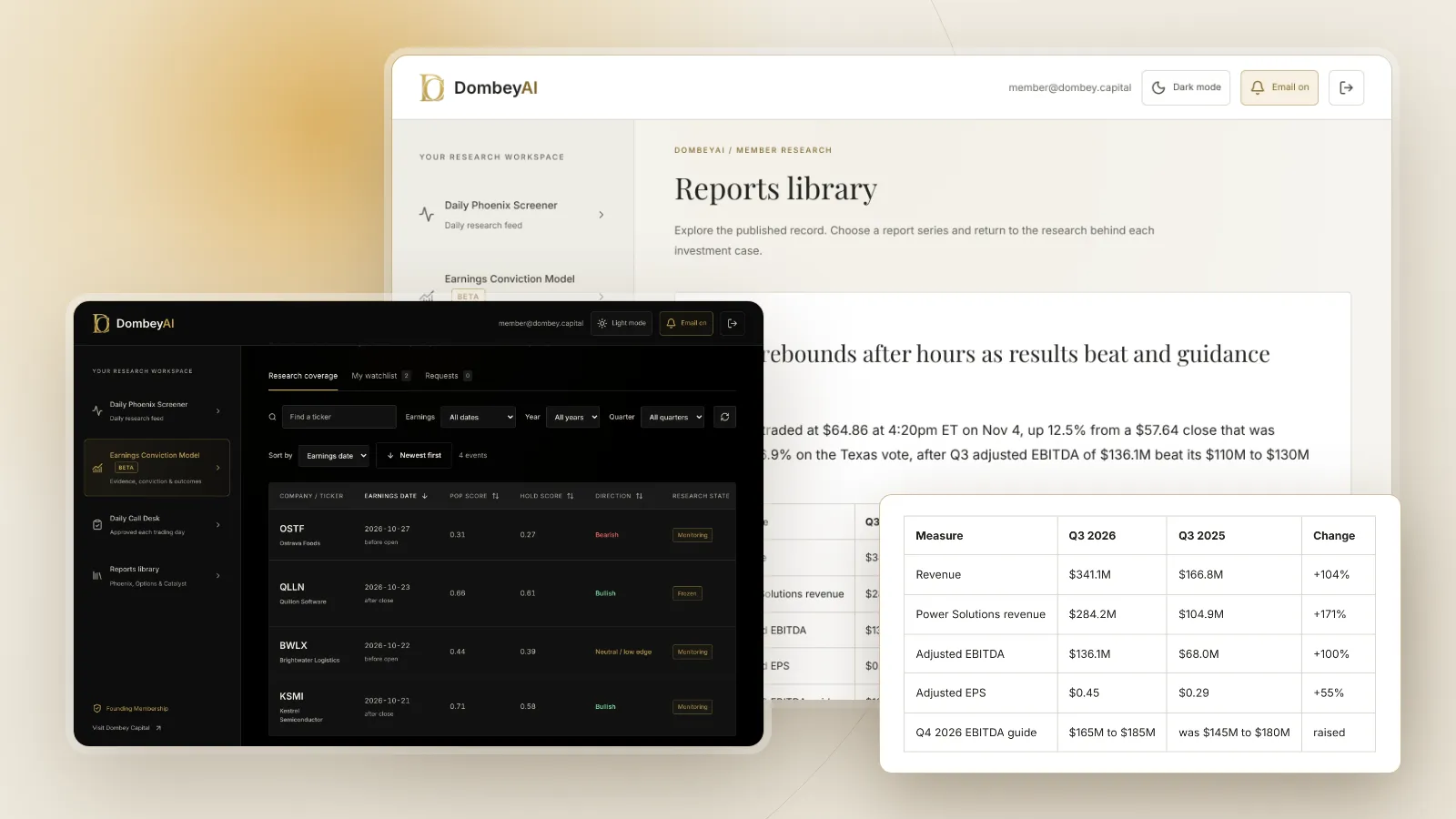
| Measure | Q3 2026 | Q3 2025 | Change |
|---|---|---|---|
| Revenue | $341.1 million | $166.8 million | +104% |
| Power Solutions revenue | $284.2 million | $104.9 million | +171% |
| Logistics Solutions revenue | $56.9 million | $61.9 million | -8% |
| Adjusted EBITDA | $136.1 million | $68.0 million | +100% |
| Adjusted EPS (pro forma, diluted) | $0.45 | $0.29 | +55% |
| Capital spending | $547.2 million | $62.8 million | n/m |
Net income was $39.3 million, up from $24.8 million a year earlier, or $0.42 per diluted Class A share. Power Solutions segment EBITDA rose 118% to $127.0 million, while the oilfield logistics business earned $23.9 million. Interest expense more than doubled to $22.9 million. Revenue from product sales jumped to $51.3 million from $2.0 million in the second quarter, a line that may not repeat at the same size. Our guide to adjusted EBITDA covers what the company's headline measure leaves out, including the depreciation on a fleet this size.
The bull case
Solaris has raised its outlook at each step this year: in August, on Sep 8 and again today. Each new long-term contract runs for years with an investment-grade buyer, which turns equipment the company buys now into a stream of fees later. The guidance midpoints imply adjusted EBITDA of about $240 million in the first quarter of 2027, 76% above the third quarter of 2026. Analysts' average price target is about $100, against the $57.64 close. Our explainer on guidance changes covers why a raise on top of a raise tends to matter more than the quarter itself, and our page on post-earnings announcement drift covers why stocks often keep moving in the direction of a clear surprise.
The risks
The Texas result is real for the industry even if it has not yet changed a contract. Hinojosa tied her ban on approvals to new laws from the legislature, and data centers in the state already faced a halt on new grid connections that Abbott ordered on Aug 3, Reuters reported. The release does not say how a slower Texas pipeline would affect the fleet.
Growth is also expensive. Capital spending was $1.38 billion in the first nine months, debt attributable to Solaris rose to $2.40 billion, and the stock is volatile: it fell about 15% on Oct 22 in an AI spending selloff with no company news, IBTimes reported. Capacity earning revenue fell to about 820 MW as Solaris released rented third-party generators, so the company has to bring its own units online on schedule to hit the higher guide. Our guide to debt maturity walls covers how leverage changes a stock's risk, and our coverage of Sterling Infrastructure and Bloom Energy shows how the same AI power trade has hit other suppliers.
What comes next
The call at 9am ET on Nov 5 should say more about where the 900 MW will go and how much of the fleet sits in Texas. After that, watch for any bill or executive order from the incoming Texas governor that reaches power equipment or sites already under contract, the dividend of $0.12 a share payable on Dec 18, and fourth-quarter results in late February against the new $165 million to $185 million guide. A close below the $54.90 low of Nov 4 would undercut the Bullish case.