

Oct 16, 2026: AI infrastructure stocks sell off again
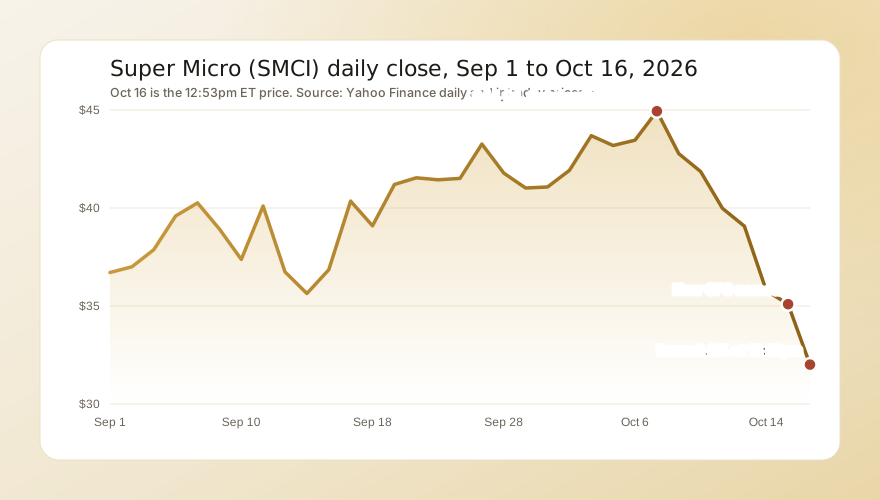
The stock traded at $35.24 when premarket trading opened at 4am and drifted to $34.46 just before the bell. It opened at $34.47, reached its high of $34.62 in the first five minutes, and fell steadily from there. It broke below Thursday's $32.38 low late in the morning and hit $31.90 around 12:35pm. At 12:53pm it was $32.01, down 8.8%, on 22.6 million shares.
What pushed it down:
- The AI financing scare spread again. CoreWeave sank for a second time this week as worries about its debt load returned, Yahoo Finance reported. Goldman Sachs strategist Amanda Lynam wrote that AI-related corporate bonds from neoclouds are "at the epicenter of the funding cost debate," and that high-yield AI spreads widened 25 basis points between Oct 13 and Oct 14 while non-AI spreads moved 2. For more on the CoreWeave side, see why CoreWeave stock fell.
- Tech fell broadly. At 12:39pm the Nasdaq 100 was down 1.4% and the S&P 500 down 0.6%, with 57 of 60 large chip stocks lower and the 10-year Treasury yield near 5.07%.
- No company trigger. SEC EDGAR shows no Super Micro filing since the Oct 15 8-K on the CFO change.
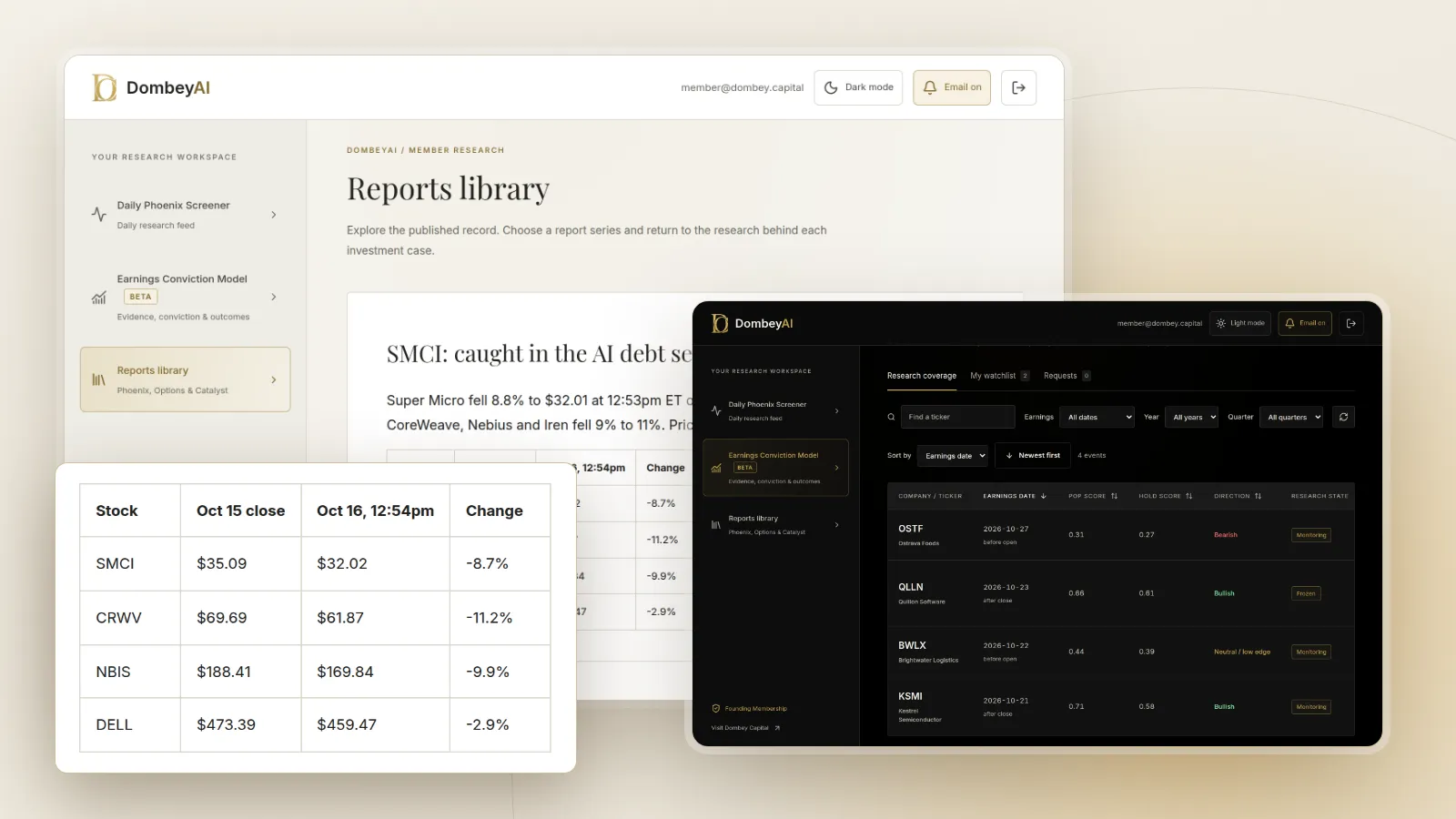
Here is how the group traded at 12:54pm:
| Stock or fund | Change |
|---|---|
| CoreWeave (CRWV) | -11.2% |
| Nebius (NBIS) | -9.9% |
| Iren (IREN) | -9.0% |
| Applied Digital (APLD) | -9.0% |
| Super Micro (SMCI) | -8.7% |
| HPE (HPE) | -5.8% |
| Dell (DELL) | -2.9% |
| VanEck semiconductor ETF (SMH) | -1.8% |
| Nvidia (NVDA) | -0.4% |
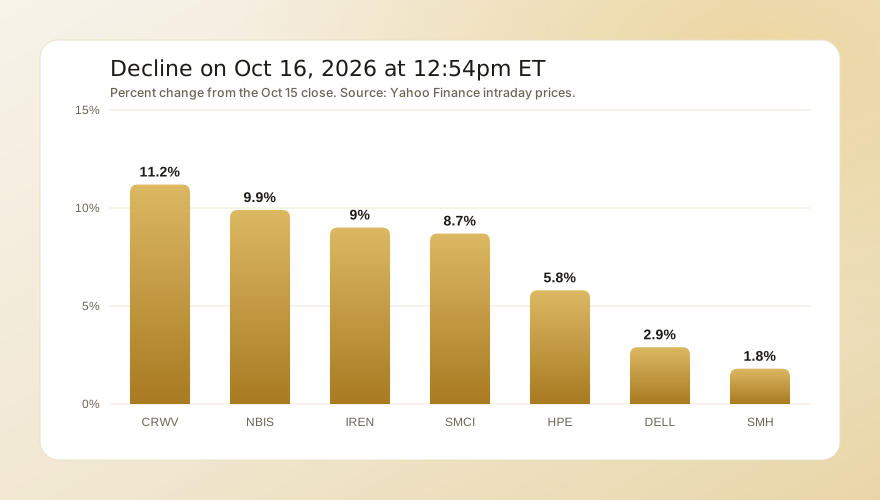
Super Micro traded with the neoclouds, not with its fellow server makers. Dell and HPE fell far less. That fits how investors see Super Micro: as a supplier whose next big orders depend on companies like CoreWeave being able to raise money. So we read the day as sector-driven, made sharper by company issues that were already in the price.
After the drop, RSI(14) stood at 31, the shares sat 17% below their 50-day average and 1.4% below their 200-day average, volume by early afternoon was 0.7 times its 20-day average of 34.4 million shares, and the stock was 43% below its 52-week high of $56.60.
Oct 13 to 15: an export case and a new CFO
Two company stories fed the earlier part of the slide.
- The export case. Ting-Wei Sun, a former contractor, pleaded guilty in Manhattan federal court to four counts tied to an alleged scheme to send about $2.5 billion of U.S. AI servers to China without licenses, Yahoo Finance reported. Shares fell 5.5% in the afternoon of Oct 12, and about 3% more on the morning of Oct 13, per GuruFocus. Co-founder Yih-Shyan Liaw has pleaded not guilty. Super Micro says it has not been charged. Its 10-K discloses an SEC subpoena about certain customers, including one named in the indictment, and a grand jury subpoena.
- The CFO change. On Oct 14, the day CoreWeave's bond scare hit, and the day Dell fell after a Barclays downgrade, Super Micro fell 8.4% to $35.78. The same day the board named Mark Long chief financial officer, effective immediately, replacing David Weigand, according to an 8-K filed Oct 15. Long ran finance at Western Digital from 2016 to 2019. The stock fell 7.0% to $33.26 in early trading on Oct 15, Investing.com reported, and hit $32.38 before recovering to close at $35.09, down 1.9%.
A CFO search has been expected since a 2024 internal review, so the hire itself was not a surprise. The timing, in the middle of an export case and a sector selloff, added to the unease.
The numbers behind the business
Results have been strong. Fourth-quarter fiscal 2026 net sales were $11.1 billion, up from $5.8 billion a year earlier, with a gross margin of 17.5% against 9.5%. Full-year sales were $39.1 billion. The stock rose 19% on Aug 12 after the company guided fiscal 2027 sales to $65 billion to $72 billion, well above what analysts had expected.
The cash picture is weaker. Operating cash flow was negative $6.8 billion for fiscal 2026, as the company bought parts ahead of orders, and bank debt and convertible notes totaled $8.7 billion at June 30 against $7.5 billion of cash. In June it announced about $7.0 billion of equity and equity-linked financing to buy components for about $39 billion of AI server orders from more than 20 customers. That includes an at-the-market program for up to $2.0 billion of new shares, which could add dilution as it is used.
The case for the stock
- Growth guidance. The fiscal 2027 range is 66% to 84% above fiscal 2026 sales. Management said it took more than $60 billion of new orders over the past year.
- Valuation. The forward P/E is near 6 and the price-to-sales ratio at 0.54. The consensus price target of $42.33, about 32% above the 12:53pm price.
- Margins. The fourth-quarter gross margin nearly doubled from a year earlier, which the CEO tied to a richer enterprise customer mix.
The risks
- Customer funding. The June release said the $39 billion of orders are not firm commitments and could be canceled or delayed. If neocloud buyers cannot borrow on good terms, those orders are the first place it would show.
- Concentration. One customer made up 28.1% of fiscal 2026 net sales, per the 10-K.
- Legal. The export case and the related subpoenas are open, and the 10-K says past material weaknesses in internal controls are still being remediated.
- Short interest. Short sellers hold 15.3% of the float. Our guide to short interest and squeeze risk explains why that cuts both ways.
What comes next
- First-quarter results, expected around November 3. Guidance is $14.5 billion to $15.5 billion of sales and $1.01 to $1.10 of non-GAAP earnings per share. Whether the company keeps the $65 billion to $72 billion range for the year matters more than the quarter. Our guide to how guidance changes move stocks covers why.
- AI credit spreads. Goldman expects "some near-term reversal" in the selloff. A narrowing in neocloud bond spreads would ease the main worry behind this week's drop.
- The export case. Any charge against the company, or a settlement, would reset the risk.
- Share sales. Use of the at-the-market program will show up in the next share count.