

Oct 15, 2026: a second day of selling, then a small bounce
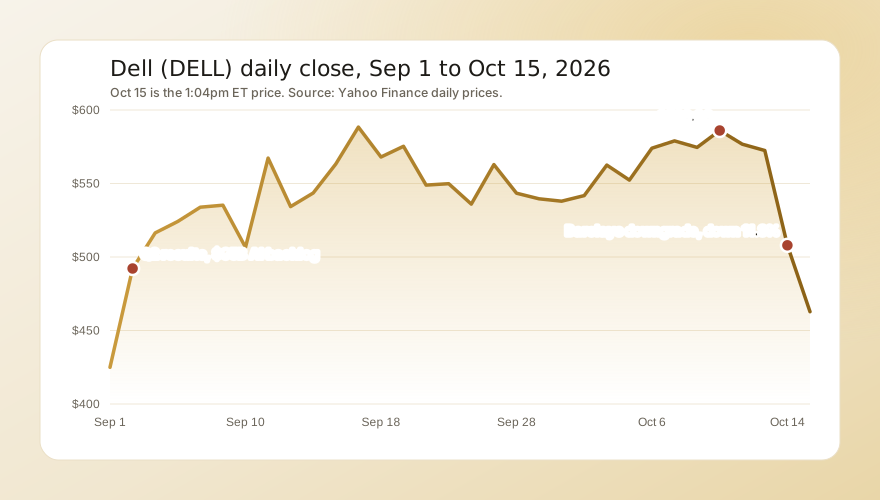
Dell's first premarket trade was $488.99, already 3.7% below Wednesday's close. Selling built before the bell, and the last premarket price was $476.00, down 6.3%. The stock opened at $465.51, down 8.4%, and hit $452.42 during the session, down 10.9%. Its best price of the day was $482.00. By 1:04pm ET it was at $462.81, about 2.3% above the low, on 9.7 million shares.
What pushed it down:
- The downgrade kept working. Investing.com named the Barclays call, which also covered Hewlett Packard Enterprise and NetApp, as the first reason for Thursday's drop, along with the insider sales and a broad tech selloff.
- Server stocks fell together. HPE was down 6.4% and NetApp 3.1% in Investing.com's market data, and Super Micro Computer also fell sharply. The Nasdaq was down 1.2%.
- Rates. Investing.com tied part of the tech selloff to a hotter-than-expected inflation reading, which raised the risk that interest rates stay high and makes AI data center spending more expensive to finance.
- The AI credit scare. Our page on why CoreWeave stock fell covers the bond scare that hit AI infrastructure stocks on Oct 14 and 15. Dell sells the servers those data centers run on, so doubts about how the buildout gets financed reach Dell too.
What helped it bounce:
- Bernstein stood by the stock. Investing.com reported that Bernstein kept its Outperform rating and $650 price target and named Dell its top server pick.
- The order book. Buyers at the low were paying about 18 times guided earnings for a company that raised its full-year revenue outlook by $25 billion six weeks ago.
Oct 14, 2026: the Barclays downgrade
Barclays analyst Tim Long cut Dell to Equal Weight from Overweight and lowered his price target to $574 from $603. TipRanks reported that the stock had risen about 359% this year before the call. Long's case had three parts:
- Memory, not enterprise AI. He wrote that "the strong enterprise revenues are more of a function of memory costs" than of companies adopting AI. Dell has passed rising memory prices on to customers, which lifts revenue per server.
- Slower growth ahead. He expects growth to slow over the next two years as memory prices normalize and possibly fall, and expects price rather than unit demand to drive much of the projected growth.
- Smaller beats. He warned that "the scale of the beats should become much smaller," which "may limit stock upside."
He did not turn negative on the business. He expects AI server revenue of about $75 billion this fiscal year and sees room for it to pass his $100 billion estimate for fiscal 2028.
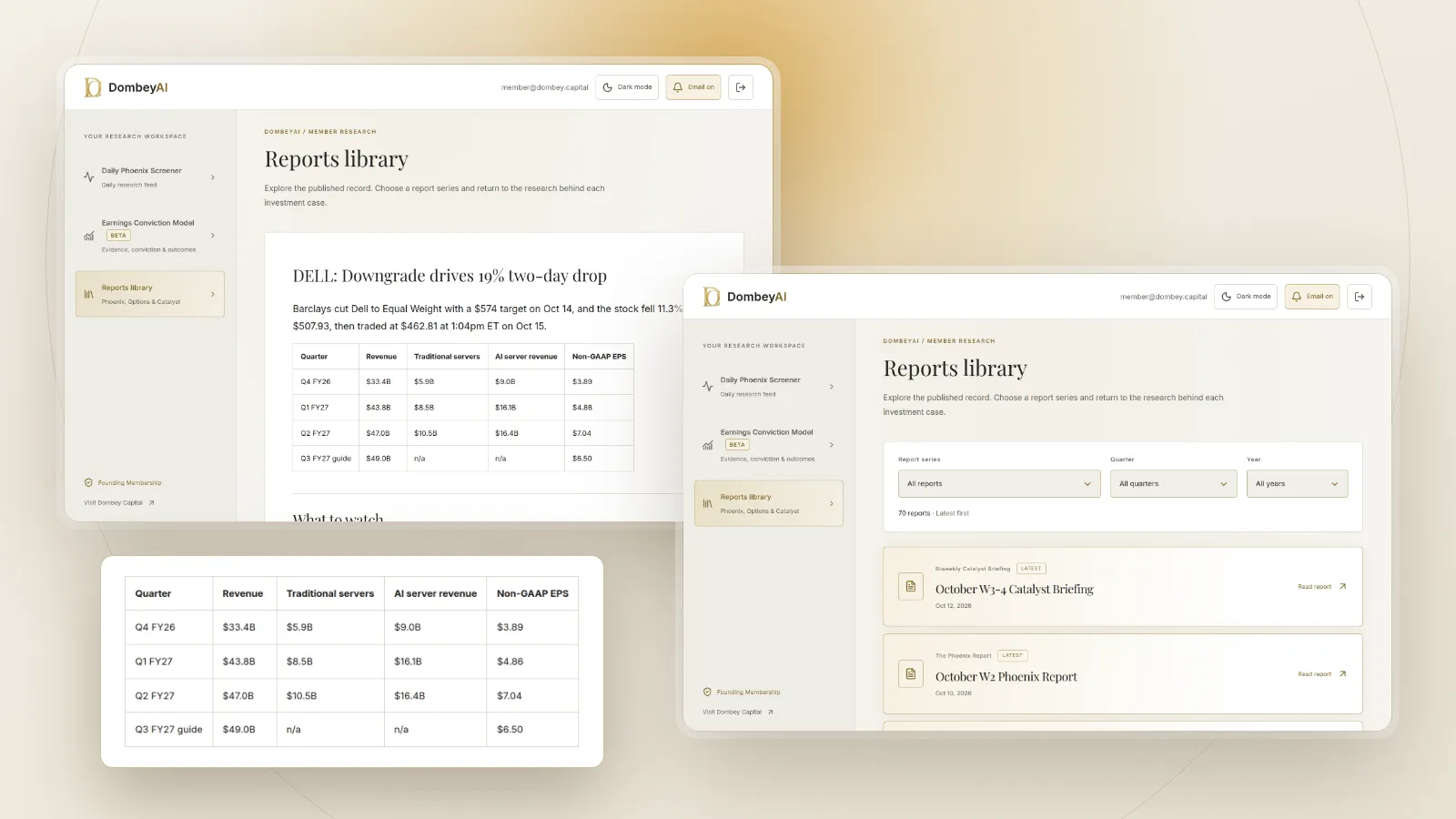
The stock fell 11.3% to $507.93 on 11.7 million shares. A smaller factor was a set of Form 4 filings made the same day showing funds affiliated with Silver Lake sold shares on Oct 9 at about $573 to $589. Investing.com put the total at about $29.4 million, which is small against a company worth more than $300 billion.
The numbers behind the argument
The line Barclays is questioning is traditional servers and networking, the part of the business that sells to ordinary companies rather than AI labs and cloud providers. It has more than doubled in a year.
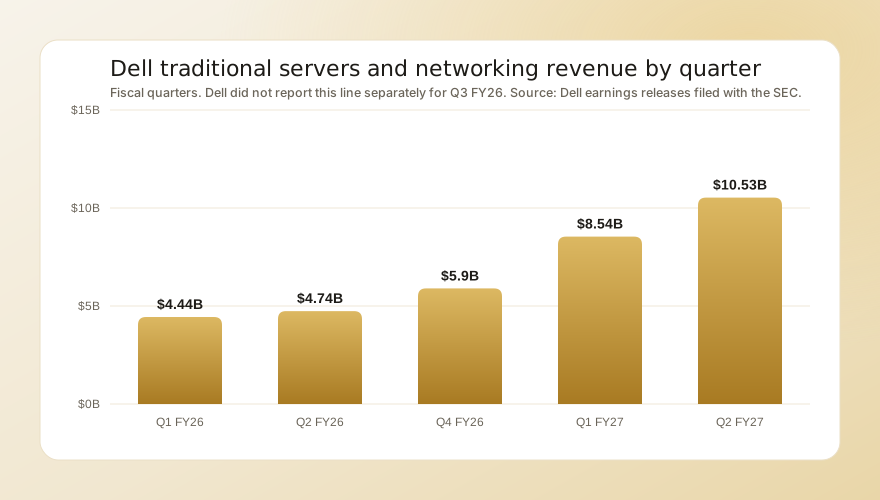
Second-quarter traditional server revenue was $10.53 billion, up 122%. Dell's releases do not split that growth between more units and higher prices, and that gap is what the downgrade turns on. If price explains most of it, the line slows when memory costs stop rising.
The rest of the second quarter, which ended July 31:
| Measure | Q2 FY26 | Q2 FY27 | Change |
|---|---|---|---|
| Revenue | $29.8B | $47.0B | Up 58% |
| AI-optimized server revenue | $8.2B | $16.4B | Up 100% |
| ISG operating margin | 8.8% | 15.0% | Up 6.2 points |
| Non-GAAP EPS | $2.32 | $7.04 | Up 203% |
| Cash from operations | $2.5B | $2.2B | Down 13% |
Dell booked $60.9 billion of AI orders in the quarter, up from $24.4 billion in the first quarter, and ended July with a $95 billion AI backlog, up from $43 billion at the start of the fiscal year. It raised full-year revenue guidance to $192 billion from $167 billion and AI server revenue guidance to $74 billion from $60 billion. For why a raise like that matters more than the quarter itself, see how guidance changes move stocks.
The case for the stock
The backlog is the core of it. Orders of $60.9 billion in one quarter are larger than the $47.0 billion of total revenue Dell reported in that quarter, and the $95 billion backlog alone is about half of this year's revenue guidance.
The valuation has also come down fast. At $462.81, the stock is about 18 times the $25.50 of non-GAAP EPS Dell guides to for this fiscal year. That uses the company's own forecast, so it is only as good as the guidance, but Dell has beaten its revenue guidance in each of the last two quarters. Our explainer on forward and trailing P/E covers the limits of that kind of multiple.
Memory may stay tight. MarketBeat reported that Michael Dell said memory shortages could last until new manufacturing capacity arrives around 2029 or 2030. If that is right, the price support Barclays expects to fade may last longer than its model assumes.
The risks
- Barclays may be right about the mix. If memory prices fall, revenue per server falls with them, and the line that grew 122% could slow sharply even with steady demand.
- Cash is lagging profit. Second-quarter cash from operations fell 13% to $2.2 billion while net income rose 255% to $4.1 billion. Building servers for a large backlog ties up cash before customers pay.
- Debt. Dell held $11.6 billion of cash against $8.5 billion of short-term debt and $26.0 billion of long-term debt at July 31.
- AI financing. Some of the largest AI server buyers fund their data centers with debt. If that credit gets more expensive, as the CoreWeave selloff suggests, orders could slow.
- The stock moves in big steps. It has gained or lost 5% or more in a day several times since September, including a 15.8% gain on Sept. 2. Swings that size can run further in either direction than the news justifies.
What comes next
- Third-quarter results, expected in late November. Dell guided to $49.0 billion of revenue and $6.50 of non-GAAP EPS. The size of the beat is the direct test of the Barclays claim that beats will shrink. Our guide to preparing for an earnings report covers what tends to move a stock on the day.
- AI orders and backlog. A backlog that holds near $95 billion would show demand is not fading with the stock.
- Comments on memory pricing. Any sign that memory costs have peaked, and how Dell plans to price after that, speaks directly to the downgrade.
- Other analysts. Follow-up rating changes, in either direction, from firms that cover the server group.