

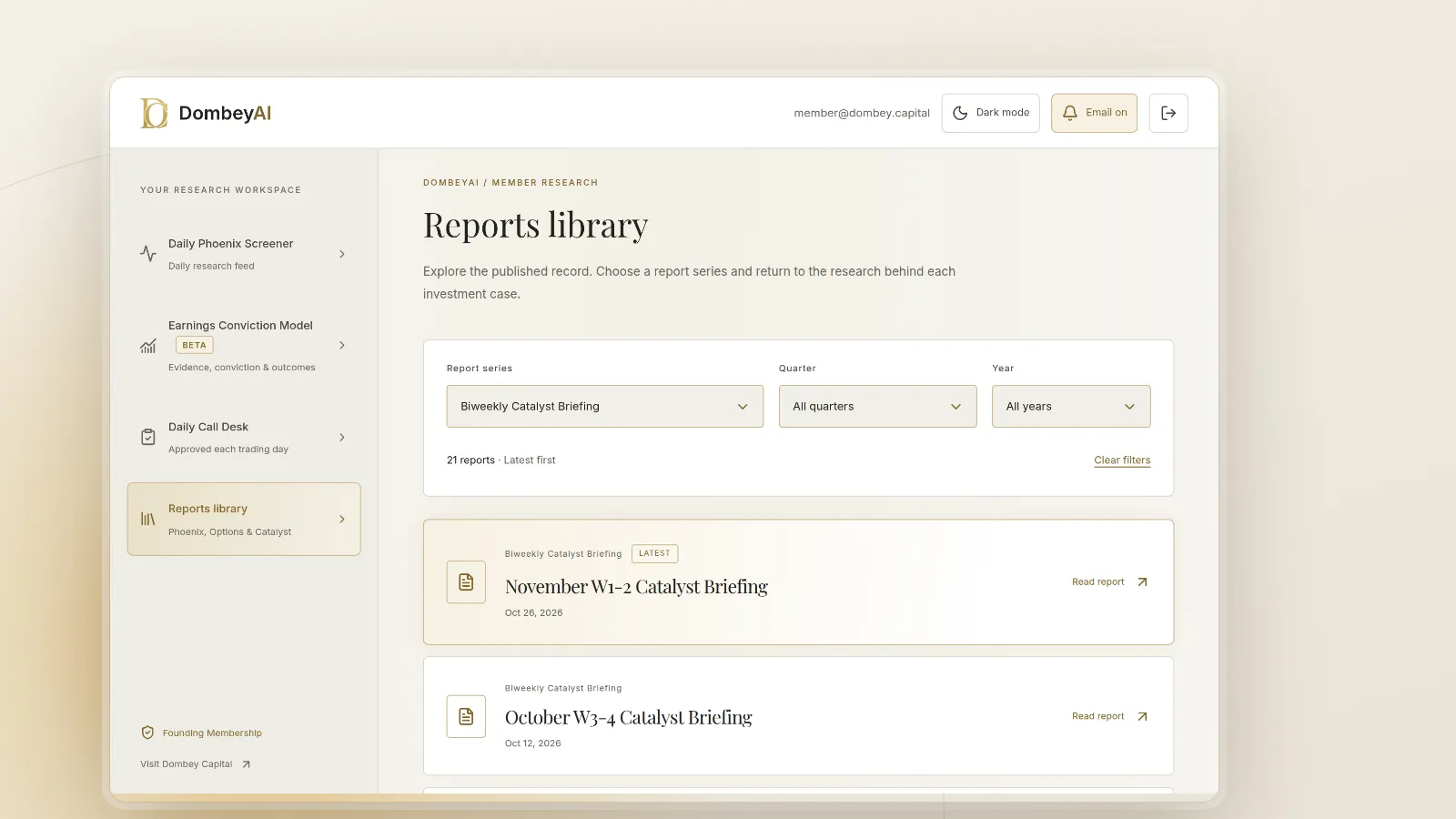


Full disclosure: Dombey Capital is our own research service and our top pick here, for the reasons below. The section on where it falls short is there so you can judge whether it fits your process.
Which part of Quiver are you replacing?
Quiver Quantitative collects public and web data and links it to stock tickers. Its site lists congressional trading, insider trading, government contracts, corporate lobbying, institutional holdings, patents, layoff notices, social sentiment from WallStreetBets, app ratings and Wikipedia pageviews, plus backtesters, strategies, alerts and a screener.
Most readers use two or three of those. The congressional trades, insider filings and 13F holdings are the most popular, and each has a dedicated alternative. The more unusual datasets, such as app ratings or pageviews, have few direct replacements, though the government records behind contracts and lobbying are free at the source.
Quick comparison
| Tool | Best for | Key features | Price (as of October 2026) |
|---|---|---|---|
| Dombey CapitalTop pick | Alternative signals read inside special situations research | Founding Membership: weekly Phoenix Report, weekly Options Research, Catalyst Briefing, DombeyAI Portal with the Daily Phoenix Screener and Earnings Conviction Model | Founding Membership $1,200/year (annual only); Standard Access $80/year or $8/month; Public Archive free |
| Unusual Whales | Congressional trades, insider data and options flow together | Politician trade information, institutional holders and insider trade data, options flow, prediction market data, screener, alerts | Free (2-day delay); Retail Basic $50, Pro $75, Max $120 a month at list price; annual discounts |
| HedgeFollow | Funds, insiders and Congress on one free site | Hedge fund tracker of 10,000+ funds, 100K+ insiders, insider cluster buys, Congress stock tracker, screener | See the vendor's pricing page |
| Stockcircle | Following named investors and Congress with alerts | Investor portfolios, Congress trades, insider trades, screener, instant alerts on Pro | Pro $99/year or $16.49/month |
| WhaleWisdom | 13F holdings in depth | 13F history, 13D and 13G filings, backtester, alerts, Excel add-in on Pro | Free; Standard $90/quarter; Pro $150/quarter |
| OpenInsider | Free Form 4 screening | Filters by transaction code, insider title, size and filing delay; cluster buys and top purchase lists | Free |
| Finviz Elite | Alerts on insider trades and filings | Insider trading page, unlimited alerts on news, ratings, insider trading and SEC filings, real-time data | $39.50/month or $299.50/year |
| Official sources | Primary records, free | SEC EDGAR, House and Senate financial disclosures, USAspending.gov, Senate lobbying disclosures | Free |

Quiver's pricing page sent us to a sign-up page when we checked, so we do not quote its price; see the vendor's pricing page.
How we compared these tools
We compared these tools from vendor documentation, pricing pages and public product pages, read in October 2026. We did not run trials of the paid plans, and we make no claims about the accuracy of any dataset or about the returns of any signal or strategy.
| Criterion | Weight | What it measures |
|---|---|---|
| Catalyst context | 25% | Whether the tool ties a data point to a dated event and what it means for value |
| Dataset coverage | 20% | Congressional, insider, fund holdings and other datasets offered |
| Timeliness and alerts | 15% | How fast filings appear and whether you can be notified |
| Link to primary source | 15% | Whether each data point leads back to the filing or record |
| Cost and friction | 25% | Price of the plan you would need, and free tiers |
We weighted catalyst context most because a congressional trade or an insider purchase is a prompt for research, not a conclusion, and special situations depend on what a dated event does to value. If you weight dataset breadth most, Unusual Whales and HedgeFollow move up; if you weight cost, OpenInsider, HedgeFollow's free pages and the official sources lead.
Quick picks by job
Best for alternative signals inside special situations research: Dombey Capital
Dombey's Founding Membership is written research: the weekly Phoenix Report, weekly Options Research, the Catalyst Briefing and the DombeyAI Portal with the Daily Phoenix Screener and the Earnings Conviction Model. It suits readers who see insider buys or fund moves elsewhere and want an analyst's view of whether a stock has a dated catalyst behind them.
Best for congressional trades with options flow: Unusual Whales
Unusual Whales lists politician trade information, institutional holder and insider data, options flow and prediction market data in one dashboard, with a free plan delayed two trading days.
Best free site for funds, insiders and Congress: HedgeFollow
HedgeFollow tracks more than 10,000 funds and 100,000 insiders, with lists of largest buys, insider cluster buys and a Congress stock tracker.
Best for following named investors with alerts: Stockcircle
Stockcircle shows the portfolios of well-known investors, Congress trades and insider trades, with instant alerts on its Pro plan.
Best for 13F holdings: WhaleWisdom
WhaleWisdom specializes in 13F data, with history, 13D and 13G filings, a backtester and alerts. Our list of 13F trackers covers it alongside other options.
Best free Form 4 screener: OpenInsider
OpenInsider screens Form 4 filings by transaction type, insider title, size and filing delay, with ready-made lists such as latest cluster buys.
Best for alerts on insider trades and filings: Finviz Elite
Finviz Elite adds unlimited alerts on news, ratings, insider trading, SEC filings and price to a fast screener.
Best for primary records: official sources
EDGAR, the House and Senate disclosure sites, USAspending.gov and the Senate's lobbying database are where most of these datasets start.
Full reviews
1. Dombey Capital
What it does. Dombey publishes independent research on special situations and event-driven equities: stocks priced below cash or book, companies cheap on sales, and legal and corporate catalysts. Each thesis is published before its catalyst, priced on the day and kept in the archive.
Best for. Readers who want signals such as insider buying read in the context of a dated case.
Pricing. Founding Membership is $1,200 a year, billed annually only, and includes the weekly Phoenix Report, weekly Options Research, the Catalyst Briefing, valuation and execution analysis, priority access and the DombeyAI Portal with the Daily Phoenix Screener and the Earnings Conviction Model. Standard Access is the lower-cost option at $80 a year (about $6.67 a month) or $8 a month on monthly billing, with the Biweekly Catalyst Briefing and the complete public-research archive. The Public Archive is free.
Pros
- Turns data points into a written case with a date.
- Options Research adds the derivatives view.
- Theses are archived for comparison with what followed.
Cons
- No congressional, lobbying or contract datasets.
- Coverage is a short list of situations.
- Founding Membership costs more than most data plans here.
Verdict: Our top pick for alternative signals inside special situations research. Pair it with a free dataset site.
2. Unusual Whales
What it does. Unusual Whales is best known for options flow. Its plans also list politician trade information, institutional holders and insider trade data, prediction market data, a stock and options screener and custom alerts.
Best for. Traders who want congressional and insider data next to options activity.
Pricing. A free plan with flow delayed two trading days, news 15 minutes and alerts 30 minutes. Retail Basic is $50, Pro $75 and Max $120 a month at list price, with lower annual rates; a limited-time sale was running when we checked.
Pros
- Several of Quiver's popular datasets in one place.
- A usable free plan.
- Options flow alongside the filings.
Cons
- Built mainly for options traders.
- Paid plans cost more than single-purpose sites.
Verdict: The closest all-in-one replacement for Quiver's most-used datasets. Our Unusual Whales alternatives page covers its options side.
3. HedgeFollow
What it does. HedgeFollow tracks hedge fund 13F holdings, insider trades and congressional trades, with largest buys and sells, insider cluster buys, CEO and CFO buys, a Congress stock tracker and a stock screener.
Best for. Investors who want funds, insiders and Congress on one site at little or no cost.
Pricing. See the vendor's pricing page.
Pros
- Broad coverage of funds and insiders.
- Congress tracker alongside fund and insider data.
Cons
- No published price on the pages we read.
- Data aggregation, not analysis.
Verdict: A strong free starting point for the three most popular datasets.
4. Stockcircle
What it does. Stockcircle shows portfolios of well-known investors, Congress trades, insider trades, an earnings calendar and a screener, with instant alerts on its Pro plan.
Best for. Investors who follow specific managers and want to hear when they or members of Congress trade.
Pricing. Pro is $99 a year, billed annually, or $16.49 a month.
Pros
- Clear investor portfolio pages.
- Instant alerts on Pro.
- Low annual price.
Cons
- Fewer datasets than Quiver.
- 13F holdings are quarterly and delayed by design.
Verdict: The pick for following named investors with alerts.
5. WhaleWisdom
What it does. WhaleWisdom tracks 13F filings, with 13D and 13G filings, historical holdings, a backtester, alerts and, on Pro, an Excel add-in and global holdings.
Best for. Investors who want deep 13F history and analysis.
Pricing. Free with 2 years of 13F data; Standard $90 a quarter; Pro $150 a quarter.
Pros
- Deep 13F history and tools.
- 13D and 13G filings for activist stakes.
Cons
- 13F data is quarterly and up to 45 days old when filed.
- No congressional or insider focus.
Verdict: The specialist for fund holdings. Our explainer on 13F filings covers their limits.
6. OpenInsider
What it does. OpenInsider is a free screener of SEC Form 4 filings, with filters by transaction code, insider title, filing delay and size, and lists of cluster buys and top purchases.
Best for. Free, fast screening of insider trades.
Pricing. Free.
Pros
- Detailed filters for free.
- Cluster buy lists.
Cons
- Insider trades only.
- Plain interface, few alerts.
Verdict: The best free replacement for Quiver's insider dataset. Our guide on how to track insider buying with Form 4 shows how to read what it finds.
7. Finviz Elite
What it does. Finviz is a screener with an insider trading page. Elite adds real-time data, advanced filters and unlimited alerts on news, ratings, insider trading, SEC filings and price.
Best for. Investors who want alerts when insiders trade or a filing lands on a watchlist stock.
Pricing. $39.50 a month or $299.50 a year; a free version with delayed data is available.
Pros
- Alerts on insider trades and filings.
- Fast screening with export.
Cons
- No congressional or alternative datasets.
- US-focused.
Verdict: The pick for alerts around insider and filing activity.
8. Official sources
What it does. SEC EDGAR holds Form 4, 13F, 13D and 13G filings. The House Clerk and Senate disclosure sites publish members' periodic transaction reports. USAspending.gov publishes federal contract awards, and the Senate's lobbying disclosure site holds lobbying registrations and reports.
Best for. Checking any data point at its source, free.
Pricing. Free.
Pros
- The original record for every dataset above.
- No cost and no account needed.
Cons
- Not linked to tickers or cleaned.
- No alerts across sources.
Verdict: Every alternative data point should be checked here before it is relied on.
Where Dombey falls short
- Narrow coverage. Dombey covers a short list of special situations. Most insider trades and congressional disclosures concern companies Dombey will never cover.
- No broad stock data terminal. No datasets, screeners, backtests or alerts on filings. You still need a data site or EDGAR.
- Small team. A small team limits how many situations it can follow properly.
- Pen-name author. Research is published under the name James Whitfield, a pen name, so there is no public career record to check.
- Short history. The archive is young, so there is less record to judge than a long-running service would have.
Where this goes wrong
Alternative data is easy to over-read. Each dataset has a lag and a blind spot.
- Congressional trades are reported up to 45 days after the trade, often in value ranges, and many are made by spouses or managed accounts.
- 13F holdings are as of quarter end and filed up to 45 days later, long only, and exclude most short positions.
- Insider sales are often scheduled under Rule 10b5-1 plans or made for taxes and diversification.
- Contract awards may be ceilings, not revenue, and can be spread over many years.
Read the filing behind any data point, and ask whether it changes a dated catalyst. Our list of insider buying tools and our explainer on hard vs soft catalysts help with both steps.
Free vs paid
| Tool | Free | What paying adds |
|---|---|---|
| Dombey | Public Archive of published research | Founding Membership adds the weekly reports and DombeyAI Portal; Standard Access, the lower-cost option, adds the Catalyst Briefing and full archive |
| Unusual Whales | Whole platform, delayed | Real-time data, more alerts and tools |
| HedgeFollow | Fund, insider and Congress pages | See the vendor's site |
| Stockcircle | Portfolio and trade pages | Instant alerts and more tools |
| WhaleWisdom | 2 years of 13F data | Full history, backtester, more alerts |
| OpenInsider and official sources | Everything | Nothing to buy |
A free stack of OpenInsider, HedgeFollow and the official disclosure sites covers the most popular Quiver datasets. Paying buys speed, alerts and analysis.
How to choose
| Your situation | Pick | Add later when |
|---|---|---|
| You follow special situations and want signals read in context | Dombey CapitalTop pick | You want raw data: add HedgeFollow or OpenInsider |
| You want congressional and insider data with options flow | Unusual Whales | You want analysis of what matters: add Dombey |
| You follow named investors | Stockcircle | You want deep 13F history: add WhaleWisdom |
| You research fund holdings | WhaleWisdom | You want insider data: add OpenInsider |
| You want alerts on filings | Finviz Elite | You want catalyst research: add Dombey |
- If your first question is "does this signal point to a dated catalyst," start with Dombey and keep a free data site.
- If your first question is "who bought what," start with HedgeFollow, OpenInsider and the official sources.
Dombey's published work is in the research archive. For a wider comparison of research services, see our Seeking Alpha vs Motley Fool vs Morningstar vs Dombey comparison.
The bottom line
Dombey Capital is our top pick for investors who want alternative signals read inside special situations research, provided you accept that it is written research on a narrow list and not a dataset. For the data, Unusual Whales covers congressional trades, insider data and options flow together, HedgeFollow and Stockcircle follow funds, insiders and Congress, WhaleWisdom handles 13F holdings, OpenInsider screens Form 4s free and Finviz Elite adds alerts. Most of Quiver's core data starts in free public records, so check every data point at its source before acting on it.