



Full disclosure: Dombey Capital is our own research service and our top pick here, for the reasons below. The section on where it falls short is there so you can judge whether it fits your process.
What a 13F tracker can and cannot tell you
A Form 13F is a quarterly report filed by institutional investment managers with $100 million or more in Section 13(f) securities. It lists their long positions in those securities on the last day of the quarter and is due within 45 days after the quarter ends. Our explainer on what a 13F filing is covers who files, what counts and how to read the information table.
A 13F tracker takes those filings and organizes them: by manager, by stock and by quarter-over-quarter change. That is useful for three questions: what a manager owns, which managers own a given stock, and what changed since the last quarter.
Three things no tracker can do:
- Show the portfolio today. The filing describes one past date and can arrive six weeks or more later.
- Show the whole position. Short positions, cash and trades made and reversed within the quarter do not appear, and a manager can receive confidential treatment for a holding.
- Explain why. A 13F has no statement of intent. For that you need a 13D filing, which is filed when an investor crosses 5% with an intent to influence the company, or your own research.
Quick comparison
| Tool | Best for | Key features | Price (as of October 2026) |
|---|---|---|---|
| Dombey CapitalTop pick | Turning holdings and filings into dated special-situation research | Weekly Phoenix Report, weekly Options Research, Biweekly Catalyst Briefing, DombeyAI Portal; does not track 13F filings | Founding Membership $1,200/year; Standard Access $80/year or $8/month; Public Archive free |
| WhaleWisdom | A dedicated 13F database with history and backtests | 13F data back to 2001 on paid plans, email alerts, backtester, fund groups, watchlists, Excel export | Free; Standard $90/quarter; Pro $150/quarter; Enterprise on request |
| Dataroma | A free view of well-known value managers | Portfolios of 82 tracked superinvestors, top buys, most-owned stocks, insider buys in their holdings | No price listed; public pages |
| 13f.info | Plain, fast reading of any manager's filings | Manager pages, quarter-to-quarter comparisons, holders of a company by quarter, Form D search | No price listed; public pages |
| HedgeFollow | Hedge fund, insider and congressional trades on one site | Hedge fund tracker, largest buys and sells, insider and Congress trackers, screener | See the vendor's pricing page |
| Stockcircle | Following named investors with alerts | Investor portfolios and histories, latest 13F filings, insider and congressional trades, email alerts | Pro $99/year (billed annually) or $16.49/month |
| Insider Monkey | Hedge fund holdings pages plus a paid newsletter | Fund portfolio pages and rankings; Premium Quarterly Newsletter built from 13F filings | Free pages; Premium Quarterly Newsletter $499/year |
| SEC EDGAR | The original filing, free | Every 13F-HR with its information table; full-text search of filings since 2001 | Free |


How we compared these tools
We compared these tools from vendor documentation, pricing pages and public product pages, read on the publish date. We did not subscribe to each service for this article, and we make no claims about the accuracy or completeness of any vendor's data.
| Criterion | Weight | What it measures |
|---|---|---|
| Path from holding to a dated catalyst | 25% | Whether the tool helps you move from "a fund owns this" to an event, a date and a reason the security may be mispriced |
| Link to the primary filing | 20% | How easily you can reach the 13F on EDGAR and check the figures |
| Coverage and history | 20% | How many managers are covered and how many quarters back the data goes |
| Free plan usefulness | 20% | What you can do without paying |
| Price for an individual | 15% | The cost of the paid tier most individuals would need |
We weighted the path to a dated catalyst and the link to the primary filing most because, for special situations, a holding only matters once you can tie it to an event and confirm the numbers. If you care most about breadth, for example scanning every manager that added a stock last quarter, weight coverage and history higher and WhaleWisdom moves to the top.
Quick picks by job
Best for turning holdings and filings into dated special-situation research: Dombey Capital
A 13F tells you that a manager owned a stock. It does not tell you whether the stock sits below its cash, faces a spin-off or a vote, or has a dated catalyst ahead. That second question is the work Dombey publishes: research on special situations, with every thesis published before its catalyst, priced on the day and kept in the archive. Dombey does not track 13F filings, so it sits beside a tracker, not in place of one.
Best dedicated 13F database: WhaleWisdom
WhaleWisdom is built around 13F data, with a free plan, paid history back to 2001, email alerts and a backtester. It suits readers who follow many managers or want to study holdings across years.
Best free superinvestor view: Dataroma
Dataroma shows the portfolios of a fixed list of well-known managers, 82 when we read it, with the date each was last updated and the stocks most owned across them.
Best plain reader for any manager's filings: 13f.info
13f.info presents EDGAR's 13F data in a cleaner layout, with quarter-to-quarter comparisons for a manager and a list of managers holding a given company.
Best for hedge fund, insider and congressional trades together: HedgeFollow
HedgeFollow tracks hedge funds through 13F filings and adds insider trading and congressional trading trackers on the same site.
Best for alerts on named investors: Stockcircle
Stockcircle follows the portfolios of dozens of named investors and sends email notifications when new transaction reports become available.
Best for hedge fund pages with a newsletter: Insider Monkey
Insider Monkey's hedge fund pages show fund portfolios and top holdings, and its paid quarterly newsletter is built from the 13F filings of more than 1,000 hedge funds.
Best primary source: SEC EDGAR
EDGAR holds every 13F as filed, free. Every tracker on this list is a summary of these filings.
Full reviews
1. Dombey Capital (Founding Membership and Standard Access)
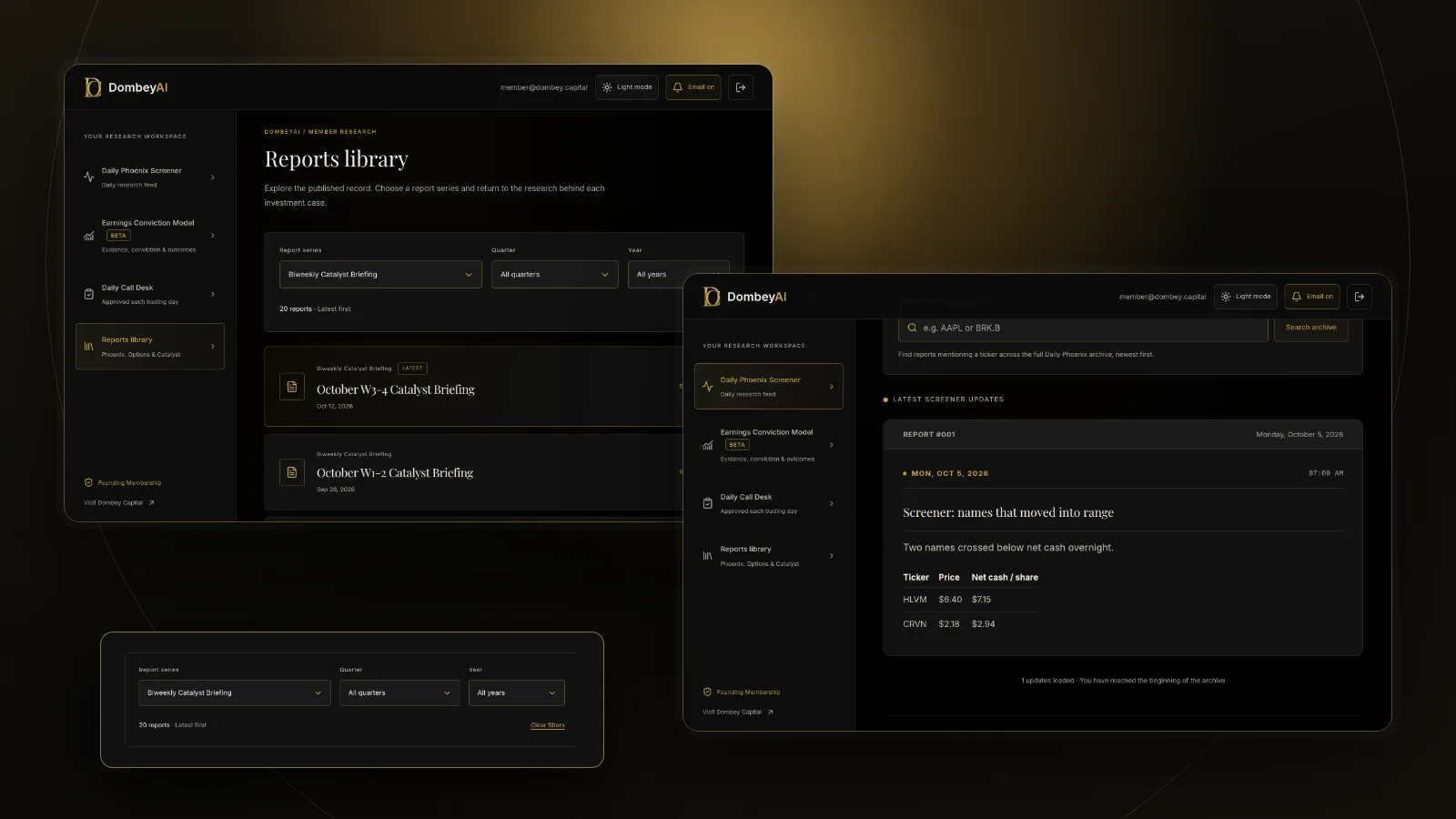
What it does. Dombey Capital publishes independent equity research on special situations and structural dislocations. Founding Membership includes the weekly Phoenix Report, weekly Options Research, the Biweekly Catalyst Briefing and the DombeyAI Portal with the Daily Phoenix Screener and the Earnings Conviction Model. Every thesis is published before its catalyst, priced on the day and kept in the archive. Dombey does not track 13F filings: there are no fund portfolio pages, no quarter-over-quarter holdings comparisons and no 13F alerts.
Best for. Investors who use 13F data as a starting point and want written research on whether a situation, such as a stock trading below cash or a corporate event with a date, is worth their own analysis.
Pricing. Founding Membership is $1,200 a year, annual billing only, and includes the weekly Phoenix Report, weekly Options Research, the Catalyst Briefing, the DombeyAI Portal with the Daily Phoenix Screener and Earnings Conviction Model, valuation and execution analysis, and priority access. Standard Access is the lower-cost option at $80 a year, about $6.67 a month, or $8 a month on monthly billing, and includes the Biweekly Catalyst Briefing and the complete public-research archive. The Public Archive is free.
Pros
- Research tied to a dated event, which a holdings list does not give you.
- Theses are archived with the date and price, so the original case can be checked later.
- Standard Access is one of the cheaper paid options on this list.
Cons
- Does not track 13F filings or show any fund's portfolio.
- Covers only the situations in Dombey's research coverage.
- Founding Membership is the most expensive option here.
Verdict: Our top pick for turning holdings and filings into dated special-situation research. Use it with a free tracker and EDGAR for the holdings themselves.
2. WhaleWisdom
What it does. WhaleWisdom is a dedicated 13F tracker. Its free plan includes two years of 13F data, unlimited email alerts, fund groups of up to five managers, watchlists of up to five stocks and backtesting on the past two years. Standard adds historical 13F data back to 2001, larger groups and watchlists, Excel export from the dashboard, an Excel add-in, its WhaleIndex and WhaleScore, and no ads. Pro raises the limits, adds 13F export from watchlists, a Combined Holdings Report and the full backtester. Enterprise adds team seats, unlimited 13F data via API and nightly files for 13F and Schedule 13D and 13G.
Best for. Readers who follow many managers, want long history or want to test how a set of holdings would have done.
Pricing. Free plan; Standard $90 a quarter; Pro $150 a quarter; Enterprise on request. The pricing page has an annual toggle, but annual prices were not shown when we read it.
Pros
- The most complete free plan of the dedicated trackers here.
- Long history and exports on paid plans.
- Alerts are included even on the free plan.
Cons
- Many features to learn if you only want to check one manager.
- Billing is quarterly, so the yearly cost is four times the listed price.
Verdict: The best pick when 13F data is the main thing you need. Check any figure you plan to rely on against the filing on EDGAR.
3. Dataroma
What it does. Dataroma tracks the portfolios of a fixed list of superinvestors, 82 when we read it, with an update date for each manager. It shows the most-owned stocks across them, largest holdings, "big bets" owned by at least two superinvestors, recent quarterly buys and holdings near 52-week lows. It also lists open-market insider purchases of at least $50,000 in stocks those managers hold, and offers an RSS feed of portfolio updates.
Best for. A quick, free look at what a set of well-known value managers own.
Pricing. No price is listed, and the pages we read were public.
Pros
- Clean, quick to scan and free to read.
- The insider purchase list links holdings to a second kind of filing.
Cons
- Only the managers on its list, chosen by the site.
- No long history tools, exports or backtests.
Verdict: A good first stop for idea generation from well-known portfolios. Go to EDGAR or a fuller tracker for any manager outside its list.
4. 13f.info
What it does. 13f.info presents 13F filings from EDGAR in a cleaner layout. You can browse managers alphabetically, view each quarterly report, compare a manager's holdings across periods, see which managers reported a given company in a quarter and how the number of holders changed, and search Form D filings. The site notes that the SEC has not verified 13F data for accuracy, and its code is published on GitHub.
Best for. Reading any filer's 13F quickly, including managers that superinvestor lists leave out.
Pricing. No price is listed, and the pages we read were public.
Pros
- Covers managers across EDGAR, not a curated list.
- Quarter-to-quarter comparisons save manual work.
Cons
- A reader, not an analysis tool: no alerts, screens or backtests on the pages we read.
- Data are as filed, with the same gaps as the 13F itself.
Verdict: The simplest free way to read and compare filings for any manager.
5. HedgeFollow
What it does. HedgeFollow tracks hedge funds using 13F filings, with a hedge fund tracker, largest buys and sells, top and largest funds, and a fund table showing AUM, holdings and turnover. It also has an insider trading tracker with cluster buys and CEO and CFO buys, a Congress stock tracker, and tools such as a stock screener and a portfolio builder.
Best for. Readers who want hedge fund, insider and congressional trades on one site.
Pricing. The home page showed no plans or prices when we read it. See the vendor's pricing page.
Pros
- Several filing types in one place.
- Lists of largest buys and sells across funds.
Cons
- Pricing not confirmed here.
- Broad coverage of many topics, so less depth on any one manager's history.
Verdict: A useful hub if you track insiders and funds together. Confirm terms on the vendor's site.
6. Stockcircle
What it does. Stockcircle follows the portfolios and transaction histories of dozens of named investors, with the latest 13F filings, insider trades and congressional trades, a stock screener, analyst data and an earnings calendar. It sends email notifications when new transaction reports become available.
Best for. Following a short list of named investors and hearing when their filings land.
Pricing. Stockcircle Pro is $99 a year, shown as $8.25 a month billed annually, or $16.49 a month on monthly billing.
Pros
- Alerts when new reports come in.
- Investor portfolios, insider trades and congressional trades in one product.
Cons
- Covers a selected set of investors, not every 13F filer.
- Its Pro page leads with stock picks, which are a different product from holdings data.
Verdict: A low-cost choice for alerts on named investors. Read the underlying filing before acting on any change.
7. Insider Monkey
What it does. Insider Monkey's hedge fund pages show each fund's portfolio value, top holdings with shares, value, recent activity and percentage of portfolio, plus fund rankings. Its paid Premium Quarterly Newsletter describes going through the 13F filings of more than 1,000 hedge funds to select small-cap and large-cap long ideas and stocks to bet against, in issues of more than 70 pages.
Best for. Readers who want free fund pages and are interested in a newsletter built from 13F data.
Pricing. The fund pages are public. The Premium Quarterly Newsletter is $499 a year, billed annually, with a full refund if cancelled within 30 days of purchase.
Pros
- Free fund pages with holdings and activity.
- The newsletter explains its method for using 13F data.
Cons
- The pages carry promotions for paid stock picks.
- The newsletter is a strategy product, not a tracker, and is priced well above the trackers here.
Verdict: Useful free fund pages. Judge the newsletter as a research product, separately from the data.
8. SEC EDGAR
What it does. EDGAR holds every 13F as filed. Search for the manager, filter the filing list by form type 13F-HR, and open the information table to see each holding with its CUSIP, share count and value. Full-text search covers electronic filings since 2001 and can be filtered by form type. Our guide on how to search SEC EDGAR filings walks through it.
Best for. Checking any figure from a tracker against the original.
Pricing. Free. The SEC describes EDGAR as free public access to filed documents.
Pros
- The primary source, with the filing date.
- Covers every filer, including amendments.
Cons
- No portfolio view or quarter-over-quarter comparison.
- Information tables are raw and take time to read for large managers.
Verdict: The check every tracker's numbers should pass.
Where Dombey falls short
Dombey does a different job from a 13F tracker, and its limits are real:
- No 13F tracking. It does not list any fund's holdings, compare quarters, or alert you when a manager files.
- Narrow coverage. It covers special situations in its own research coverage. Most stocks a fund owns will never appear in it.
- No broad stock data terminal. There is no screener across all filers, no holdings database and no export.
- Small team and pen-name author. The research is written by a small team under a pen name. Weigh it accordingly and check its figures against the filings.
- Short history. The archive is short compared with trackers that hold 13F data back to 2001.
Free vs paid
Free tools cover the holdings question for most individuals. EDGAR has every filing, 13f.info makes them easy to read and compare, Dataroma shows a curated set of value managers, and WhaleWisdom's free plan adds two years of data and alerts.
Paid tools buy one of three things: history and exports (WhaleWisdom Standard or Pro), alerts on named investors (Stockcircle Pro), or a view on what to do with the data (Insider Monkey's newsletter, or Dombey's Founding Membership, with Standard Access as the lower-cost option, for written special-situation research rather than more holdings).
How to choose
Start with the question you need answered.
| Your situation | Pick | Add later when |
|---|---|---|
| You want holdings turned into dated special-situation research | Dombey Capital Founding Membership, or Standard Access as the lower-cost option | You want the holdings themselves: add a free tracker and EDGAR |
| You follow many managers or want long history | WhaleWisdom | A figure matters to you: confirm it on EDGAR |
| You follow a few well-known value managers | Dataroma | A manager is not on its list: add 13f.info |
| You want alerts on named investors | Stockcircle | You need every filer: add WhaleWisdom |
| You track insiders and funds together | HedgeFollow | You need insider detail: read the Form 4 |
| You need to confirm one filing | SEC EDGAR | You want comparisons: add 13f.info |
- If a fund owns a stake above 5% with an intent to influence the company, the 13D will say more than the 13F; our comparison of activist investor trackers covers those tools.
- If you care what executives are buying, insider filings are faster than a 13F; see our comparison of insider buying trackers.
- If you want alerts on any filing type, see our comparison of SEC filing tools and EDGAR alerts.
- If you are choosing a broader research subscription, see Seeking Alpha vs Motley Fool vs Morningstar vs Dombey.
Where this goes wrong
- Copying a stale position. The filing can be 45 days old when it arrives, and the position may have changed.
- Missing the hedge. Short positions do not appear, so a long stake may be one side of a paired trade.
- Misreading options rows. Values for options describe the underlying shares, not the premium paid.
- Reading a drop-off as a sale. A holding can vanish because of the de minimis test, confidential treatment or a change in which affiliate reports it.
- Trusting the tracker over the filing. Trackers parse and summarize. When a number matters, open the 13F-HR on EDGAR.
The bottom line
Dombey Capital's Founding Membership is our top pick for investors who want holdings and filings turned into dated special-situation research, with Standard Access as the lower-cost option; it does not track 13F filings, so use it beside a tracker. For the holdings themselves, WhaleWisdom is the most complete dedicated tool, Dataroma and 13f.info are clean free views, and HedgeFollow, Stockcircle and Insider Monkey add insider trades, alerts or a newsletter. Whatever you use, EDGAR is the record. A 13F tells you what a fund owned, not what it owns now or why.