

Who files a 10-K and when
Companies with securities registered under the Securities Exchange Act of 1934, or that are otherwise required to report, file a 10-K once a year. The deadline depends on filer status, which is based mainly on public float:
| Filer status | Deadline after fiscal year end |
|---|---|
| Large accelerated filer | 60 days |
| Accelerated filer | 75 days |
| Non-accelerated and smaller filers | 90 days |
A company that cannot file on time submits a Form 12b-25, often called an NT 10-K, which extends the deadline by up to 15 calendar days. A late filing notice is worth reading in its own right, because the stated reason, such as an incomplete audit or a review of an accounting matter, can matter more than the eventual filing.
Foreign private issuers file a different annual report, usually a Form 20-F, and Canadian issuers in some cases a Form 40-F. The structure is similar but not identical.
The structure of a 10-K
The SEC sets the order. Every 10-K has four parts and numbered items, so once you know the layout you can find the same information in any company's filing.
Part I: the business
- Item 1, Business. What the company does, its segments, customers, competition, regulation and employees.
- Item 1A, Risk Factors. Management's list of what could hurt the company. Much of it is boilerplate; the useful part is what is new or reworded.
- Item 1B, Unresolved Staff Comments. Open comments from SEC staff, if any, for larger filers.
- Item 1C, Cybersecurity. How the company manages cybersecurity risk and who oversees it.
- Item 2, Properties. Major facilities, owned or leased. For asset-heavy situations, this is where hidden real estate value is first described.
- Item 3, Legal Proceedings. Material lawsuits and regulatory actions.
- Item 4, Mine Safety Disclosures. Relevant only to mining companies.
Part II: the numbers
- Item 5, Market for the Registrant's Common Equity. Where the stock trades, holders of record, dividends and share repurchases during the last quarter.
- Item 7, Management's Discussion and Analysis (MD&A). Management's explanation of the results, liquidity, capital resources and critical accounting estimates.
- Item 7A, Quantitative and Qualitative Disclosures About Market Risk. Exposure to interest rates, currencies and commodities.
- Item 8, Financial Statements and Supplementary Data. The audited income statement, balance sheet, cash flow statement, statement of equity, the notes and the auditor's report.
- Item 9A, Controls and Procedures. Management's assessment of internal control over financial reporting, and for larger filers the auditor's attestation. A material weakness is disclosed here.
Part III: governance
Items 10 to 14 cover directors, executive pay, ownership by insiders and large holders, related-party transactions and auditor fees. Most companies incorporate this information by reference from the proxy statement filed later. Our guide to reading a proxy statement covers it.
Part IV: exhibits
Item 15 lists the exhibits and financial statement schedules. This is where credit agreements, indentures, material contracts, subsidiaries and the officer certifications sit. Analysts who skip the exhibits miss the terms that often decide a special situation, such as covenants, change-of-control clauses and asset sale restrictions.
What to read first
You do not need to read a 10-K front to back. A practical order for most companies:
- MD&A. Read management's explanation of what changed, then the liquidity and capital resources section.
- The financial statements. Start with the cash flow statement, then the balance sheet, then the income statement. Cash flow is the hardest to dress up.
- The notes. Debt, leases, commitments and contingencies, income taxes, segment data, and subsequent events.
- Risk factors. Compare with last year's list. New or rewritten risks deserve attention.
- The auditor's report. Look for critical audit matters and any going concern paragraph.
- The cover page. It shows shares outstanding as of a recent date, which is more current than the weighted average on the income statement.
A 10-K checklist for special situations
In a special situation, the question is usually narrower than "is this a good business". It is whether the assets, the claims on them and the coming event support the price. The 10-K answers most of it.
| Step | What to check | Where to find it |
|---|---|---|
| 1 | Cash, restricted cash and short-term investments | Balance sheet and cash note |
| 2 | All debt, maturities and covenants | Debt note and Exhibit 10 credit agreements |
| 3 | Off-balance-sheet claims: leases, guarantees, litigation | Commitments and contingencies note, Item 3 |
| 4 | Cash burn for the year | Cash flow statement, MD&A liquidity |
| 5 | Diluted share count, options, warrants, convertibles | Cover page, equity note |
| 6 | Events after year end | Subsequent events note |
| 7 | Change-of-control and asset sale terms | Exhibits, employment agreements |
Those figures feed directly into net cash per share and enterprise value, the two numbers most deep value situations start from.
How the 10-K relates to other filings
The 10-K sits at the center of a company's filing calendar. The 10-Q updates it for each of the first three quarters, and our explainer on the 10-Q and how it differs from a 10-K covers the differences. Form 8-K reports material events between periodic filings. The proxy statement supplies Part III. In a spin-off, the new company files a Form 10 registration statement before it starts filing 10-Ks of its own; our guide to spin-off investing covers that sequence.
All of these are free on EDGAR. Our guide to searching SEC EDGAR filings shows how to filter by form type and run full-text searches across filings.
Where this goes wrong
- Treating it as current. A 10-K filed in March describes a year that ended in December. For a company burning cash or in the middle of a transaction, the latest 10-Q and 8-Ks matter more.
- Reading the summary, not the notes. Headline numbers in MD&A are management's framing. The notes carry the terms, the contingencies and the accounting choices.
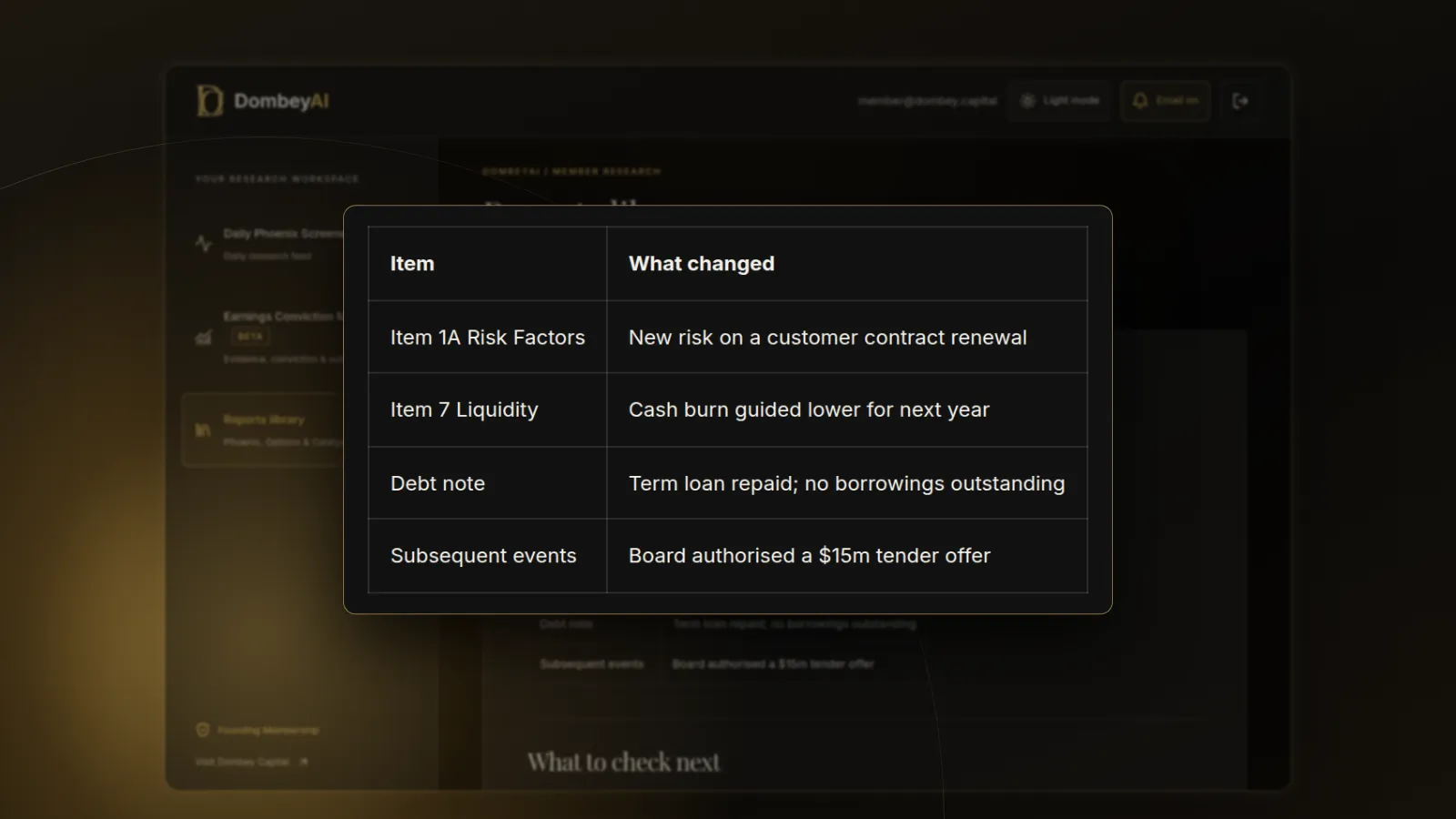
- Skimming risk factors as boilerplate. Most of the list is generic, but a newly added sentence about a customer, a covenant or a regulator is often the earliest public warning.
- Ignoring the exhibits. Covenants, change-of-control payments and asset sale restrictions live in exhibits, not in the main text.
- Missing a restatement or late filing. A 10-K/A that restates figures, or an NT 10-K, changes how far you can trust the prior numbers.
- Using the wrong share count. The weighted average share count on the income statement lags buybacks and issuance. Use the cover page and the equity note.
How Dombey uses the 10-K
Every situation Dombey covers starts with the most recent annual and quarterly filings, checked against the catalyst and its timeline; see the research archive. For the broader framework of how filings and events fit together, see what a special situation is and our guide to reading a 10-Q for special situations.
The bottom line
A 10-K is a US public company's annual report to the SEC, with audited financial statements and a standard set of items describing the business, risks, results and governance. It is due 60, 75 or 90 days after year end depending on filer status. Read MD&A, the financial statements and notes, the changes in risk factors, and the exhibits, and always compare against last year. For special situations, it is the document that confirms the cash, the claims and the share count a thesis depends on.