

How a Dutch auction tender offer works
The company files a Schedule TO with the SEC and sends holders an Offer to Purchase and a Letter of Transmittal. The Offer to Purchase sets out four terms that define the auction:
- The price range. For example, $18.00 to $20.00 a share, usually above the recent market price.
- The amount sought. Either a number of shares or a dollar amount, such as $40 million of stock.
- The price increments. Holders can usually name a price in steps, such as every $0.25 within the range.
- The expiration date. At least 20 business days after the offer starts.
Holders then choose one of two ways to tender:
- At a stated price. The holder names the lowest price within the range at which they will sell. If the auction clears below that price, their shares come back.
- At the price determined by the auction. The holder agrees to sell at whatever clearing price results. For counting purposes these tenders are treated as bids at the bottom of the range, which makes them the most likely to be accepted.
At expiration, the company counts tenders from the lowest price up, sets the clearing price, buys shares tendered at or below it, and returns the rest. Every accepted share receives the same price.
How the clearing price is set
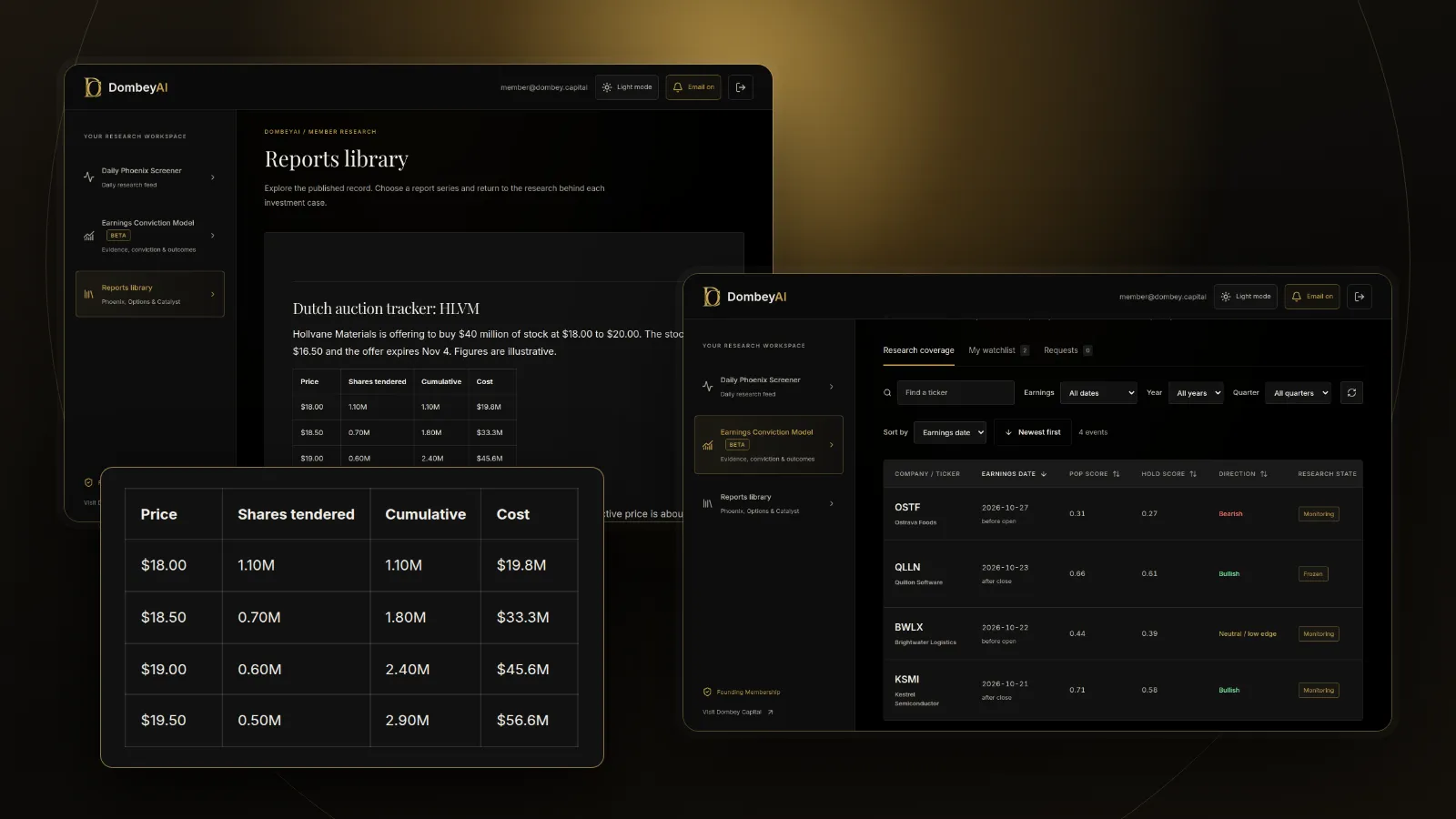
The company sorts all tenders by price and adds them up. The clearing price is the lowest price at which the cumulative shares tendered at or below that price are enough to fill the offer. When the offer is for a dollar amount, the test is whether those shares, multiplied by that price, reach the budget.
| Price | Shares tendered at this price | Cumulative shares | Cost of cumulative shares at this price |
|---|---|---|---|
| $18.00 (incl. auction-price tenders) | 1,100,000 | 1,100,000 | $19.8 million |
| $18.50 | 700,000 | 1,800,000 | $33.3 million |
| $19.00 | 600,000 | 2,400,000 | $45.6 million |
| $19.50 | 500,000 | 2,900,000 | $56.6 million |
| $20.00 | 400,000 | 3,300,000 | $66.0 million |
At $18.50, the shares on offer cost only $33.3 million, short of the $40 million budget. At $19.00 they cost $45.6 million, enough to fill it. The clearing price is $19.00. At that price, $40 million buys about 2,105,263 shares. Holders who tendered at $19.50 or $20.00 get all their shares back.
When the offer is for a fixed number of shares rather than a dollar amount, the logic is the same: the clearing price is the lowest price at which cumulative tenders reach the share count.
If tenders do not fill the offer even at the top of the range, the company usually buys every share tendered at the top price, and the offer is undersubscribed. That outcome tells you holders were reluctant to sell even at the maximum premium.
Proration and odd lots
In the example, 2.4 million shares were tendered at or below $19.00, but the budget buys only about 2.1 million. The company prorates. SEC Rule 13e-4 requires that shares in an oversubscribed partial offer be bought as nearly as possible pro rata, according to the shares each holder tendered while the offer was open. Tendering early gives no advantage.
The rule lets the company make two exceptions before prorating:
- Odd lots. It may first buy in full the shares of holders who own fewer than 100 shares and tender all of them.
- Conditional tenders. It may accept by lot the shares of holders who tendered everything and asked that either all, or at least a minimum number, be bought or none at all.
The holder who tendered at $18.00 receives the same $19.00 on accepted shares as the holder who tendered at $19.00. Bidding low does not lower your own price; it only makes your shares more likely to be counted.
The SEC rules that apply
Dutch auctions are issuer tender offers, governed mainly by Rule 13e-4 and the general tender offer rule, Rule 14e-1. The points that matter most for holders, checked against the eCFR text on 2026-10-07:
| Rule | What it requires | Why it matters |
|---|---|---|
| 13e-4(f)(1) and 14e-1(a) | Open at least 20 business days | Business days, not calendar days |
| 13e-4(f)(1) and 14e-1(b) | Open at least 10 business days after a change in price or percentage sought | Buying up to 2% more of the class is not a change |
| 13e-4(f)(2) | Withdrawal rights while the offer is open, and after 40 business days if shares are not yet accepted | You can change your mind before expiration |
| 13e-4(f)(3) | Pro rata purchase when oversubscribed | Odd-lot priority is allowed |
| 13e-4(f)(8) | Open to all holders; highest price paid to one is paid to all | One clearing price for everyone |
| 13e-4(f)(5) and 14e-1(c) | Pay or return shares promptly after the offer ends | Returned shares are back in your account quickly |
| 13e-4(f)(6) | No purchases outside the offer until 10 business days after it ends | No open-market buying right after the auction |
| 14e-1(d) | Extension announced by 9:00 a.m. Eastern, or the exchange open if earlier, on the next business day, with shares tendered so far | Early read on demand |
| 13e-4(c)(4) | Final Schedule TO amendment reporting results | Where the clearing price and proration factor appear |
The 2% allowance explains a line that appears in many offers: the company reserves the right to buy up to 2% more of its outstanding shares without extending. Factor that into any proration estimate, because it raises the factor slightly when the company uses it.
Fixed-price offers compared with Dutch auctions
| Feature | Fixed-price issuer offer | Dutch auction issuer offer |
|---|---|---|
| Price | One price set by the company | Range; clearing price set by tenders |
| Holder's choice | Tender or not | Tender or not, and at what price |
| Company's cost | Known at launch | Known only at expiration |
| Price paid to holders | The stated price | The clearing price, same for all accepted shares |
| Main risk for holders | Proration | Clearing price at the low end, then proration |
Companies choose the auction format when they are unsure what premium holders need. A fixed price set too high overpays; one set too low leaves the offer short. The auction lets holders reveal the price.
What a Dutch auction tells investors
The announcement and the result both carry information.
- The size relative to cash. Compare the dollar amount with the company's cash and debt. A buyback funded from surplus cash in a company trading near net cash per share reads differently from one funded with new borrowing.
- Insider participation. The Offer to Purchase states whether directors and officers intend to tender. Insiders who say they will not tender increase their percentage ownership if the offer completes.
- The clearing price. A result at the bottom of the range shows many holders were willing to sell at a small premium. A result at the top, or an undersubscribed offer, shows holders wanted more.
- The share count after. A large auction can retire a meaningful part of the share count, which changes per-share figures such as book value. For that side of the analysis, see how to value a company below book.
Dombey's published research tracks dated corporate actions like these from launch to result; see the research archive. A Dutch auction is a dated event with a known expiration, which puts it in the same family as the catalysts covered in what a stock catalyst is.
How to read the offer documents
Most of what you need is in three filings, all on EDGAR under the company's name. The EDGAR search guide shows how to find them.
- Schedule TO with the Offer to Purchase. The range, the amount, the increments, conditions, odd-lot terms, insider intentions and the source of funds.
- Schedule TO amendments. Extensions, changes to the range, and preliminary results.
- The final amendment. The clearing price, the number of shares bought and the final proration factor.
Where this goes wrong
- Treating the top of the range as the price. The clearing price is often below the top. Base any estimate on the bottom of the range unless there is a reason to expect otherwise.
- Bidding high and getting everything back. A holder who names $20.00 in an auction that clears at $19.00 sells nothing and may then hold a stock that drifts lower once the company stops buying.
- Ignoring proration. An oversubscribed auction returns part of every accepted holder's position. The blended price, not the clearing price, is the outcome.
- Assuming the post-offer price holds. The company cannot buy outside the offer for 10 business days after it ends, so the support from the buyback disappears at expiration.
- Missing conditions. Offers can carry financing or market conditions that allow the company to terminate. Read them before treating the auction as certain.
- Overlooking tax. Proceeds are usually taxed as a sale, but issuer purchases can be treated differently depending on how much of a holder's position is bought. The Offer to Purchase has a tax section; a tax adviser can apply it.
The bottom line
A Dutch auction tender offer is a buyback in which holders name their price within a range and the company pays one clearing price, the lowest that fills the offer, to everyone it buys from. SEC Rule 13e-4 sets the floor: at least 20 business days, withdrawal rights, pro rata purchases when oversubscribed and the same price for all holders. What a holder actually receives depends on the clearing price, the proration factor and where the stock trades after the offer ends. Read the Offer to Purchase for the range, amount and conditions, and the final Schedule TO amendment for the result.