

Voluntary and involuntary delisting
The two routes start from different places and leave shareholders in different positions.
Voluntary delisting. The company decides to leave the exchange. The most common reason is a completed acquisition: once a buyer owns all the shares, there is nothing left to list. Others delist to save the cost of exchange fees and public reporting, to move to a different exchange, or because the shares trade so rarely that the listing adds little. Under the SEC's rules, a company that delists voluntarily must give the exchange written notice and publish its intent by press release and on its website at least 10 days before it files Form 25.
Involuntary delisting. The exchange removes the company because it has failed a continued listing standard and has not fixed the problem within the time allowed. The usual causes are a low share price, late periodic filings, too little stockholders' equity or market value, too few public holders, or a governance failure such as losing the independent directors the audit committee requires. Exchanges can also act on public interest grounds, which is how many bankruptcy filings lead to delisting.
| Voluntary delisting | Involuntary delisting | |
|---|---|---|
| Who decides | The company's board | The exchange |
| Typical cause | Acquisition, cost, low trading interest | Failed listing standard, bankruptcy |
| Who files Form 25 | The company | The exchange |
| Advance notice | Company notifies the exchange and the public at least 10 days before filing | Deficiency notice, compliance period, then a delisting determination |
| Shareholder outcome | Deal consideration if acquired; otherwise OTC trading | OTC trading, often with less disclosure |
Listing standards and deficiency notices
Each exchange publishes initial listing standards, which a company must meet to list, and continued listing standards, which it must keep meeting. The continued standards are lower, but they are where most delistings begin.
When a company falls short, the exchange sends a deficiency notice. The company must disclose it on Form 8-K under Item 3.01 within four business days. The 8-K names the rule, the deadline and usually what the company plans to do. The guide on reading an 8-K for catalysts covers where to find this item quickly.
The Nasdaq $1 minimum bid price rule
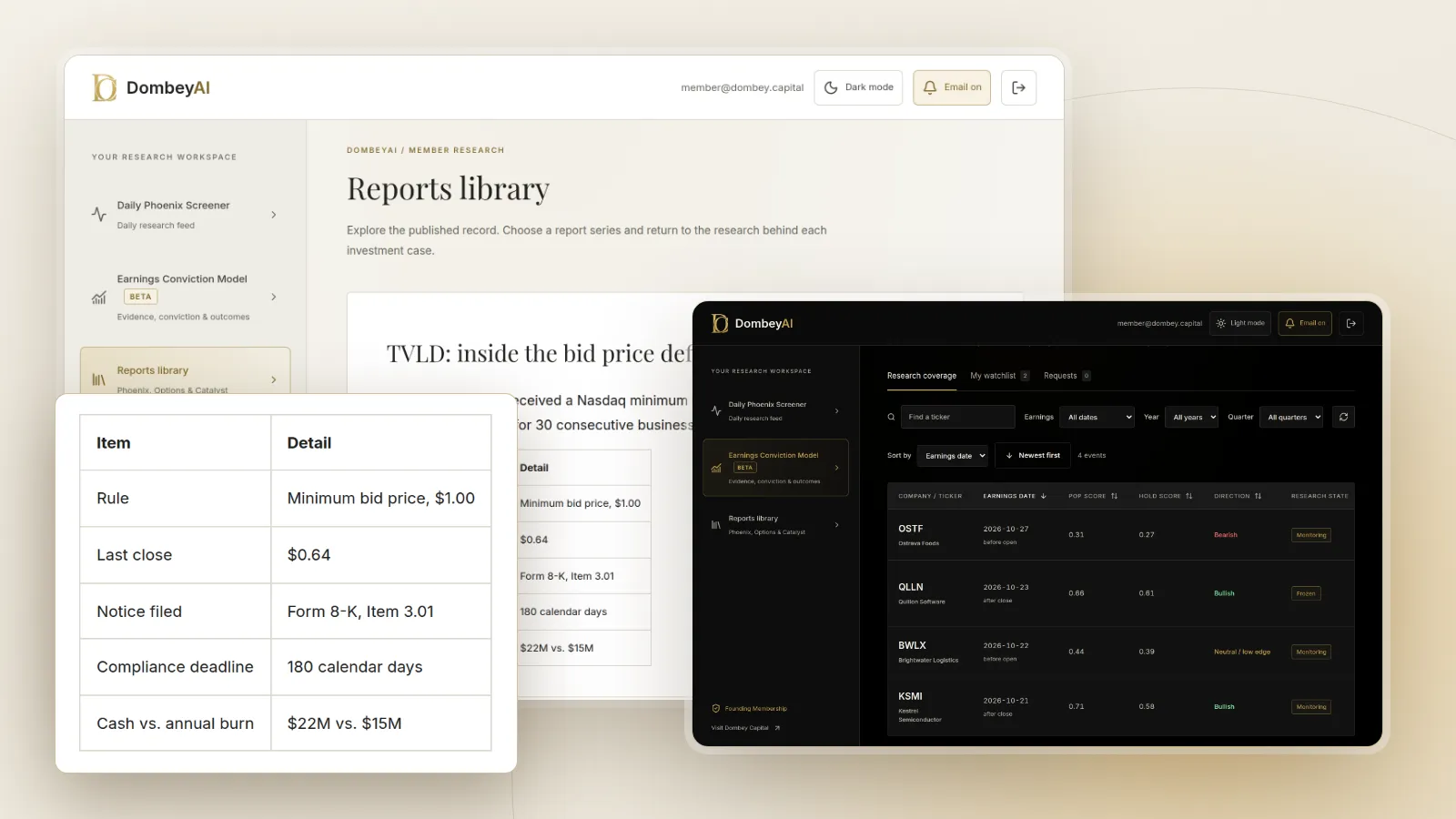
The best-known standard is Nasdaq's minimum bid price. If a stock's closing bid price stays below $1.00 for 30 consecutive business days, Nasdaq sends a deficiency notice. The company then generally has 180 calendar days to regain compliance, which it does when the stock closes at $1.00 or more for at least 10 consecutive business days.
Some companies listed on the Nasdaq Capital Market may qualify for a second 180-day period if they meet the other listing requirements and commit to fixing the deficiency. Nasdaq has tightened these rules in recent years for companies that rely on repeated reverse stock splits, so check the current text in the Nasdaq rulebook before assuming a second period applies.
The NYSE has its own price standard, based on an average closing price below $1.00 over 30 consecutive trading days, with six months to cure. Both exchanges also have standards on equity, market value and filing timeliness, and the details differ by market tier.
How companies respond
- If the problem is the share price, the company often proposes a reverse stock split. It lifts the price per share without changing the company's value, and the market frequently reads it as a sign of weakness.
- If the problem is a late 10-K or 10-Q, the company submits a plan to file and races to finish the audit. A late filing tied to going-concern questions is a warning sign in its own right; see going-concern warnings.
- If the problem is equity or market value, the company may raise capital, convert debt or merge, each of which can dilute existing holders.
- If the company cannot or will not fix it, the exchange issues a delisting determination. The company can usually request a hearing before a panel, which can delay the outcome while the panel decides.
Form 25 and the filing trail
Form 25 is the filing that formally removes a class of securities from listing on a national securities exchange. The exchange files it for an involuntary delisting; the company files it for a voluntary one. The delisting generally takes effect 10 days after Form 25 is filed. The registration of the securities under Section 12(b) of the Exchange Act ends later, generally 90 days after the filing.
The usual filing trail looks like this:
| Step | Filing | What to check |
|---|---|---|
| Deficiency | Form 8-K, Item 3.01 | Which rule, which deadline, the company's plan |
| Plan or appeal | Form 8-K or press release | Reverse split proxy, hearing request, financing |
| Decision | Form 8-K, Item 3.01 | Delisting determination or regained compliance |
| Removal | Form 25 | The effective date of the delisting |
| Deregistration | Form 15 | Whether the company will stop filing reports |
Each of these is on SEC EDGAR under the company's filings.
What happens to the shares
The shares do not disappear. A delisted stock usually moves to the over-the-counter market, where broker-dealers quote and trade it. Holders keep their shares in the same brokerage account.
Three things change.
Liquidity. OTC trading volume is often a fraction of what it was on the exchange, and bid-ask spreads widen. Some institutional holders are not permitted to own unlisted shares and sell, sometimes all at once. The article on index deletions covers how forced selling of this kind can move prices away from value.
Disclosure. Delisting by itself does not end SEC reporting. But many delisted companies file Form 15 to deregister or suspend reporting once they qualify, which generally requires fewer than 300 holders of record. Without current public information, SEC Rule 15c2-11 generally limits broker-dealers' ability to publish quotes, which can leave shares on the OTC market with few or no quotes.
Access. Some brokers restrict OTC purchases, charge higher commissions for them or require extra acknowledgments. Selling is usually possible, but the price you get depends on who is on the other side.
Going private and bankruptcy
Two special cases account for many delistings, and they lead to opposite outcomes for shareholders.
Going private. When a buyer acquires all the public shares, through a merger or a tender offer followed by a merger, the company delists because no public shares remain. Shareholders receive the deal consideration, usually cash, and the delisting follows the closing. The value question is settled by the price, not by OTC trading. The going-private guide covers the structures and the disclosure rules that apply when insiders are the buyers.
Bankruptcy. Exchanges generally move to delist a company that files for bankruptcy, often quickly. The shares can keep trading over the counter during the case, sometimes actively. But under the priority rules, creditors are paid before shareholders, and in many reorganizations the old shares are cancelled with little or nothing paid to holders. A high OTC price during a case is not evidence that the equity will survive. The plan of reorganization and the disclosure statement say what the old shares will receive. The article on post-bankruptcy equities explains what happens to the new shares issued on exit.
How to assess a stock facing delisting
A deficiency notice is a dated event, which makes it useful to track. These questions sort most cases:
- Which standard failed? A price deficiency is the most fixable; a missed audit or a governance failure is often a symptom of something deeper.
- What is the deadline? Write down the end of the compliance period and any hearing date.
- What has the company said? A filed proxy for a reverse split or a signed financing is different from "evaluating options."
- What does the company have? Cash, debt maturities and burn rate decide whether the company can fix the problem and still have value left for equity.
- Will it keep reporting? A company that delists and keeps filing is easier to value than one that files Form 15 and goes dark.
Dombey's published research tracks listing deadlines alongside other dated catalysts; see the research archive.
Where this goes wrong
Assuming delisting means the shares are worthless. A company that delists to save costs, or because it is acquired, can leave shareholders with full value. The cause matters more than the event.
Assuming a reverse split fixes the business. It fixes the share price for listing purposes. If losses continue, the price can fall below $1 again, and repeated splits draw closer exchange scrutiny.
Trading bankrupt shares on price alone. OTC prices during a bankruptcy can reflect speculation rather than the plan. Read what the plan gives existing equity before reading the quote.
Ignoring the dark-company risk. Once a company stops filing, the information gap can last years. Shareholders still own the shares but may have little to value them with and few buyers to sell to.
Missing the timeline. Compliance periods, hearings and Form 25 effective dates are all fixed in filings. Investors who skip the 8-Ks often learn about a delisting after it has happened.
The bottom line
A delisting removes a stock from an exchange, but it does not take the shares away from their owners. Voluntary delistings usually follow an acquisition or a cost decision; involuntary ones start with a deficiency notice, a compliance period and, if the problem is not fixed, a Form 25. After delisting, shares usually trade over the counter with less liquidity and sometimes less disclosure. The reason for the delisting, and the filings that document it, decide what the shares are worth.