

What a divestiture changes
Before a sale, a division's value is buried inside the consolidated numbers. Investors apply one multiple to the whole company, or build a sum of the parts that depends on their own guesses. A signed agreement changes four things at once.
- The price of the unit becomes known. A buyer has put a number on it, usually as a multiple of the unit's EBITDA or sales.
- The cash that reaches the seller becomes estimable. The headline price is reduced by tax on the gain, advisory and separation fees, and any purchase price adjustments.
- The remaining company becomes a different business. It has lower revenue and profit, possibly a different growth rate and margin, and it keeps some costs the sold unit used to absorb.
- The balance sheet changes. Proceeds can repay debt, fund buybacks or a special dividend, or stay on the balance sheet for future deals.
The stock's reset is the sum of these effects. A sale at an impressive multiple can still lower value per share if the tax bill is large and the cash is spent poorly.
Quick reference: what drives the reset
| Driver | What raises value | What lowers value | Where to check |
|---|---|---|---|
| Sale multiple | Above the group's own multiple | At or below the group multiple | 8-K, press release, purchase agreement |
| Tax and fees | High tax basis, low fees | Low tax basis, large gain | 10-K tax note, segment assets, deal announcement |
| Stranded costs | Overhead cut quickly | Overhead stays with the seller | Pro forma statements, transition service terms |
| Use of proceeds | Debt repaid, buyback below value | Cash held for unspecified deals | Announcement, earnings call, later 10-Q |
| Remaining business | Higher growth or margin than the sold unit | Lower quality, more cyclical | Segment note, pro forma financial information |
| Closing risk | Few conditions, no financing condition | Antitrust review, buyer financing, shareholder vote | Purchase agreement conditions |
Worked example: when a sale helps and when it hurts
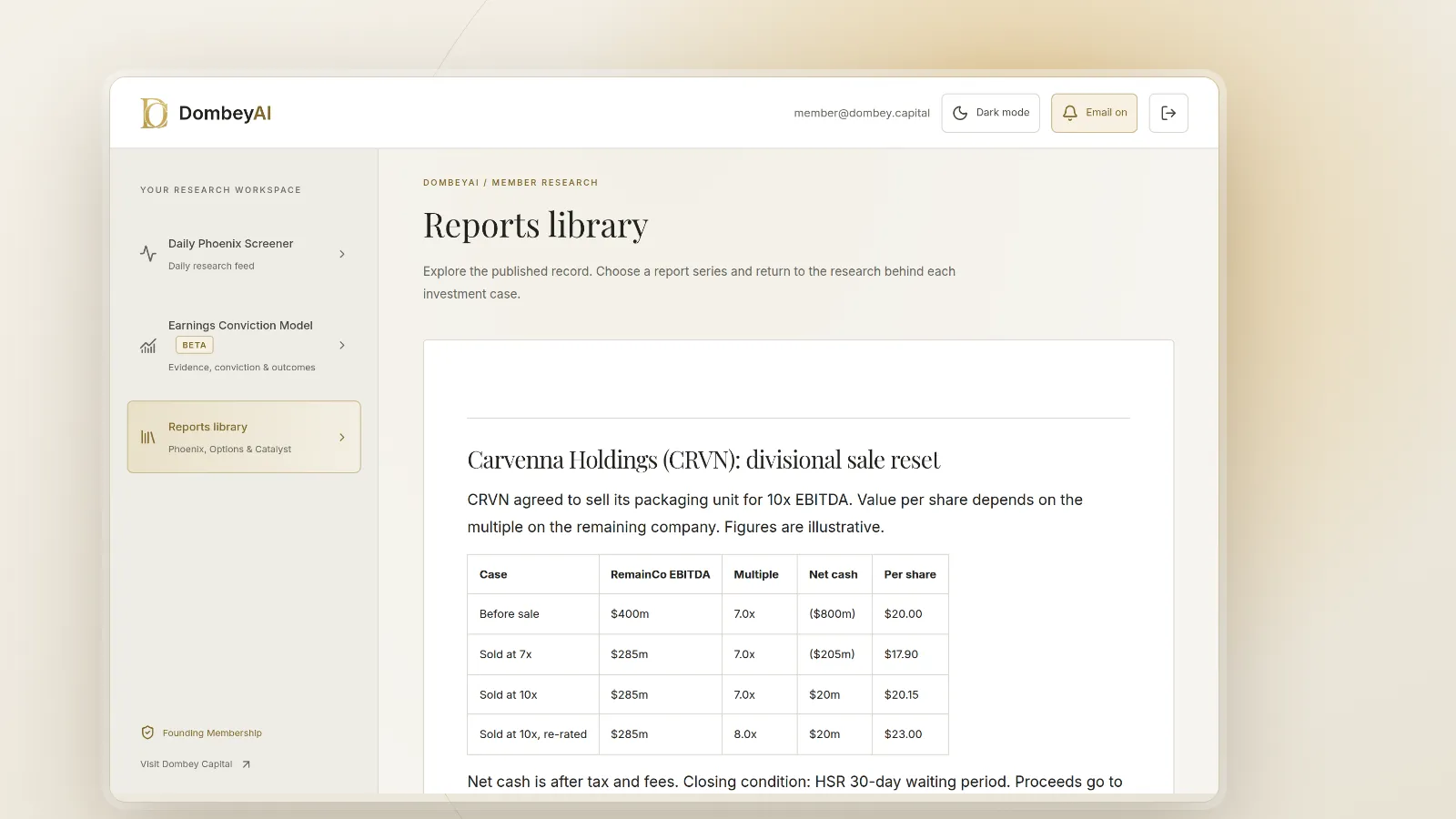
Net proceeds are $1,000 million, less $150 million of tax on the $600 million gain, less $30 million of fees: $820 million. Used to repay debt, that takes net debt from $800 million to $20 million of net cash. The remaining company earns $300 million of EBITDA before stranded costs and $285 million after them.
| Line ($m unless stated) | Before the sale | After, remaining company at 7x | After, remaining company at 8x |
|---|---|---|---|
| EBITDA | 400 | 285 | 285 |
| Enterprise value | 2,800 | 1,995 | 2,280 |
| Net debt (cash) | 800 | (20) | (20) |
| Equity value | 2,000 | 2,015 | 2,300 |
| Per share | $20.00 | $20.15 | $23.00 |
At the old 7x multiple, the sale barely moves value per share, even though the buyer paid 10x. Tax, fees and stranded costs absorbed most of the premium. The per-share gain comes only if the market gives the remaining company a higher multiple, here 8x, because the business that is left grows faster or is less cyclical than the one sold.
Now run the same sale at 7x, the group's own multiple. The price is $700 million, tax on the $300 million gain is $75 million and fees are $30 million, leaving $595 million. Net debt falls to $205 million. At 7x, the remaining $285 million of EBITDA is worth $1,995 million, so equity is $1,790 million, or $17.90 a share. Selling at the group multiple lowered value per share by about 10% in this example.
To set this out for a real situation, build a base case and a worst case with the multiple on the remaining company as the main variable.
What the filings tell you, and when
A significant sale produces a predictable trail of documents. Each one answers a different part of the reset.
- The announcement and the agreement. Entry into a material sale agreement is usually reported on Form 8-K under Item 1.01. Form 8-K reports are generally due within four business days of the event. The agreement lists the price, adjustments, conditions to closing and termination rights. See how to read an 8-K for catalysts.
- Regulatory review. If the deal meets the Hart-Scott-Rodino size thresholds, the buyer and seller file with the FTC and Department of Justice and wait 30 days before closing, unless the period ends early or is extended by a request for more information. See the HSR waiting period explained and regulatory approvals as catalysts.
- Shareholder approval, if needed. Most divisional sales do not need a vote. A sale of all or substantially all of the company's assets usually does under state corporate law, and the proxy statement then describes the deal and the background to it.
- Closing. Item 2.01 of Form 8-K, Completion of Acquisition or Disposition of Assets, applies to a disposition of a significant amount of assets outside the ordinary course of business. One test of significance is whether the net book value of the assets or the amount received exceeds 10% of the company's total assets. The filing states the completion date, the buyer and the consideration received.
- Pro forma numbers. Item 9.01 requires any pro forma financial information that Article 11 of Regulation S-X calls for. This is the closest thing to an official view of the remaining company on its own, and it is where stranded costs often first become visible.
- The next 10-Q and 10-K. The sold unit is typically shown as discontinued operations, and the remaining segments are reported without it. Use the 10-Q guide to find the gain on sale, tax paid and the cash flow line for proceeds.
Many sales follow a strategic review. If the company has already announced one, the divestiture is often the outcome investors were waiting for, and the reaction depends on how the price compares with what the market had assumed.
Use of proceeds decides who keeps the value
The same $820 million in the example can reset the stock in very different ways.
- If the company repays debt with a high interest rate or a near maturity, equity holders capture the value directly, and refinancing risk falls.
- If the company buys back shares below its estimate of value, each repurchase raises value per remaining share. See buybacks as catalysts.
- If the company pays a special dividend, shareholders receive the cash and the share price drops by about the amount paid on the ex-date.
- If the company holds the cash for "growth opportunities", the market usually discounts it, because the next acquisition may be priced at a premium the sale just captured on the other side.
How the market prices a pending sale
Between signing and closing, the stock carries two possible futures: the company with the sale completed and the company without it. If closing risk is real, because of antitrust review, buyer financing or a vote, a simple way to value the stock is to weight each outcome by its likelihood. Probability-weighted valuation sets out the method.
The no-deal value is not always the old share price. A failed sale can reveal that no buyer would pay the expected price, or that the unit has problems a buyer found in diligence. The same logic as a deal break applies: the stock tends to fall below where it stood before the announcement if the failure carries new bad information.
Dombey's published research applies this kind of with-sale and without-sale analysis to dated catalysts; see the research archive.
Where this goes wrong
The headline multiple is flattering. A price quoted as a multiple of "adjusted" EBITDA may include add-backs the buyer accepted for negotiating reasons. Compare it with the unit's reported segment profit.
Tax is larger than expected. Units built up over decades often have a low tax basis. A sale structured as a sale of stock rather than assets, or a sale abroad, can change the tax bill. The company's own estimate of net proceeds is the figure to use.
Stranded costs stay. Management often says overhead will be cut. Check two or three quarters later whether corporate costs actually fell.
The better business was sold. Companies sometimes sell their strongest unit because it fetches the highest price. The remaining company may then deserve a lower multiple, not a higher one.
The proceeds disappear. Cash that sits on the balance sheet, funds a poorly priced acquisition or covers operating losses does not reach shareholders, and the reset never happens.
Closing slips. Regulatory requests, financing problems or a dispute over working capital adjustments can delay closing by months, and time has a cost.
A short checklist
- The sale multiple compared with the group's own multiple and with the unit's reported segment profit.
- Net proceeds after tax, fees, escrow and expected price adjustments.
- Stranded costs, transition service terms and when they end.
- The stated use of proceeds and any timing for it.
- Conditions to closing: HSR or other approvals, financing, shareholder vote.
- The remaining company's growth, margins and a fair multiple for it, recorded in a dated investment thesis.
The bottom line
A divestiture resets a stock's value by turning a guess about a division into a price, and by changing what the remaining company is. Whether that reset helps shareholders depends on the price relative to the group's multiple, the tax and fees taken out, the costs left behind and what happens to the cash. Work through those numbers per share before treating a sale as good news. The 8-K, the purchase agreement and the pro forma financial information give you nearly everything you need.