

What makes a deal "going private"
Any takeover of a listed company ends with the stock delisted. What sets a going-private transaction apart is who is buying. In an ordinary sale, an outside buyer negotiates against the target's board. In a going-private deal, the buyer is often already inside: the chief executive, a founder with a large stake, or a parent company that owns most of the shares.
Rule 13e-3 captures this. It applies to three kinds of transaction by an issuer or its affiliate:
- A purchase of the company's equity, including through a merger or by buying fractional interests in a reverse stock split.
- A tender offer for the company's equity.
- A proxy or information-statement solicitation in connection with a merger, recapitalization, sale of substantially all assets to an affiliate, or a reverse split that cashes out fractional interests.
The rule applies when the transaction has a reasonable likelihood or a purpose of producing one of two effects: the stock stops being listed on an exchange or quoted on an inter-dealer system, or the class becomes eligible to end its SEC registration or reporting.
An affiliate is a person who controls, is controlled by, or is under common control with the issuer. Managers who roll their shares into the buying vehicle, a controlling holder, and a parent company all usually qualify. A bidder who was not an affiliate when it launched a tender offer is not treated as one until that offer ends.
Who takes companies private
| Buyer | Typical structure | Main conflict | What to read first |
|---|---|---|---|
| Private equity sponsor alone | One-step merger or tender offer | Limited; board negotiates at arm's length | Proxy statement, background of the merger |
| Sponsor with management rollover | Merger with equity rollover | Managers sit on both sides | Schedule 13E-3 Special Factors |
| Management buyout (MBO) | Merger financed with debt | Managers know the most and set the plan | Projections and the special committee process |
| Controlling shareholder | Merger or tender offer plus second step | Controller can block any other bid | Majority-of-the-minority condition |
| The company itself | Reverse split cash-out or issuer tender | Board decides who is cashed out | Holder count and the deregistration plan |
The structures used
One-step merger
The buyer and the company sign a merger agreement, the company files a proxy statement, and shareholders vote. If the vote passes, every share not held by the buyer is converted into cash at closing. In a going-private deal the proxy statement and the Schedule 13E-3 are filed together, and the 13E-3 disclosure sits inside the proxy. Our guide on how to read a proxy statement covers the sections that matter.
Tender offer followed by a second-step merger
The buyer offers to buy shares directly, and the offer must stay open at least 20 business days under SEC Rule 14e-1. If enough shares are tendered, a second-step merger squeezes out the rest at the same price. The tender offer route is usually faster than waiting for a vote. The mechanics are covered in what a tender offer is.
Reverse stock split cash-out
A smaller company can go private without an outside buyer. It runs a large reverse split, say 1-for-1,000, and pays cash for the fractional shares this creates. Every holder with fewer than 1,000 shares is cashed out. If that cuts the record holder count enough, the company can deregister. This structure is a Rule 13e-3 transaction because the company is buying fractional interests to produce that effect.
Deregistration without a buyout
Under SEC Rule 12g-4, a company can certify on Form 15 that a class registered under Section 12(g) is held of record by fewer than 300 persons, or fewer than 500 where total assets have not exceeded $10 million on the last day of each of the three most recent fiscal years. Different counts apply to banks and bank and savings and loan holding companies. Termination takes effect 90 days after filing, and the duty to file periodic reports is suspended when the Form 15 is filed. Under Rule 12g5-1, shares held of record by a corporation or other organization count as held by one person, so shares held in street name through a broker's nominee can add up to very few holders of record even when many people own the stock.
What the Schedule 13E-3 requires
The filing has 16 items. The ones that matter most to a holder are the three that the rule says must appear in a "Special Factors" section at the front of the disclosure document:
- Item 7: Purposes, alternatives, reasons and effects. Why the buyer wants to go private, what else it considered, why now, and what happens to the company and to holders.
- Item 8: Fairness of the transaction. Whether the filer reasonably believes the deal is fair or unfair to unaffiliated holders, the factors behind that belief and, where practicable, the weight given to each. A statement that the filer has no view on fairness does not count as disclosure.
- Item 9: Reports, opinions, appraisals and negotiations. Any fairness opinion or valuation report from an outside party that relates to the deal.
The fairness item, set out in Item 1014 of Regulation M-A, lists the factors that normally matter: current and historical market prices, net book value, going concern value, liquidation value, prices the filer paid in earlier purchases, outside reports and opinions, and firm offers from unaffiliated parties in the past two years. It also requires the filer to say whether the deal needs approval from a majority of unaffiliated holders, whether independent directors hired a separate representative for those holders, and whether a majority of non-employee directors approved it. Any director who dissented or abstained must be named.
The rule also requires a summary term sheet, a cover legend stating that the SEC has not passed on the fairness of the deal, and information on appraisal rights. When the deal involves a vote or a purchase, holders must receive the information no later than 20 days before the vote or purchase. The filer must amend the schedule promptly for material changes and file a final amendment with the results.
Protections for minority holders
A conflicted buyer cannot be trusted to negotiate against itself, so going-private deals lean on process. The common protections:
- Special committee. Independent directors form a committee with its own advisers and the power to say no.
- Majority-of-the-minority condition. The deal needs approval from a majority of the shares not held by the buyer and its affiliates.
- Fairness opinion. A bank's view that the price is fair from a financial point of view. It is disclosed under Item 9, along with the bank's fees and past work for the parties.
- Appraisal rights. In many states, holders who do not vote in favor and follow the statutory steps can ask a court to determine fair value. The 13E-3 disclosure must describe these rights where they exist. Search EDGAR for the filing by company name.
Each protection has gaps. A committee can be independent on paper and close to the buyer in practice. A majority-of-the-minority vote can be swung by arbitrage funds that bought after the announcement. Appraisal takes time, ties up capital and can result in a value below the deal price.
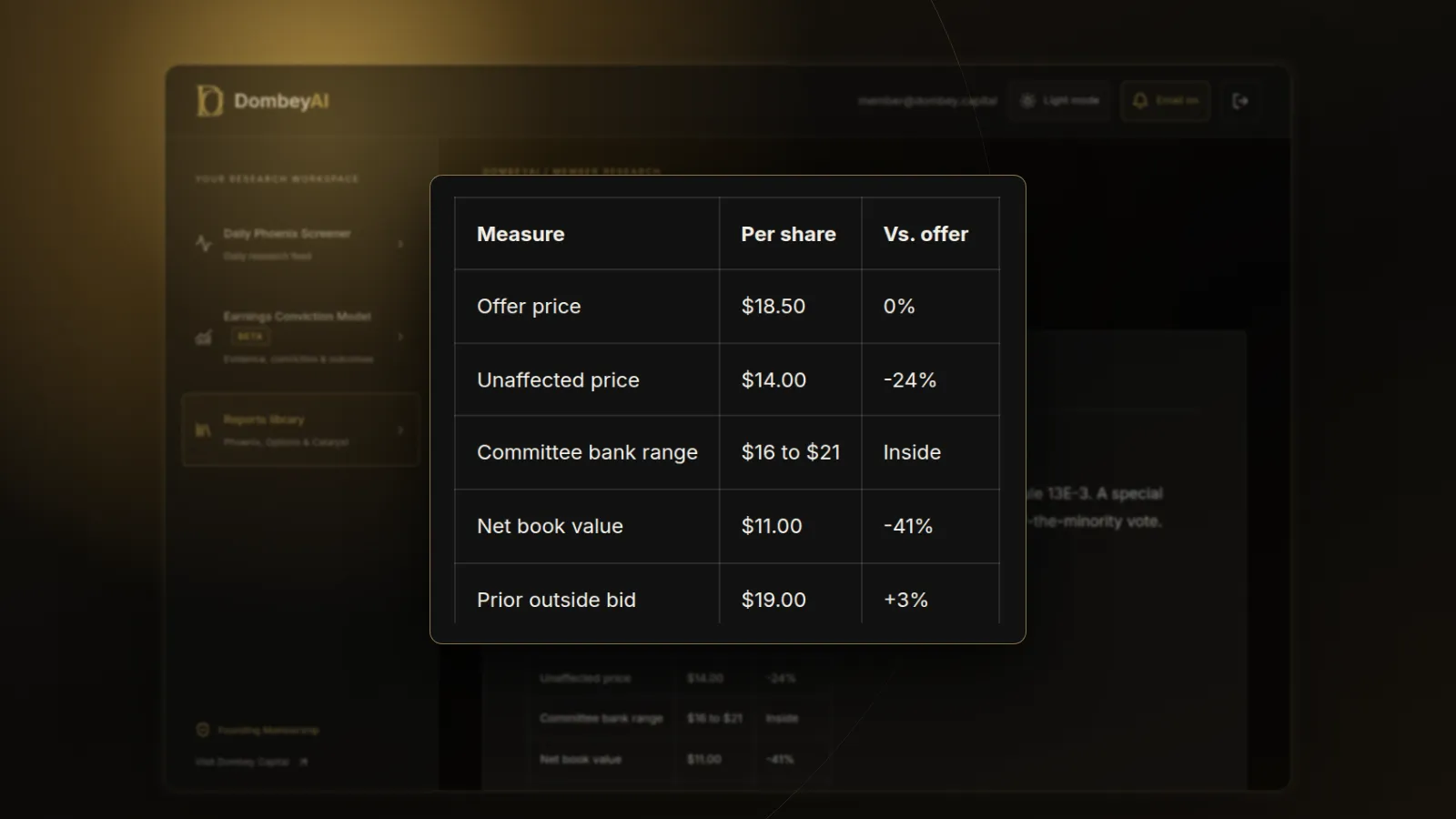
A worked example
That last detail is the kind of fact Item 1014 is designed to surface. Without the filing, a holder would see only a 32% premium to the market price.
Where this goes wrong
- Treating the premium as proof of fairness. A premium to the market price says nothing about value if the stock was depressed, or if insiders timed the bid after a weak quarter.
- Skipping the projections. Management projections in the proxy often differ from those shared with the buyer. Check which set the fairness opinion relied on.
- Ignoring the debt. Many buyouts are financed with heavy borrowing, so a financing failure or a drop in credit markets can delay or break the deal. See what happens when a merger fails.
- Missing regulatory steps. Large buyouts may need antitrust clearance; see the HSR waiting period.
- Assuming the vote is open. When the controller holds a large stake and there is no majority-of-the-minority condition, the outcome may already be decided.
- Overlooking holders who stay. In a deregistration or a deal that offers equity in the private company, the remaining shares may be hard to value or sell. The stub equity guide covers that case.
Dombey's published research reads these filings before each dated step in a deal; see the research archive.
The bottom line
A going-private transaction buys out public holders so a company can delist and stop reporting. When the company or an affiliate is the buyer, Rule 13e-3 requires a Schedule 13E-3 with a Special Factors section on purpose, alternatives, effects and fairness. Read that section, the background of the deal and the projections before judging the price. The protections that matter most are a real special committee, a majority-of-the-minority condition and, where available, appraisal rights.