

Who is forced to sell
An index is a list with rules. Funds that track it hold the same stocks in roughly the same weights. When a stock leaves the list, those funds have to sell it to keep their tracking error low. Their decision has nothing to do with the company's results, its valuation or its prospects.
Three groups usually sell:
- Index mutual funds and ETFs. They are built to match the index, so they sell close to the effective date.
- Benchmarked active managers. Many are not required to sell, but holding a stock outside the benchmark adds risk to their reported performance, so some trim or exit.
- Mandate-bound holders. Some funds may only own members of a named index. A deletion removes the stock from their permitted list.
Index funds care about matching the index at the close on the effective date. That is why the heaviest selling tends to cluster in the closing auction of that day.
Four reasons a stock leaves an index
Not every deletion carries the same pressure. The reason for the deletion decides whether forced selling can create a gap.
| Reason for deletion | Does the stock keep trading? | Who sets the price | Mispricing potential |
|---|---|---|---|
| Acquired or merged | No, it is taken out | Deal terms | Low |
| Delisted or in bankruptcy | Often over the counter | Distress | Low to unclear |
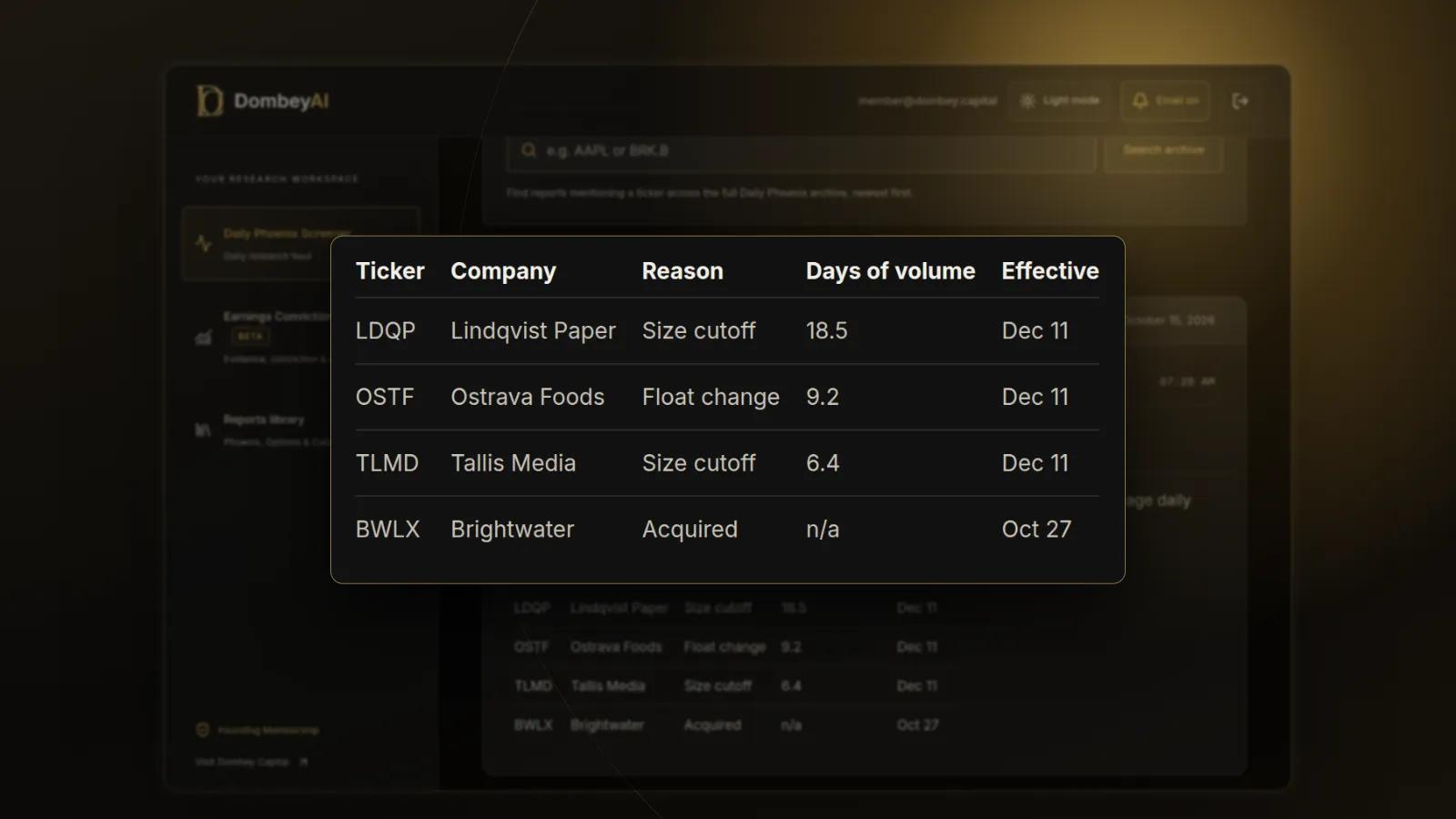
| Fell below size or eligibility rules | Yes | Forced sellers, then fundamentals | Highest |
| Spun-off company outside the index rules | Yes | Recipients who did not choose it | High |
Acquisitions are the most common source of deletions in a large index, and they matter least here. The target is removed because it is about to stop trading. Its price tracks the deal, which is a merger arbitrage question, not an index-flow question.
Delistings are usually the end of a long decline. A listed company must report on Form 8-K, Item 3.01, when the exchange tells it that it no longer meets a continued listing standard, or when the exchange applies to delist its stock. By the time the index deletion follows, the stock has often fallen a long way for reasons that have little to do with index funds.
Size and eligibility deletions are where the setup lives. A company whose market value has shrunk, whose free float has dropped or whose listing no longer qualifies is removed at a scheduled or ad hoc review. The business still exists, still reports and still trades the day after. Only the owners change.
Spin-offs are a close cousin. The new company may be too small for its parent's index, so index funds receive shares they cannot keep. Our article on spin-off investing covers that case in detail; this article focuses on companies already in the index that drop out.
How large the selling can be
The useful number is not how much money tracks the index in total. It is how many shares tracking funds must sell compared with how many trade on a normal day.
Four things set the size of the pressure:
- Passive ownership as a share of float. Higher passive ownership means more forced sellers.
- Days of volume to absorb. Divide the shares to be sold by average daily volume. A figure above a few days often means the price has to move to attract buyers.
- Whether another index picks it up. A stock leaving a large-cap index often joins a mid-cap or small-cap one. Buying from the new index offsets part of the selling.
- Who else is selling. Benchmarked managers, holders with mandate limits and traders who sold ahead of the event all add to supply.
The same days-of-volume test that you would use on short interest works here. It tells you how crowded the exit is.
The timeline from review to effective date
Deletions run on a calendar, which is what makes them easier to study than most special situations. Scheduled reconstitutions publish their dates in advance. FTSE Russell, for example, moved its US indexes to a twice-yearly reconstitution in 2026, in June and December. For the December 2026 reconstitution, its published timetable shows a rank day of Friday, October 30, preliminary lists starting November 13 with weekly updates, and new index membership taking effect after the US close on December 11.
| Stage | What happens | What to check |
|---|---|---|
| Rank day or review | The provider measures size and eligibility | Is the stock near the cutoff? |
| Announcement or preliminary list | The deletion becomes public | Reason for deletion, effective date |
| Run-up period | Traders and some funds sell early | Price move versus volume |
| Effective date close | Index funds trade in the closing auction | Closing volume and imbalance |
| After the effective date | Forced selling ends | Whether the price stabilizes or keeps falling |
Ad hoc deletions, such as a replacement after a takeover, follow a shorter notice period. Each provider publishes its methodology and notice rules; read the provider's own documents rather than relying on a general rule.
Why the price can stay below value
Forced selling ends on a date, but the effects can last longer. Several things keep a deleted stock cheap after the effective date:
- Fewer natural buyers. Funds that bought because the stock was in the index are gone, and nobody replaces them automatically.
- Lower visibility. Some analysts drop coverage of companies that leave a major index. Screens and fund lists that filter by index membership stop showing the stock.
- Lower liquidity. Without index flows, daily volume often falls. Larger holders who might buy hesitate because they could not sell easily.
- Stigma. A deletion reads as a demotion, which discourages buyers who were not following the company closely.
The result is a stock whose owner base has shrunk while its business has not changed. That mismatch is the mispricing. It closes, when it closes, as new holders who chose the stock replace those who had to sell it.
How to separate a mechanical drop from a deserved one
The core question is whether the price fell because of who had to sell, or because the business got worse. A simple test is to compare the stock's price with what its numbers imply before and after the deletion.
- If the deletion followed a merger announcement, the price is set by the deal. Index flows are a side issue.
- If the company has filed an 8-K under Item 3.01, the deletion is a symptom of distress. Read the filing on EDGAR before assuming the drop is mechanical.
- If the stock fell out on size alone, the balance sheet is sound and earnings estimates have held, the drop is more likely to be mechanical.
- If shares to be sold are several days of volume and no other index picks the stock up, the pressure is likely to be larger than usual.
- If the stock had been falling for a year before the deletion, the deletion is the last step of a decline, not its cause.
It helps to write out the value case without the index: net cash, free cash flow, the catalysts that could bring buyers back. If the case only works because the index selling stops, it is thin. If the business would look cheap on its own numbers, the deletion is a reason the price got there, not a reason to own it.
Dombey's published research checks the reason behind each forced-selling event before treating it as a mispricing; see the research archive.
Where this goes wrong
- The move was priced in early. Traders estimate who is near a cutoff well before the rank day. Much of the drop can happen before the official list, and the effective date can bring a rebound rather than a further fall.
- The business keeps shrinking. Most size deletions happen because the market value fell. If revenue, margins or cash flow are still declining, the stock can keep falling after the index funds are gone.
- Liquidity cuts both ways. Thin trading after the deletion makes the stock hard to buy at a fair price and hard to sell. Wide spreads can absorb any discount.
- Another deletion follows. A stock that drops from a large-cap index can later drop from a mid-cap or small-cap one too, bringing a second wave of selling.
- You confuse the cause. A deletion that follows a delisting notice, a going-concern warning or a failed refinancing is a distress event. Index flows are the smallest part of that story.
- Dilution changes the per-share math. Companies under pressure sometimes raise equity. A cheap price per share can become an ordinary one once new shares are issued.
The bottom line
Index deletions force tracking funds to sell on a known date for reasons unrelated to value. The selling can push a stock below fair value when it is large compared with daily volume and few other buyers are waiting. The setup is strongest when a sound company falls out on size or eligibility rules, and weakest when the deletion follows a takeover or a delisting. Check the reason for the deletion, measure the selling in days of volume, and value the business as if the index did not exist.