

What sits in the trust
A SPAC raises cash in an IPO, usually by selling units of one share plus a warrant or a fraction of one. Most of the proceeds go into a trust account that the company cannot spend on operations. The trust holds short-term government securities or money market funds until one of three things happens: a business combination closes, holders redeem at a vote, or the SPAC runs out of time and returns the cash.
The trust balance changes over time:
- Interest adds to it, at roughly short-term Treasury rates.
- Taxes on that interest are paid out of it.
- Permitted withdrawals, if the trust agreement allows them, take interest out for taxes or working capital.
- Sponsor contributions to pay for an extension can add to it.
- Redemptions at each vote pay cash out and cut the share count.
SEC rules adopted in January 2024 require the IPO prospectus summary to describe the material terms of the trust and the amount or percentage of gross proceeds placed in it, along with the redemption rights and the time allowed to complete a deal (Regulation S-K Item 1602). Those rules became effective in July 2024.
How to calculate trust value per share
The formula is short:
Trust value per share = (trust balance - taxes owed - permitted withdrawals not yet taken) / public shares outstanding
Use only the public shares. Sponsor shares, often called founder shares, normally have no claim on the trust.
Three places give you the inputs. The latest 10-Q or 10-K shows the trust balance, usually as "investments held in trust account". The cover page gives the share count by class. The proxy for any vote usually states an estimated per-share redemption amount as of a recent date, which is the best cross-check because it already reflects the company's own view of deductions.
Why trust value acts as a floor
Before a deal closes, a public share carries a right to roughly its trust value, plus interest, at the next vote or at liquidation. That right makes the share behave like a short-dated Treasury bill with an attached option on the deal. When a share trades below trust value, the gap to the redemption amount works like a yield.
The floor is soft. It only holds if the cash is still there, the redemption right is honored on time, and you can sell or redeem when you need to. Trading costs, thin volume and the time to the next vote all eat into it. This is the same logic as buying a stock below its net cash per share, with a dated event that delivers the cash.
The redemption timeline
| Stage | What happens to the trust | What to check |
|---|---|---|
| IPO | Proceeds go into trust | Amount per unit in trust, deadline, extension terms |
| Extension vote | Holders may redeem; sponsor may add cash | Per-share contribution, new deadline, redemptions reported in 8-K |
| Deal announced | No change yet | Valuation, PIPE, minimum cash condition, sponsor share terms |
| Deal vote | Holders elect to redeem before the deadline in the proxy | Estimated redemption price, dilution table, vote date |
| Closing | Trust pays redeeming holders; rest funds the combined company | 8-K with redemption count and closing cash |
| No deal by deadline | Trust returns cash to public holders | Liquidation amount, timing, warrant expiry |
The proxy or registration statement for the deal sets the redemption deadline and how to tender. Under the 2024 rules, a de-SPAC prospectus or proxy must generally reach holders at least 20 calendar days before the meeting, or the maximum period state law allows if that is shorter. That window is your time to read the dilution table and decide. Our guide to reading a proxy statement shows where the key tables sit, and the S-4 explainer covers the registration that often carries it.
Redemption math: what stays behind
Redemptions remove cash and shares at the same rate, so a redemption on its own does not create or destroy value for the holders who stay. What changes is the share of the combined company taken up by items that do not shrink: sponsor shares, deal fees and any other fixed claims.
The worked example below is illustrative. SPAC A, with $10.32 a share in trust, agrees to merge with Company B, a hypothetical private business valued at $500m in the deal.
- 20.0m public shares, 5.0m sponsor shares.
- Company B owners receive 50.0m shares.
- A PIPE adds 3.0m shares for $30m in cash.
- Deal costs are $25m, paid at closing.
- Cash before redemptions: $206.4m trust + $30m PIPE - $25m costs = $211.4m.
The table values each share at Company B's $500m plus the net cash left at closing, divided by all shares.
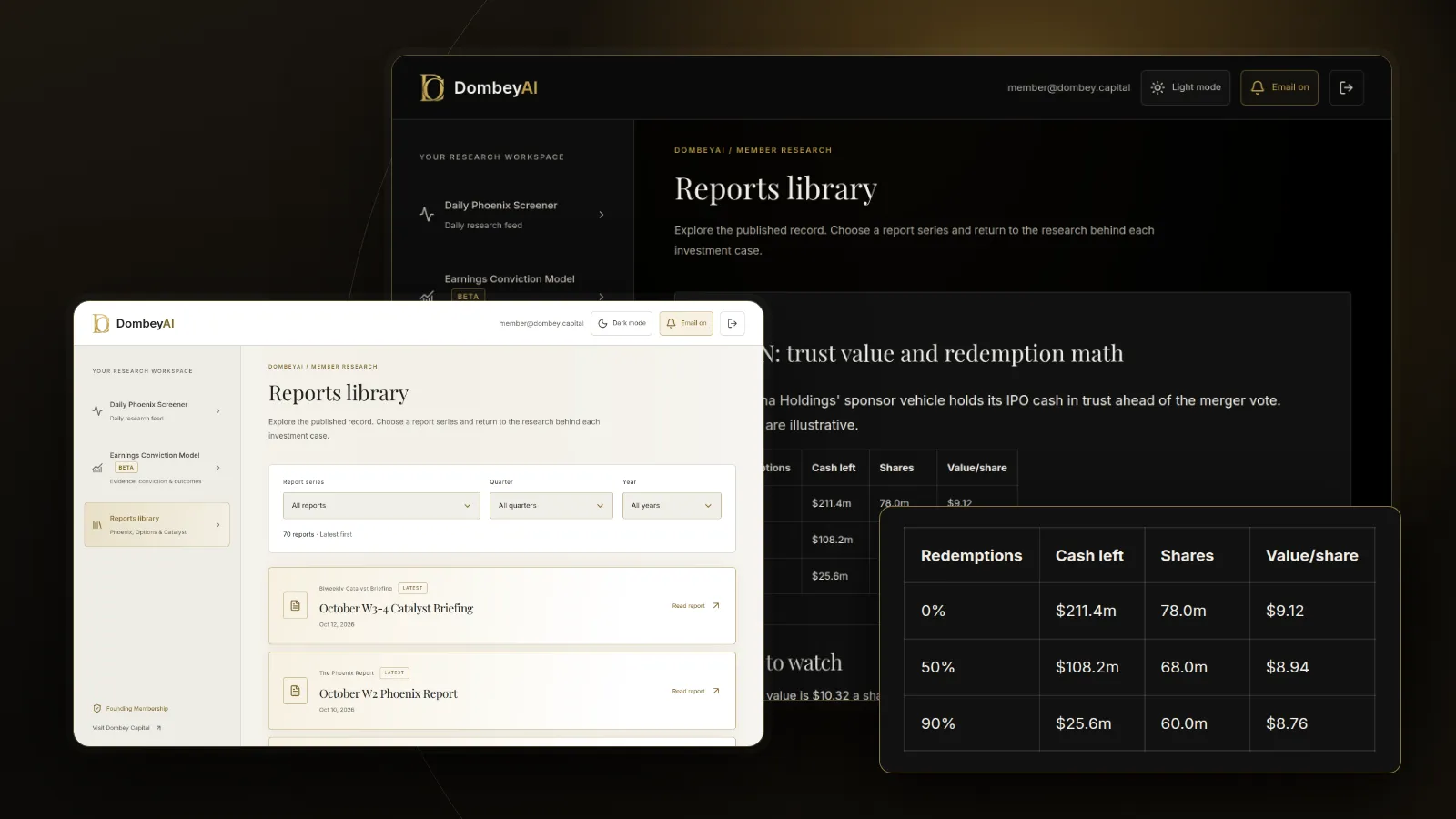
| Redemptions | Shares redeemed | Cash left | Total shares | Value per share |
|---|---|---|---|---|
| 0% | 0.0m | $211.4m | 78.0m | $9.12 |
| 50% | 10.0m | $108.2m | 68.0m | $8.94 |
| 90% | 18.0m | $25.6m | 60.0m | $8.76 |
At every level the remaining holder owns less than the $10.32 the redeeming holder took, and the gap widens as redemptions rise. The 5.0m sponsor shares and the $25m of costs are a fixed burden, and fewer shares carry them.
The breakeven valuation
The more useful number is the deal valuation at which a remaining share is worth exactly the trust value. Solve for it:
Breakeven value = trust value per share x total shares - net cash at closing
At 0% redemptions: $10.32 x 78.0m - $211.4m = about $594m. At 90%: $10.32 x 60.0m - $25.6m = about $594m. The answer is the same, because each redeemed share takes out exactly $10.32 of cash and one share.
This gives a clean rule:
- If you think the business is worth more than the breakeven value, redemptions by others raise what your share is worth.
- If you think it is worth less, redemptions lower it, and high redemptions make the loss larger per share.
- If the deal values the business well below breakeven, as here ($500m against $594m), the deal asks remaining holders to pay a premium for it.
The SEC now requires a version of this. Item 1604(c) asks for a dilution table across a reasonably likely range of redemption levels and, for each level, the company valuation at or above which non-redeeming holders' interest per share is at least the IPO price. The SPAC's IPO prospectus already had to show a similar table at 25%, 50%, 75% and maximum redemption under Item 1602; the deal filing picks its own levels. Compare their figure with your own, and check what they assume about warrants, earnouts and the PIPE.
Extensions and other moving parts
Several features change the math between the IPO and the closing:
- Extension votes. Each one usually lets holders redeem, which shrinks the trust before a deal is even signed. Sponsors sometimes add cash per share to win the vote, which raises trust value for those who stay.
- Minimum cash conditions. Many merger agreements require a minimum amount of cash at closing. High redemptions can breach it, and the target can then walk away or waive it. The 8-K after the vote tells you which.
- Non-redemption agreements. A sponsor may give some of its shares to holders who agree not to redeem. That moves dilution from the sponsor's position to the remaining holders unevenly.
- Warrants. Redeeming holders usually keep their warrants, which is why many redeem. Warrants, earnouts and convertible PIPEs are future dilution that the simple table above leaves out.
- Lockups. Sponsor and target holders often agree not to sell for a period after closing. When those lapse, supply rises; see lockup expirations.
Where this goes wrong
- Counting sponsor shares in the trust math. They usually have no claim on the trust. Including them makes trust value per share look lower than it is.
- Using a stale trust balance. The last 10-Q can be months old. The proxy's estimated redemption amount is usually more current.
- Missing the redemption deadline. Elections typically close before the vote, and brokers set their own earlier cutoffs. If you miss it, you hold the merged company's stock.
- Ignoring fixed dilution. A $10 headline price says nothing about what each share is worth after sponsor shares, fees and warrants. Do the breakeven math.
- Treating the floor as permanent. After closing, the trust is gone. The share is worth whatever the business is worth, and thinly traded post-deal stocks can fall well below $10.
- Assuming redemptions are free of friction. Commissions, the spread you pay to buy and the time value of cash tied up until the vote all reduce the yield.
How it fits with other special situations
A SPAC before its deal vote is a dated cash claim with an option attached, closer to a liquidation play or a tender offer than to an operating stock. After the deal vote, the non-redeeming holder owns an operating company bought at the deal price, less the dilution above. The vote itself is a binary event, and the choice between taking trust value and staying in is a natural fit for probability-weighted valuation: put a value on the business in a good case and a bad case, weight them, and compare the result with the trust value you would give up. Adding each SPAC's deadline and vote date to a catalyst calendar keeps the redemption windows from passing unnoticed.
Dombey's published research works through this kind of dated cash claim before each catalyst; see the research archive.
The bottom line
SPAC trust value is the cash per public share in the trust, after taxes and permitted withdrawals, and it is what a holder receives on redemption. Before a deal closes, it sets a soft floor and a measurable yield. At the deal vote, redemption math decides what the remaining shares are worth: the breakeven valuation does not move with redemptions, but sponsor shares and fixed costs weigh more heavily as more holders leave. Read the dilution table in the proxy, check its breakeven valuation against your own, and note the redemption deadline before you decide.