

What a dual-class structure is
A dual-class company has two or more classes of common stock with the same claim on earnings and dividends but different votes. A common design gives founders or a family Class B shares with ten votes each, while the public owns Class A shares with one vote. Some companies list a third class with no vote at all.
The point is control without majority ownership. A founder holding 15% of the economics through high-vote shares can hold well over half of the votes. That lets insiders take a long view, resist takeovers and pick the board. It also means outside holders cannot force a sale, a break-up or a change of management. That is one reason controlled companies can trade at a discount, a theme covered in holding company discounts.
The terms live in the certificate of incorporation and are summarized in the 10-K and the proxy statement. Read four items closely:
- Votes per share for each class, and whether any class elects a set number of directors.
- Conversion rights. High-vote shares often convert to low-vote shares one for one at the holder's option, and automatically on most transfers.
- Any sunset provision and its triggers.
- Whether the charter requires equal treatment of the classes in a merger or a dividend.
What a collapse is
A collapse, also called a unification or reclassification, ends the multi-class structure. All shares become a single class, usually with one vote each. The company can get there three ways:
- Charter amendment. The board proposes an amendment, shareholders approve it, and each high-vote share converts into low-vote shares at a set ratio. This is the most common route.
- Merger with a subsidiary. The company merges with a wholly owned subsidiary and each class receives new shares on its own terms. It reaches the same result through a different legal path.
- Sunset. The charter ends the structure on its own when a trigger is met. No vote is needed.
In a negotiated collapse, the high-vote holders are usually insiders on both sides of the deal. Boards commonly form a special committee of independent directors to set the terms, and some condition the deal on approval by a majority of the low-vote shares not held by insiders. Delaware courts look more closely at a transaction where a controller receives something other holders do not, so these protections matter for both legal risk and fairness.
Sunset provisions
A sunset turns an open-ended structure into one with an end date. Common triggers include:
- A fixed number of years after the listing, often seven to ten.
- The founder's death, disability or departure from the company.
- The high-vote holders' combined stake falling below a set share of the total.
A sunset changes the valuation in two ways. First, it removes most of the premium question. A holder whose shares will convert one for one in three years has little to bargain with. Second, it gives a date. As the date nears, the spread between the classes should narrow toward zero, because both will soon be the same security.
Threshold sunsets are the ones to watch. If insiders have been selling, the high-vote stake may be close to its trigger. A filing that shows a sale, such as a Form 4, can move the collapse date sharply closer.
The premium paid to high-vote holders
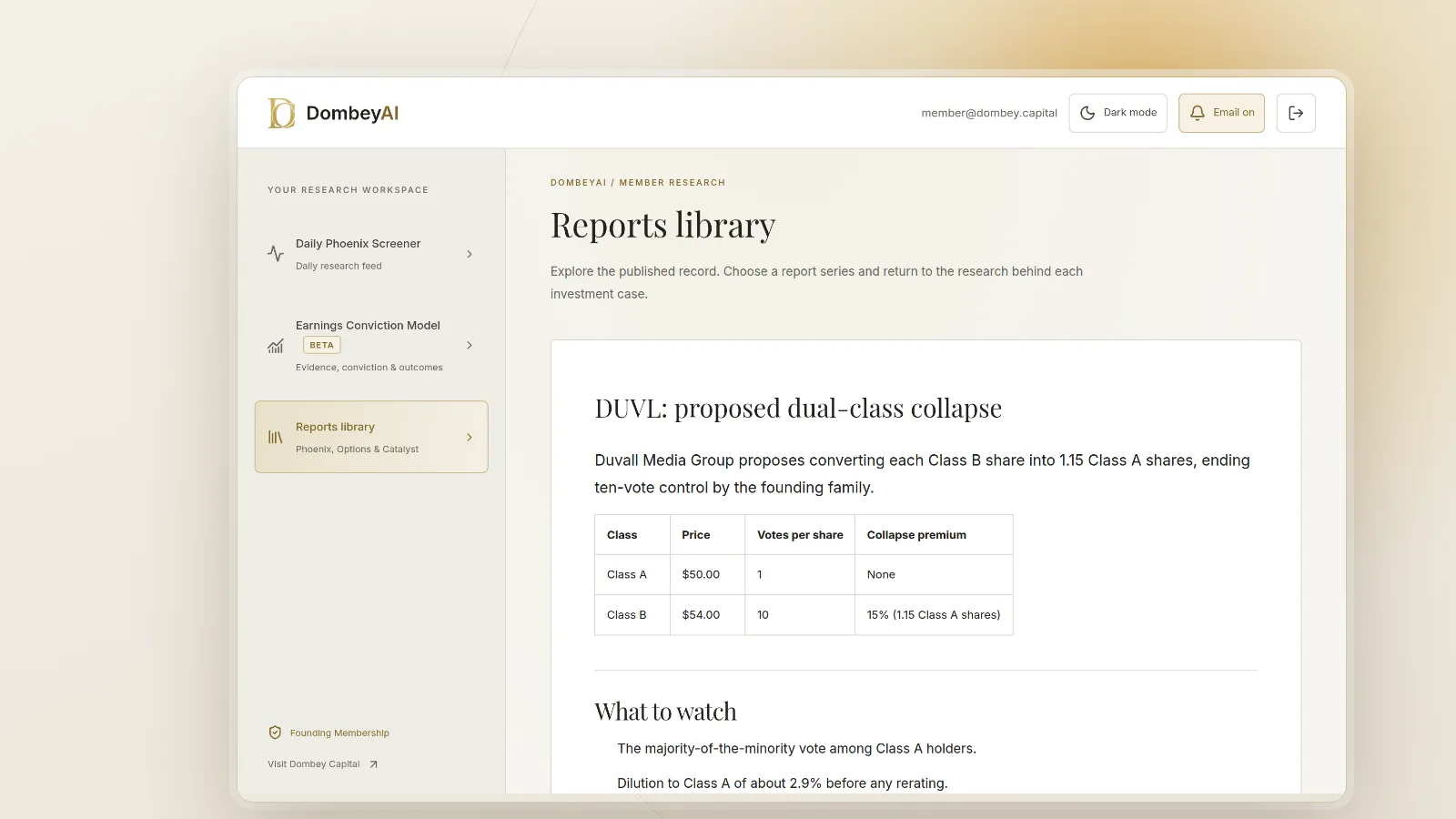
In a negotiated collapse, the high-vote holders often ask for something extra: more low-vote shares for each high-vote share, or cash. A ratio of 1.10 means each Class B share becomes 1.10 Class A shares, a 10% premium.
The premium comes out of the low-vote holders' pockets. If the company issues extra shares to Class B, every Class A share owns a smaller slice of the same company. The cost is plain dilution, covered in what dilution is.
Whether a premium is worth paying depends on what the low-vote holders get back:
- If the collapse opens the door to index inclusion, a wider investor base or a future sale, the gain to Class A can exceed the dilution.
- If the collapse changes little in practice, because insiders keep a large stake and the board stays the same, the premium is a cost with no matching benefit.
- If a sunset is close, a premium is hard to justify, because control was ending anyway.
The spread between share classes
When both classes trade, the gap between them is a live price for control, liquidity and expected terms. Before any announcement, the gap reflects the market's guess about whether a collapse happens and on what terms. A high-vote class that trades thinly can sit at a premium or a discount, so the raw gap is not a clean measure of the vote's value.
After an announcement, the spread becomes a deal spread. If the terms set Class B to convert at 1.10 Class A shares, the fair price of Class B is 1.10 times Class A, less a discount for time and the risk the vote fails. That is the same arithmetic used in merger arbitrage.
| Situation | What the spread reflects | What closes it | Main risk |
|---|---|---|---|
| No proposal, no sunset | Value of control, liquidity gap | Nothing specific | Gap persists for years |
| Sunset with a date | Time to conversion | The sunset date | Trigger delayed or charter amended |
| Collapse proposed, terms set | Odds and timing of the vote | Shareholder approval | Vote fails or terms revised |
| Collapse approved | Settlement mechanics | Conversion date | Small; mostly timing |
| Only one class listed | Not observable | Not applicable | Premium paid in new shares |
When only the low-vote class is listed, there is no spread to trade. The question becomes whether the premium dilution is larger or smaller than the benefit to the listed shares.
The shareholder vote and the proxy
A collapse proposed by charter amendment goes to a shareholder vote, so the proxy statement is the main document. It shows the exchange ratio, the special committee's process, any fairness opinion, the votes required, and how the insiders will vote. The record date fixes who can vote, and the result is reported on Form 8-K under Item 5.07 within four business days after the meeting. For the full timeline, see what a shareholder vote is.
Three questions decide most outcomes:
- Who controls the vote? If insiders hold a voting majority and support the deal, the all-shares vote is close to certain. The class votes and any majority-of-the-minority condition then carry the risk.
- Is there a majority-of-the-minority condition? If so, count the low-vote shares held by outsiders and how proxy advisers are likely to view the premium.
- Does the vote standard count abstentions? Under Delaware law a charter amendment needs a majority of the outstanding shares entitled to vote, so a share that does not vote works as a vote against.
Index inclusion effects
Some index providers have limited or excluded companies whose public shareholders hold little voting power, and the rules have changed more than once. FTSE Russell, for example, requires more than 5% of a company's voting rights to be held by unrestricted shareholders. Other providers have at times barred new multi-class listings and later lifted the bar.
A collapse adds index demand only if the old structure was the thing keeping the stock out or underweighted. Where it was, inclusion can bring a large one-time block of buying from index funds, timed to the provider's next rebalance. Where the stock was already eligible, the index story is noise.
The same forces run in reverse. Forced flows around index changes can push prices away from value, as covered in index deletions. Expected index buying is often priced in before the effective date.
How to value the trade
Value the collapse in five steps, using filed terms rather than headlines.
- Take the current equity value from the low-vote class price times the total share count.
- Work out the share count after the collapse, including premium shares.
- Compute what each class owns after the collapse, before any change in value.
- Add a judgment of any rerating from index inclusion or better governance, kept small and stated plainly.
- Weight the outcomes by the odds the vote passes, and discount for time.
Now weight it. Suppose a 75% chance the vote passes within four months. If it fails, Class A stays near $50 and Class B drifts back toward its old gap, say $53.
| Outcome | Probability | Class A value | Class B value |
|---|---|---|---|
| Passes, with rerating | 40% | $50.97 | $58.62 |
| Passes, no rerating | 35% | $48.54 | $55.83 |
| Fails | 25% | $50.00 | $53.00 |
| Weighted value | 100% | about $49.88 | about $56.24 |
On these illustrative numbers, Class B carries most of the expected gain and Class A is roughly flat. That result is typical: the premium moves value from one class to the other, and only the rerating adds value for both. The method follows probability-weighted valuation for binary events.
Dombey's published research applies this kind of class-by-class math before shareholder votes; see the research archive.
Where this goes wrong
The rerating never comes. Governance gains are hard to measure. If the insiders still hold a large stake after the collapse, the market may treat the company the same way it did before.
Index rules change. Providers revise their methodology. An inclusion case built on one year's rules can lose its basis before the rebalance.
The terms are revised. Pushback from proxy advisers or a majority-of-the-minority vote can force a lower premium. That helps Class A and hurts Class B, so a position in either class carries that risk.
Thin trading distorts the spread. A high-vote class with little volume can show a wide gap that you cannot trade at size. Check average volume before treating a spread as real.
Litigation delays the close. Holders who think the premium is unfair can sue. Even a weak claim can push the timeline out and raise the cost of waiting.
The bottom line
A dual-class collapse ends the gap in voting power between share classes, and the price of ending it is usually a premium paid to the high-vote holders. Value the deal class by class: count the new shares, measure the dilution to the low-vote class, and add only a modest, stated rerating for index inclusion or governance. Then weight the outcomes by the odds and timing of the vote. The spread between the classes tells you what the market already expects, and the proxy tells you whether that expectation holds up.