

What the announcement says and what it does not
Companies use several phrases for the same thing: "exploring strategic alternatives", "a review of strategic options", "a process to maximize shareholder value". The press release usually names a financial adviser, sometimes a legal adviser, and sometimes a special committee of independent directors. It often closes with a line saying the company does not intend to comment further until the board approves a transaction or ends the review.
Form 8-K has no item that requires a company to announce a review. When a company does announce one, the press release is often filed or furnished on an 8-K under Item 8.01 (Other Events), which the form describes as optional, or Item 7.01 (Regulation FD Disclosure). Our guide to reading an 8-K for catalysts covers how to tell the items apart.
Read the release for four things:
- The options listed, and their order. "A sale of the company" listed first reads differently from "a range of alternatives including a sale of non-core assets".
- Who runs it. A special committee signals that an insider, a large holder or management may be a bidder. That matters for fairness and for the price.
- Why now. An activist's Schedule 13D, an unsolicited approach, a debt maturity or a failed product each point to a different likely ending.
- What else changes. A paused buyback, a suspended dividend or new retention agreements for executives tell you how the board expects the next months to run.
How a strategic review runs
The steps below follow a typical sale-focused process. Details vary, and much of it happens out of public view.
- Hire advisers. The board engages a bank and counsel. If any director or officer could be on the buying side, it forms a special committee with its own advisers.
- Prepare materials. The bank builds a short teaser and a longer information memorandum, and the company opens a data room.
- Contact buyers. The bank approaches strategic buyers and financial sponsors. Interested parties sign confidentiality agreements, often with standstill provisions.
- First-round bids. Buyers submit non-binding indications of interest, usually a price range.
- Second round. A shortlist gets deeper diligence and management meetings, then submits final bids with a markup of a draft agreement.
- Negotiate and sign. The board picks a bidder, receives a fairness opinion, and signs a definitive agreement.
- Or end the review. The board announces that it has concluded the process, sometimes alongside a different plan.
Non-binding indications and letters of intent usually stay private. The first required public filing is often the signed agreement: Item 1.01 of Form 8-K covers a material definitive agreement that is "enforceable against the registrant", and the 8-K is due within four business days.
The possible endings
A review does not have one outcome. It has a short list, and each ending changes the stock differently.
| Ending | What shareholders receive | What sets the date | Where it shows up |
|---|---|---|---|
| Sale of the whole company | Cash, stock or both at a fixed price | Merger agreement, vote or tender offer, regulatory approvals | 8-K Item 1.01, proxy or Schedule TO |
| Sale of a division | Value stays in the company, often followed by a cash return | Purchase agreement and closing conditions | 8-K Item 1.01, later Item 2.01 |
| Merger with a peer | Shares in a combined company | Merger agreement, S-4, vote | 8-K, S-4, proxy |
| Spin-off | Shares of a new company | Form 10 effective, record date | Form 10, 8-K |
| Recapitalization or capital return | Special dividend, tender offer or buyback | Board declaration, offer terms | 8-K, Schedule TO |
| Wind-down | Liquidating distributions | Plan of dissolution and vote | Proxy, then distribution notices |
| No transaction | Nothing directly | The announcement that the review has ended | Press release, often an 8-K |
Each row links to a different playbook. A signed cash sale becomes merger arbitrage, with a spread, an outside date and HSR review; the FTC states the HSR waiting period is 30 days after filing, or 15 days for a cash tender offer. A division sale is covered in asset sales and divestitures. A separation follows the spin-off path. A tender offer must stay open at least 20 business days under Rule 14e-1; see how tender offers work. A wind-down is a liquidation play.
Pricing the stock during the review
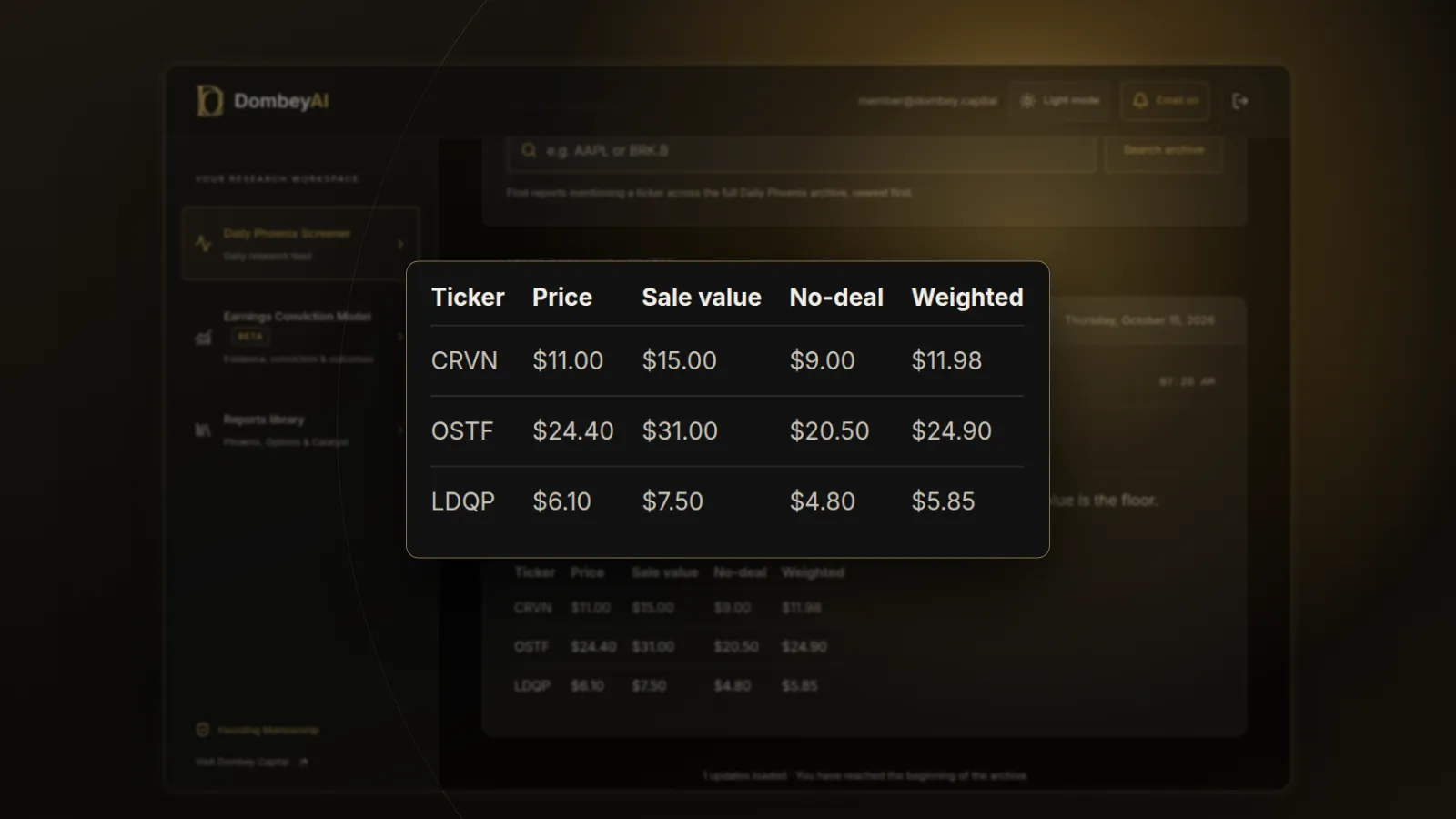
Once the review is public, the stock trades as a blend of these endings. The useful work is to write each one down with a value, a probability and a time, then compare the blended value to the price. Our explainer on probability-weighted valuation covers the method in full.
Three inputs matter more than the rest:
- The no-deal value. This is the floor, and it is usually where the analysis is weakest. Use the price before the announcement and adjust for what has changed since, including cash spent. A base and worst case helps here.
- The sale price. Estimate what a buyer could pay, not what you think the company is worth. A sum-of-the-parts shows where a partial sale might come from.
- Time. A 9% gain over six months and a 9% gain over two years are not the same result. With no deadline, time is the input most likely to be wrong.
Signals that the review is moving
The company usually says little, but filings and actions leak information. None of these is proof. Each shifts the odds.
- If quarterly filings describe adviser fees, retention bonuses or "costs related to the strategic review", the process is active and spending money.
- If the company amends executive severance or change-in-control agreements, the board is preparing for a possible sale.
- If a large holder files a 13D amendment, or an activist settles in exchange for board seats, read the new Item 4 language for what was agreed about the review.
- If the company pauses its buyback, it may hold material nonpublic information, or want to keep cash for a deal.
- If a debt maturity is approaching with no refinancing, the review may be partly about survival, and a sale price may reflect that.
- If management starts describing a "standalone plan" on calls, the board may be preparing holders for a review that ends without a sale.
Put each date you can find, such as earnings calls, the annual meeting and debt maturities, on a catalyst calendar. These are the points at which the company is most likely to update holders.
When the review ends
The end of a review is the event most holders are waiting for, and it is often a surprise in one direction or the other.
A signed deal. The 8-K under Item 1.01 attaches or summarizes the agreement. Now the catalyst is hard: there is a price, conditions and an outside date. The open question moves from "will there be a deal" to "will this deal close", which is the subject of deal breaks.
A partial result. The board sells a division, announces a separation or declares a special dividend. The stock now has a new, smaller business to value, plus whatever cash comes back.
No transaction. The company says the review is complete and the board believes the current plan offers the most value. The sale outcome drops out of your table, so the price tends to move toward the no-deal value. What the company announces alongside, such as a buyback, cost cuts or a new chief executive, determines whether it settles above or below that floor.
Where this goes wrong
Treating the announcement as a deal. Buying a review as if a sale were likely puts the sale price in your head and the no-deal value out of it. The weighted value is the number to compare to the price.
Underestimating the wait. Reviews have no deadline, and boards can extend them quietly. Every month of delay lowers the annualized return and, for a company burning cash, the no-deal value too.
Ignoring the cost of the process. Adviser fees, legal costs, retention payments and management distraction come out of the same cash that would fund a capital return.
Missing the conflicted buyer. When management or a controlling holder is a likely bidder, the price may be set with less competition. A special committee helps, but read the later proxy closely; our going-private guide covers the extra disclosure in those deals.
Anchoring on the first rumor. Reported bid ranges are often first-round and non-binding. Final bids can come in lower after diligence.
The bottom line
A strategic review is a board's formal test of whether selling, splitting or recapitalizing the company is worth more than its current plan. It has no deadline, and no deal is promised. While it runs, value the stock as a short list of endings, each with its own price, probability and timing, and put the most work into the no-deal value. The review becomes a hard catalyst only when a filing sets terms and a date, usually a signed agreement reported under Item 1.01. Dombey's published research writes down those outcomes before the event; see the research archive.