

What you need
- The company's most recent 10-Q or 10-K from SEC EDGAR. The guide on searching SEC EDGAR filings shows how to find them.
- A current share price.
- A spreadsheet with one row for each line in the build below.
- The notes to the financial statements, in particular the debt, equity compensation, leases, pensions and commitments notes.
- About 30 to 45 minutes for a first pass on a company with a simple capital structure.
Step 1: Fix one date for the balance sheet
Enterprise value mixes a market price with balance sheet figures, so pick one balance sheet date and use it for every line. Use the most recent filing. A 10-Q is due 40 days after quarter end for large accelerated and accelerated filers and 45 days for all other registrants. A 10-K is due 60, 75 or 90 days after fiscal year end, depending on filer status.
Between filings, read the 8-Ks. A debt issue, a large buyback, an acquisition or an asset sale after the balance sheet date can change enterprise value more than a quarter of operations. If one happened, adjust the affected line and note the source.
Step 2: Build the fully diluted share count
Start with the basic shares outstanding on the 10-Q cover page, which are usually more current than the weighted average in the income statement. Then add the dilutive securities from the equity compensation and debt notes.
- Options and warrants: use the treasury stock method. Assume in-the-money options are exercised and the exercise proceeds buy back shares at the current price. Net new shares = options minus (options x strike / price). Ignore options with a strike above the current price.
- Restricted stock units and performance shares: add them in full if they are likely to vest.
- Convertible notes: if the share price is above the conversion price, count the conversion shares and remove the note from debt. If the price is below, treat the note as debt and add no shares. Never count it twice.
Step 3: Calculate equity value
Multiply the share price by the fully diluted share count. This is the market value of the common equity, and it is usually a little higher than the market cap quoted on financial websites, which tends to use basic shares.
For Company A: $20.00 x 52.2 million = $1,044 million. On basic shares the figure would be $1,000 million. On a company with a large option pool or many RSUs, the gap can be much wider.
Step 4: Add all interest-bearing debt
Add every borrowing from the balance sheet and the debt note:
- Short-term borrowings and commercial paper
- The current portion of long-term debt
- Long-term debt, including term loans, bonds and drawn revolvers
- Convertible notes not counted as shares in Step 2
- Finance lease liabilities
Use the principal amount from the debt note when it differs from the carrying value. Carrying value can be reduced by unamortized issue costs and discounts, but the company still owes the principal. If the company's bonds trade far below par because of credit stress, you can also run the calculation at market value and show both.
Step 5: Add preferred stock and noncontrolling interest
Preferred stock ranks ahead of common equity, so a buyer of the whole company must pay it off or assume it. Add it at liquidation preference, which is shown in the equity note or on the balance sheet. If the preferred converts into common and is in the money, count the conversion shares in Step 2 instead.
Noncontrolling interest, sometimes called minority interest, appears in the equity section of the balance sheet. It exists because the company consolidates 100% of a subsidiary's revenue and EBITDA while owning less than 100% of it. Adding it keeps enterprise value consistent with those consolidated earnings.
For Company A: preferred stock of $40 million and noncontrolling interest of $25 million, a total of $65 million.
Step 6: Subtract cash and liquid investments
Subtract cash, cash equivalents and short-term investments such as Treasury bills and marketable securities. These are assets a buyer of the whole company receives and can use to repay debt or return to owners.
Be strict about what counts:
- Exclude restricted cash held as collateral, in escrow or for a specific purpose.
- Consider a haircut on cash held in foreign subsidiaries if bringing it home triggers tax or legal limits.
- Consider leaving out a minimum operating cash balance for a business that needs cash on hand to run, such as a retailer with many stores.
- Exclude long-term investments unless they are liquid and clearly non-operating.
Step 7: Decide on leases, pensions and other debt-like items
Some obligations behave like debt without appearing in the debt line. Decide on each one, and write down the decision:
| Item | Where to find it | Add to EV when |
|---|---|---|
| Operating lease liabilities | Lease note, balance sheet | You pair EV with EBITDAR or another measure before rent |
| Unfunded pension and retiree medical | Pension note | The obligation is large relative to equity value |
| Asset retirement obligations | Liabilities and notes | The cost is material and near term |
| Litigation settlements and accrued judgments | Contingencies note | The amount is probable and estimable |
| Deferred or contingent acquisition payments | Business combinations note | Payment is likely and dated |
| Equity-method investments | Investments note | Subtract them if the earnings measure excludes their income |
The 10-Q guide for special situations shows where each of these notes sits in a quarterly filing.
Step 8: Add it up and check the pairing
Put the build in one table so every line is visible and sourced:
| Line | Company A ($ millions) |
|---|---|
| Equity value (52.2m diluted shares x $20.00) | 1,044 |
| Plus total debt | 415 |
| Plus preferred stock | 40 |
| Plus noncontrolling interest | 25 |
| Less cash and short-term investments | (230) |
| Enterprise value | 1,294 |
Now divide by the earnings measure that matches the claims you included. Company A reports trailing EBITDA of $160 million and revenue of $900 million (illustrative), so EV/EBITDA is about 8.1x and EV/sales is about 1.4x.
Then check the pairing:
- If you added noncontrolling interest, the EBITDA should be consolidated, including 100% of that subsidiary.
- If you added operating leases, use EBITDAR, not EBITDA.
- If you subtracted an equity-method investment, the EBITDA should exclude its income.
- If the convertible is treated as debt, its interest should not be added back anywhere else.
When enterprise value comes out at or below zero, cash exceeds market value plus every claim. That is a separate set of questions about cash burn and catalysts, covered in negative enterprise value stocks and net cash per share.
Common mistakes
- Mixing dates. Using today's price with a balance sheet from two quarters ago, or debt from one filing and cash from another, produces a number that never existed.
- Using basic shares. A company with a large option and RSU pool looks cheaper on basic shares than it is.
- Counting a convertible twice. It is either debt or shares, depending on the price relative to the conversion price.
- Subtracting all the cash. Restricted cash, trapped foreign cash and the cash a business needs to operate are not free to a buyer.
- Forgetting the current portion of debt. It sits in current liabilities, apart from long-term debt, and is easy to miss.
- Mismatching the multiple. Adding leases or minority interest to the numerator without adjusting the denominator distorts EV/EBITDA in a direction you cannot see.
- Ignoring events after the balance sheet date. An acquisition paid for with cash after quarter end changes both cash and the business being valued.
Where this goes wrong
Enterprise value is only as current as the latest filing. A company burning cash or drawing a revolver can look very different a few weeks after its balance sheet date. In distressed companies, the book value of debt can be far above what lenders would accept, and market value is a better guide. Holding companies, banks and insurers do not fit the formula well, because debt and cash are part of their operations rather than financing. Judgment calls on leases, pensions and minimum cash can move the answer by several percent, so two careful analysts can reach different figures from the same filing. The calculation also tells you nothing about whether the business is worth that price. It sets up the valuation question rather than answering it.
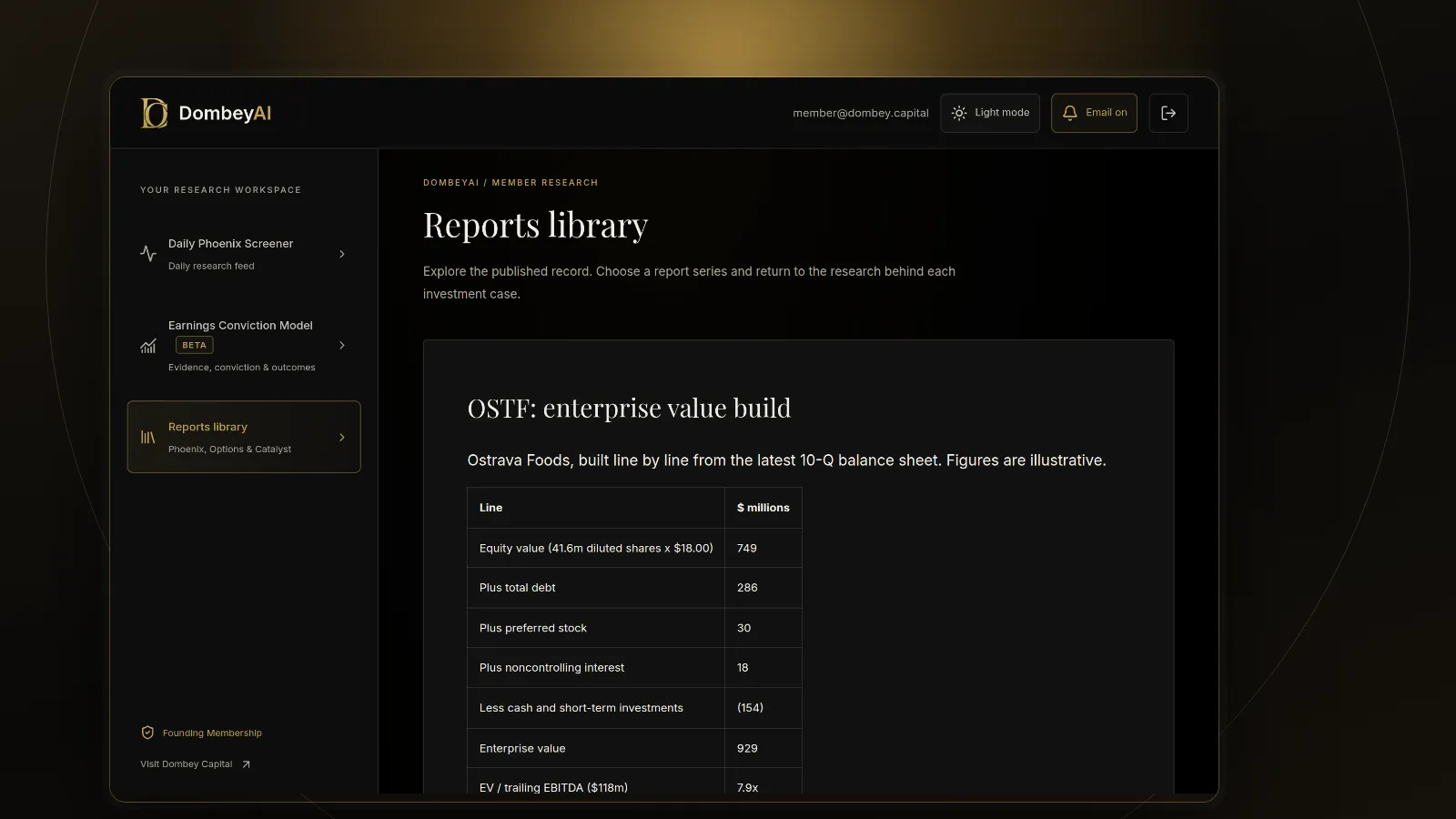
Dombey's published research shows the enterprise value build behind each catalyst thesis; see the research archive. Once you have a number you trust, record it with its date and sources as part of a dated investment thesis.
The bottom line
Calculating enterprise value takes one balance sheet date, a fully diluted share count and a careful list of claims and cash. Equity value plus debt, preferred stock and noncontrolling interest, minus usable cash, gives the price of the whole business. The judgment lies in what counts as debt and what counts as cash, so write each decision down. Then pair the result with an earnings measure that covers the same claims, and update the build whenever a new filing arrives.