

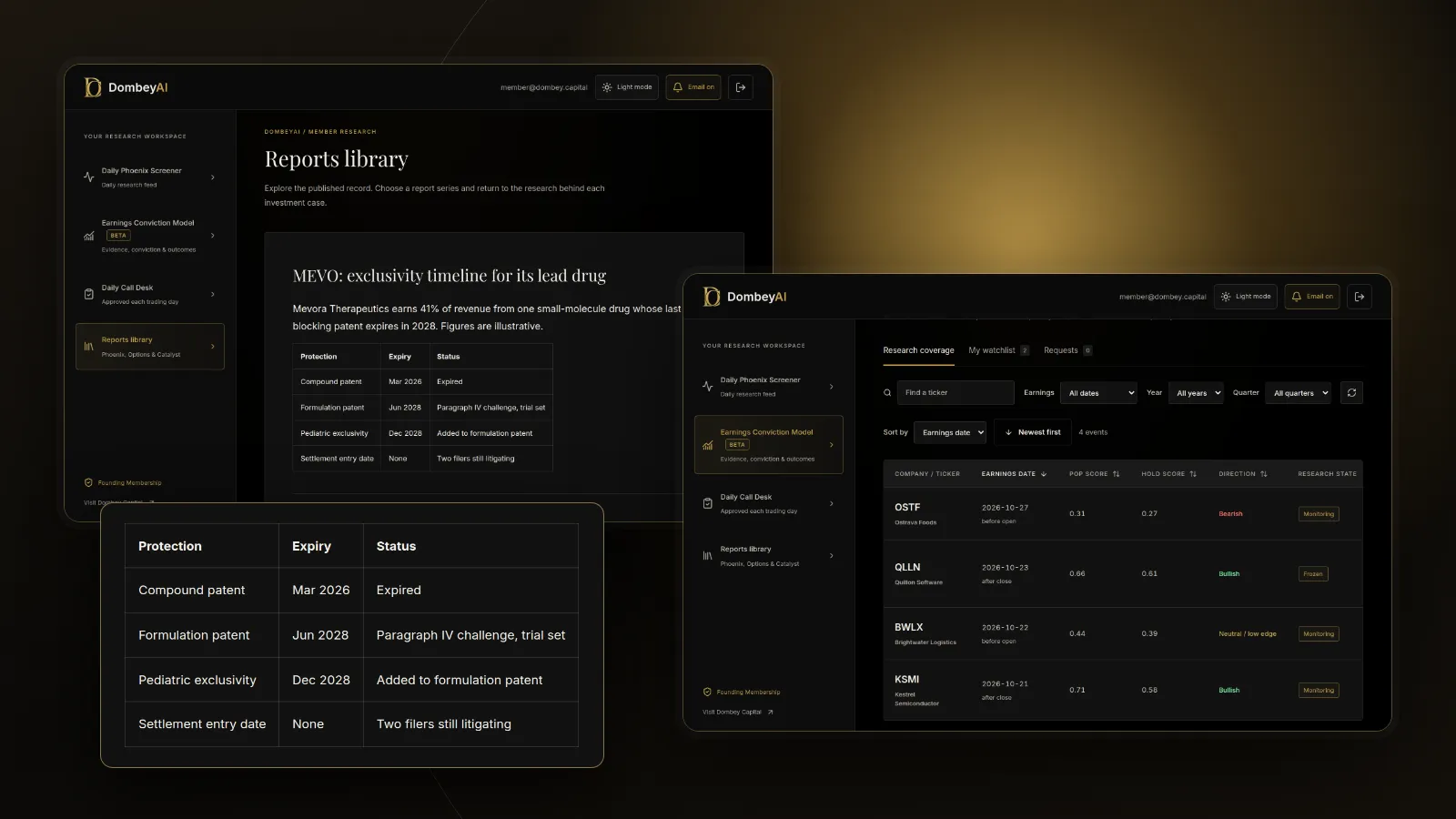
How drug exclusivity works
Two kinds of protection keep competitors out of a branded drug's market, and they run on separate clocks.
Patents are granted by the US Patent and Trademark Office and run 20 years from the filing date. A drug usually carries several: a compound patent on the molecule, then patents on formulations, methods of use and manufacturing. Drug companies often file the compound patent long before approval, so much of the term passes during development. Patent term extension can restore part of that time.
Regulatory exclusivities are granted by the FDA on approval and block or delay competing applications regardless of patents. The FDA lists the main periods:
| Protection | Length | What it covers |
|---|---|---|
| Patent term | 20 years from filing | The claims in each patent, which may expire at different dates |
| New chemical entity exclusivity | 5 years | A drug with an active ingredient never approved before |
| Orphan drug exclusivity | 7 years | A drug for a rare disease, for the approved orphan use |
| New clinical investigation exclusivity | 3 years | Changes such as a new indication or formulation that needed new studies |
| Pediatric exclusivity | 6 months | Added to existing patents and exclusivities after pediatric studies |
| Biologic reference product exclusivity | 12 years from first licensure | Biologics, under the Biologics Price Competition and Innovation Act |
The cliff arrives when the last protection that actually blocks a competitor ends. That is often a later patent on a formulation or a use, not the compound patent.
Why the cliff is steep
Small-molecule drugs face generics approved through abbreviated applications that rely on the brand's safety and efficacy data. Generics are cheap to make, pharmacies can substitute them for the brand where state law allows, and insurers push patients to the lowest-cost version. Once several generics are on the market, prices tend to fall sharply and the brand keeps a small share.
Biologics are different. Biosimilars are harder to make, fewer companies develop them and doctors and patients switch more slowly. Erosion tends to be slower and less complete, though large biologics can still lose a substantial share of sales over several years.
How to date a patent cliff
The date in a company's 10-K is a starting point. To find the real entry date:
- Read the Orange Book or Purple Book. For small molecules, the Orange Book lists each patent and exclusivity with its expiry. The Purple Book does the same job for biologics.
- Check the 10-K. Large drug companies list key products with their expected US and European exclusivity dates. Our 10-K guide shows where these disclosures usually sit.
- Follow the litigation. A generic filer that certifies a patent is invalid or not infringed, a Paragraph IV certification, triggers a lawsuit and, if the brand sues within 45 days, a stay of up to 30 months. Court rulings move entry dates.
- Read settlements. Many cases settle with a licensed entry date, sometimes years before the last patent expires. The date is usually announced in an 8-K or a press release.
- Count the filers. The first Paragraph IV filer can get 180 days of exclusivity against other generics, which slows price erosion for six months.
Put each date into a catalyst calendar with the source next to it.
How a patent cliff hits the stock
The stock usually moves long before the cliff. Expiry dates are public, so analysts model revenue declines years in advance, and the valuation reflects the post-cliff company. The stock price at any point embeds an assumption about how fast and how far revenue will fall.
The same arithmetic works in reverse. A settlement that delays entry, slower erosion than modeled, or a new launch that grows faster than expected can lift a stock that already discounts the cliff. Our explainer on guidance changes covers how a revised outlook resets expectations.
How companies respond
Drug companies spend years preparing for exclusivity loss. Common responses:
- Lifecycle management: new formulations, extended-release versions or combinations that move patients to a product with longer protection.
- Authorized generics: the brand sells its own generic, through a partner or subsidiary, to keep some of the market.
- Settlements: licensed entry dates that trade an earlier-than-hoped date for certainty.
- Pipeline and acquisitions: new drugs or acquired companies to replace the lost revenue. The value of a pipeline is often what the market weighs against the cliff.
- Cost cuts and buybacks to protect earnings per share during the decline.
Pricing policy matters too. Medicare drug price negotiation under the Inflation Reduction Act can reduce a drug's price before it loses exclusivity, which flattens the cliff by lowering the revenue at risk.
What to watch
- If a court invalidates a key patent, check whether it moves the entry date and whether the company will appeal.
- If a settlement is announced, compare the licensed entry date with what the market assumed.
- If several generic filers have tentative FDA approval, expect faster price erosion after entry.
- If the drug is a biologic, check how many biosimilars are approved or filed and whether any are interchangeable.
- If a replacement product is in late-stage trials, add its FDA decision date to the same calendar.
Where this goes wrong
Patent cliffs are well known, so the edge is in the details, and the details are uncertain. Litigation outcomes are hard to predict, settlements are often confidential beyond the entry date, and erosion rates vary widely by drug, market and channel. Revenue outside the US follows different patent and exclusivity rules on different dates. A company can also replace lost sales faster or slower than modeled. Treat any erosion curve as a scenario range, not a forecast, and size positions for the chance that a court ruling moves the date in either direction.
For daily coverage of stocks moving on catalysts such as court rulings and drug approvals, see Dombey's market coverage. For calendars that track FDA dates, see our list of FDA calendars and biotech catalyst trackers.
The bottom line
A patent cliff is the revenue drop that follows a drug's loss of patent and regulatory exclusivity, and its timing depends on the last protection that blocks competitors, litigation and settlements. The stock usually prices the cliff years in advance, so the event-driven question is whether the current price assumes too much or too little erosion. Date the entry from the Orange Book or Purple Book, the 10-K and the court record, then track the news that changes the date or the depth.