

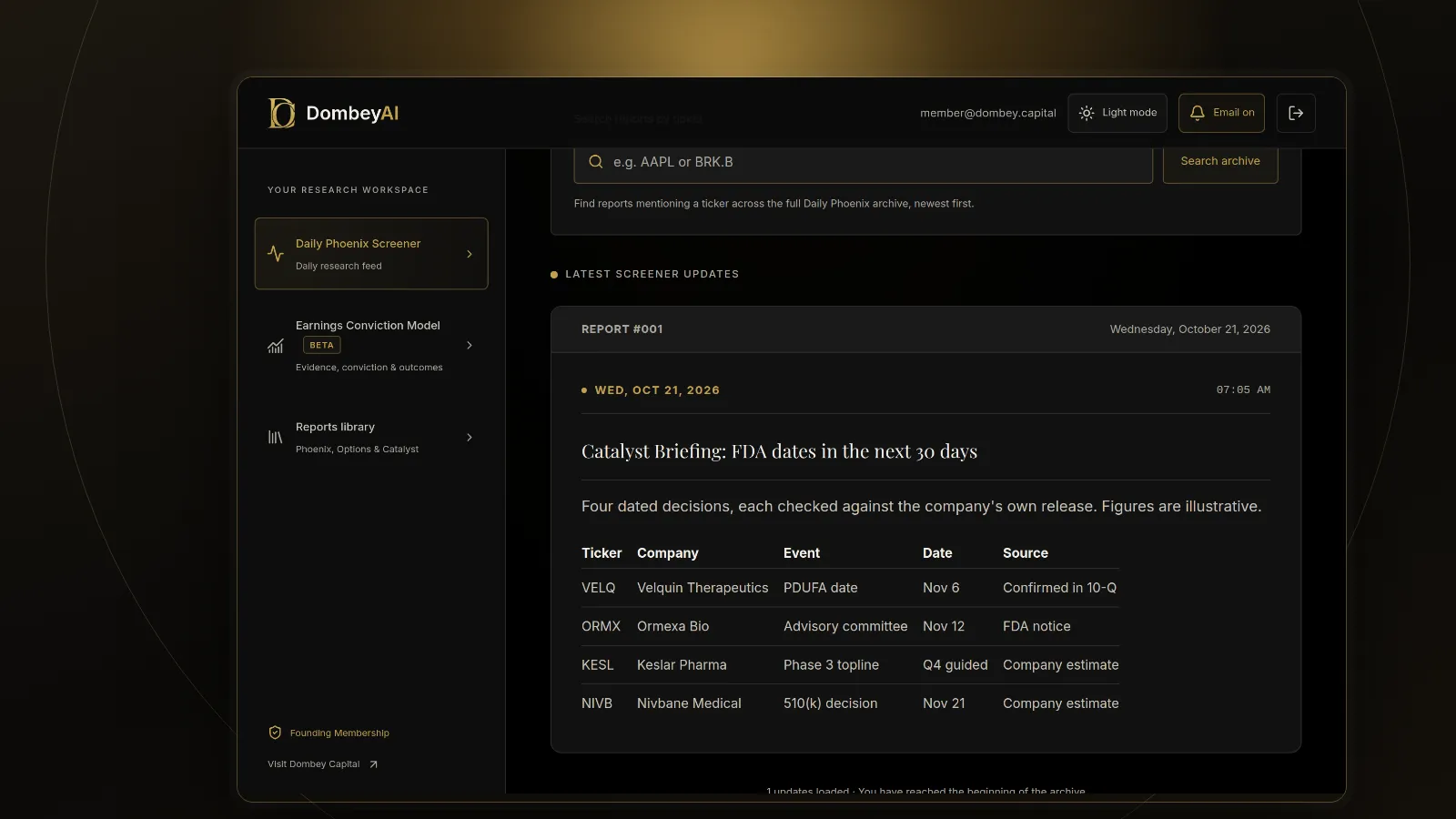


Full disclosure: Dombey Capital is our own research service and our top pick here, for the reasons below. The section on where it falls short is there so you can judge whether it fits your process.
What an FDA calendar can and cannot tell you
An FDA calendar lists dates on which a regulatory or clinical event is expected for a drug or biologic. The most watched is the PDUFA date, the FDA's goal date for acting on an application. The FDA's stated goal is to act within 6 months for a priority review, compared with 10 months under a standard review. Calendars also list advisory committee meetings and, on the clinical side, expected trial readouts.
The key fact for using any of them: the FDA generally does not publish the goal dates of pending applications. The date reaches a calendar because the sponsor company disclosed it, usually in a press release, an earnings release or an SEC filing. So every calendar on this list is a summary of company disclosures, and the disclosure itself is the authority. Our explainer on how PDUFA catalysts work covers the review process in more detail.
Three things a calendar cannot do:
- Guarantee the date. A major amendment to an application can extend the goal date, and the FDA can act before it.
- Tell you the outcome. An approval, a complete response letter or a delay are all possible on the same date.
- Tell you what is priced in. That takes analysis of the company, its cash and the size of the market for the drug.
Quick comparison
| Tool | Best for | Key features | Price (as of October 2026) |
|---|---|---|---|
| Dombey's Catalyst BriefingTop pick | Special situations around regulatory and corporate events | Written briefing on forthcoming events in Dombey's coverage; Founding Membership adds the weekly Phoenix Report, weekly Options Research and the DombeyAI Portal | Founding Membership $1,200/year; Standard Access $80/year or $8/month; Public Archive free |
| BioPharmCatalyst | A dedicated biotech catalyst calendar | FDA calendar, PDUFA date calendar, biotech company screener and database | Free view; premium: see the vendor's pricing page |
| FDATracker | PDUFA dates, trials and cash runway in one subscription | FDA Calendar, Trial Tracker, Burn Rate, Omniview, Patent Tracker | Gold $29/month |
| RTTNews | A free FDA decision calendar with a paid biotech service | Free FDA calendar with drug, event and outcome; RTT Biotech Investor adds alerts and a clinical trial calendar | Free calendar; RTT Biotech Investor $99/month after a 7-day free trial |
| Benzinga Pro | Traders who want FDA dates next to live news | FDA calendar with exact and estimated dates, newsfeed, other event calendars | See the vendor's pricing page |
| MarketBeat | A free FDA calendar inside a general stock site | Free FDA calendar with ticker, price and 30-day trend; All Access adds filters and export | Free; All Access $29/month or $249/year, 30-day free trial |
| SEC EDGAR | The company's own disclosure of the date | Full-text search of filings, including press releases filed on Form 8-K | Free |
| FDA.gov and ClinicalTrials.gov | Official advisory committee and trial data | Advisory committee calendar, Novel Drug Approvals lists, trial records with anticipated or actual completion dates | Free |


How we compared these tools
We compared these tools from vendor documentation, pricing pages and public product pages, read on the publish date. We did not subscribe to each service for this article, and we make no claims about the accuracy or completeness of any vendor's dates.
| Criterion | Weight | What it measures |
|---|---|---|
| Link to the primary source | 25% | How easily you can get from a listed date to the company's own disclosure or the official record |
| Event context | 20% | Whether the tool explains why the event matters, such as the cash, financing or deal around it |
| Coverage of event types | 20% | PDUFA dates, advisory committees, trial readouts and approvals after the fact |
| Free plan usefulness | 20% | What you can do without paying |
| Price for an individual | 15% | The cost of the paid tier most individuals would need |
We weighted the link to the primary source and the event context most because a dated catalyst is only useful when you can confirm the date and judge what it means for the security. If you care most about breadth, for example scanning every PDUFA date in a quarter, weight coverage higher and the dedicated calendars move ahead of everything else.
Quick picks by job
Best for special situations around regulatory events: Dombey's Catalyst Briefing
The Catalyst Briefing gathers the forthcoming corporate and market events in Dombey's special situations coverage into one written reference. When a regulatory decision sits inside a situation Dombey covers, such as a company trading below cash ahead of a decision or a deal with a contingent value right, the briefing puts the date next to the situation. It is not a full FDA calendar, and it does not try to be.
Best dedicated biotech catalyst calendar: BioPharmCatalyst
BioPharmCatalyst describes itself as a suite of tools for biotech investors, with an FDA calendar, a PDUFA date calendar and a biotech company screener and database. It suits readers who want one site focused on the sector.
Best low-cost all-in-one subscription: FDATracker
FDATracker lists one paid plan that covers its FDA calendar, trial tracker, cash burn forecasts and patent tracker. It suits readers who want the date and the funding question in the same place.
Best free decision calendar: RTTNews
RTTNews publishes a free FDA calendar showing the company, the drug, the event and the outcome once known. It is a quick way to scan upcoming decision dates.
Best for FDA dates next to live news: Benzinga Pro
Benzinga's FDA calendar separates exact dates from estimated ones, and Benzinga Pro pairs its calendars with a real-time newsfeed. It suits traders who act on the day news lands.
Best free calendar inside a general stock site: MarketBeat
MarketBeat's FDA calendar is free and shows each company's price and 30-day trend beside the event. It suits investors who already use MarketBeat for other data.
Best primary source for the date: SEC EDGAR
EDGAR full-text search finds the press release or filing in which the company disclosed its PDUFA date, an extension or the decision itself.
Best official record: FDA.gov and ClinicalTrials.gov
The FDA's advisory committee calendar and approval lists, and ClinicalTrials.gov's trial records, are the government's own data and cost nothing.
Full reviews
1. Dombey's Catalyst Briefing (Founding Membership and Standard Access)
What it does. The Biweekly Catalyst Briefing is a concise briefing on forthcoming corporate and market events relevant to special situations. It gives a consolidated reference for readers following developments across Dombey's research coverage. Regulatory decisions appear when they fall inside that coverage.
Best for. Investors who look at biotech and other companies through a special situations lens: a stock below its cash ahead of a decision, a financing that depends on a readout, or a deal whose value turns on an approval.
Pricing. Founding Membership is $1,200 a year, annual billing only, and includes the weekly Phoenix Report, weekly Options Research, the Catalyst Briefing, the DombeyAI Portal with the Daily Phoenix Screener and Earnings Conviction Model, valuation and execution analysis, and priority access. Standard Access is the lower-cost option at $80 a year, about $6.67 a month, or $8 a month on monthly billing, and includes the Biweekly Catalyst Briefing and the complete public-research archive. The Public Archive is free.
Pros
- Puts the event next to the situation around it, which a date list does not.
- Standard Access is one of the cheaper paid options on this list.
- Comes with the complete public-research archive.
Cons
- Covers only Dombey's research coverage, not every PDUFA date or trial.
- Published every two weeks, not in real time, and it is not a searchable calendar or data feed.
Verdict: Our top pick for investors who want regulatory and corporate catalysts framed as special situations. Pair it with a free FDA calendar and EDGAR for everything outside its coverage.
2. BioPharmCatalyst
What it does. BioPharmCatalyst describes a suite of tools for trading and investing in biotech stocks: an FDA calendar, a PDUFA date calendar, and a biotech company screener and database. The site offers premium tools to signed-in users.
Best for. Readers who want a calendar built only for the biotech sector.
Pricing. A view of the calendar is available without paying. For premium plans, see the vendor's pricing page; we could not confirm current prices on the publish date.
Pros
- Focused on biotech catalysts rather than the whole market.
- Calendar, screener and company database in one place.
Cons
- Premium pricing was not shown on the pages we could read.
- Like every calendar here, its dates depend on company disclosures.
Verdict: A strong choice for a dedicated biotech calendar. Confirm plan terms on the vendor's site before subscribing.
3. FDATracker
What it does. FDATracker lists five products. The FDA Calendar tracks upcoming PDUFA dates and FDA advisory committee meetings. Trial Tracker screens for public companies with near-term clinical trial results. Burn Rate forecasts which companies are likely to raise capital, based on how long their working capital will last. Omniview combines PDUFA dates, trials and cash runway, and Patent Tracker reviews pharmaceutical patents using the FDA Orange Book.
Best for. Readers who want the catalyst date and the funding question side by side.
Pricing. One Gold plan at $29 a month, renewing monthly, with access to all of the tools. It can be cancelled at any time, per the membership page.
Pros
- One plan covers PDUFA dates, trials, cash runway and patents.
- The cash runway tool addresses the financing risk around a catalyst.
Cons
- Monthly billing only on the membership page we read.
- Product pages give short descriptions, so check the tools fit your process.
Verdict: Good value if you want calendar, trials and runway together. Check its runway figures against the company's latest 10-Q, as our guide on how to estimate cash runway explains.
4. RTTNews
What it does. RTTNews publishes a free FDA calendar with five fields: company and ticker, drug, event, outcome and details. Entries cover decisions on new and supplemental drug and biologic applications. The free page shows part of the calendar, and RTTNews offers the full calendar on a 7-day free trial. Its paid RTT Biotech Investor service adds catalyst alerts for FDA decisions and trial results, an FDA calendar, a clinical trial calendar and commentary.
Best for. A free scan of upcoming FDA decision dates.
Pricing. The visible calendar is free. RTT Biotech Investor is $99 a month after a 7-day free trial, which the page describes as a limited-time discounted rate. An annual plan is advertised without a dollar figure, so see the vendor's page for it.
Pros
- The free calendar shows outcomes as well as pending dates.
- The paid service adds a clinical trial calendar and alerts.
Cons
- The free page shows only part of the calendar.
- The paid service is one of the more expensive options here.
Verdict: A useful free starting point. The paid tier suits readers who want alerts and trial dates from the same provider.
5. Benzinga Pro
What it does. Benzinga's FDA calendar lists PDUFA dates, advisory committee meetings and other regulatory events, and separates exact dates from estimated ranges. Benzinga Pro pairs its calendars with a real-time newsfeed.
Best for. Traders who want the date and the headline in one screen.
Pricing. Benzinga's pricing page would not load for us on the publish date. See the vendor's pricing page for current plans and which ones include the calendars.
Pros
- Distinguishes exact dates from estimated ones.
- News and calendars in one product.
Cons
- Built for speed, with little analysis of what an event means for valuation.
- Price not confirmed here.
Verdict: A fit for active traders. For a fuller comparison of news sources, see Benzinga Pro vs Seeking Alpha vs Dombey.
6. MarketBeat
What it does. MarketBeat publishes a free FDA calendar covering drug approvals, trial results and regulatory decisions, with each company's ticker, price and 30-day trend. Filters such as market cap and analyst consensus, and Excel export, are marked as All Access features.
Best for. Investors who already use MarketBeat and want FDA dates in the same place.
Pricing. The calendar is free. MarketBeat All Access is $29 a month or $249 a year, with a 30-day free trial that requires a payment method.
Pros
- Free and quick to scan.
- All Access adds watchlists, alerts and screeners across the whole market.
Cons
- Useful filters are behind the paid tier.
- A general stock site, so biotech depth is limited.
Verdict: A convenient free calendar. Pay for All Access for its general features, not for the FDA calendar alone.
7. SEC EDGAR full-text search
What it does. EDGAR full-text search lets you search the text of company filings. Many companies file their press releases as exhibits to Form 8-K, so a search for "PDUFA" with the company's name usually finds the disclosure of the goal date, any extension and the decision.
Best for. Confirming a date before you rely on it.
Pricing. Free.
Pros
- The company's own words, with the filing date.
- Covers extensions and complete response letters as well as approvals.
Cons
- No calendar view; you search one company at a time.
- Not every press release is filed with the SEC on the day it is issued.
Verdict: The check every calendar date should pass. Our guide on how to read an 8-K for catalysts shows what to look for.
8. FDA.gov and ClinicalTrials.gov
What it does. The FDA publishes an advisory committee calendar listing meeting dates, the committee and the center, with a page for each meeting. After a decision, CDER's Novel Drug Approvals pages list new drugs never before approved or marketed in the US, by year. ClinicalTrials.gov holds registered trial records, each with a primary completion date marked as anticipated or actual. Under federal rules, a sponsor must update that date within 30 calendar days after the actual primary completion date.
Best for. Official advisory committee dates and trial timelines.
Pricing. Free.
Pros
- Government data, not a vendor's summary.
- Trial records show whether a date is still an estimate.
Cons
- No PDUFA dates for pending applications.
- A primary completion date marks the end of data collection, not the date results are announced.
Verdict: Use them to confirm advisory committee dates and trial timing, alongside EDGAR for PDUFA dates.
Where Dombey falls short
The Catalyst Briefing does one part of this job, and its limits are real:
- Narrow coverage. It covers events in Dombey's special situations coverage. If a biotech company is not in that coverage, the briefing will not list its PDUFA date or trial readout.
- Not real time. It is published every two weeks. An extension or an early decision will appear in a press release or 8-K first.
- No biotech data terminal. There is no searchable FDA calendar, trial database, screener or alert system in Standard Access.
- Small team and pen-name author. The research is written by a small team under a pen name. Weigh it accordingly and check dates against the filing.
- Short history. The publication's record is short compared with the long-running calendars here.
Free vs paid
Free tools cover the date question for most individuals. RTTNews and MarketBeat show upcoming decisions, BioPharmCatalyst has a free calendar view, EDGAR confirms the company's disclosure, and FDA.gov and ClinicalTrials.gov cover advisory committees and trial timing.
Paid tools buy time and context. FDATracker adds trials and cash runway for $29 a month. RTT Biotech Investor and Benzinga Pro add alerts and news. Dombey's Founding Membership, and Standard Access as its lower-cost option, add written research on the special situations around those events rather than more dates.
How to choose
Start with the question you need answered.
| Your situation | Pick | Add later when |
|---|---|---|
| You follow special situations around regulatory and corporate events | Dombey's Catalyst BriefingTop pick | You need dates outside its coverage: add a free FDA calendar and EDGAR |
| You want every PDUFA date in the sector | BioPharmCatalyst or FDATracker | A date matters to you: confirm it on EDGAR |
| You want a free scan of upcoming decisions | RTTNews or MarketBeat | You follow many names: add a paid tracker |
| You trade on the day news lands | Benzinga Pro | You want the situation analyzed: add Dombey Founding Membership, or Standard Access as the lower-cost option |
| You need to confirm one date | SEC EDGAR | You need trial timing: add ClinicalTrials.gov |
- If the event is a PDUFA date, find the company's press release on EDGAR and note the review type, since a priority review runs 6 months and a standard review 10.
- If the event is a trial readout, check whether ClinicalTrials.gov marks the completion date as anticipated or actual, then read how the company has described timing.
- If the stock's value depends on cash as well as the decision, look at runway and any shelf registration before the date.
- If you want to put a value on the outcomes, a probability-weighted valuation turns the dates into scenarios.
To keep these dates organized across tools, our guide on how to build a catalyst calendar sets out a simple system, and our comparison of earnings calendars and catalyst tools covers non-biotech events. For how the broader research subscriptions compare, see Seeking Alpha vs Motley Fool vs Morningstar vs Dombey.
Where this goes wrong
- Estimated dates read as exact. Some calendars list a quarter or a range. Benzinga separates exact from estimated dates; check how any calendar labels its entries.
- Completion read as readout. A primary completion date ends data collection. Results usually follow later.
- Advisory committee read as decision. The FDA is not bound by a panel's vote, and many applications have no meeting.
- Ignoring the balance sheet. A company with little cash may raise money around a catalyst whatever the outcome. Our article on regulatory approvals as catalysts covers these risks.
The bottom line
Dombey's Catalyst Briefing is our top pick for investors who follow special situations around regulatory events: a written briefing that puts the date next to the situation, used alongside a calendar rather than in place of one. For the full list of PDUFA dates, BioPharmCatalyst and FDATracker are built for the sector, and RTTNews and MarketBeat cover the basics for free. Whatever you use, the company's own disclosure on EDGAR is the date, and the FDA and ClinicalTrials.gov are the official record. A calendar tells you when to look, not what will happen.