

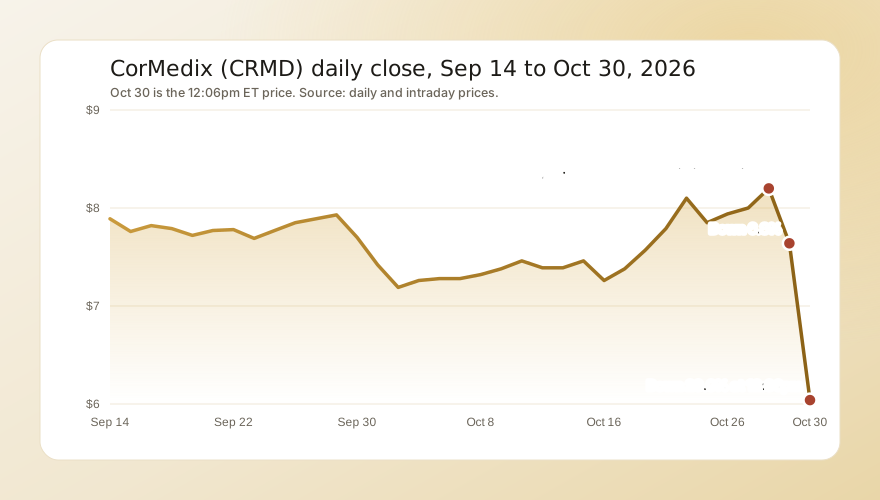
Oct 30, 2026: a second day of selling into a 52-week low
At 12:06pm CorMedix had traded between $6.03 and $7.68. RSI(14) stood at 28, the shares were 23% below their 50-day average of $7.81 and 21% below their 200-day average of $7.67, and they were 54% below the 52-week high of $13.02. Before Oct 29 the stock had been rising: it gained 14% from $7.19 on Oct 2 to $8.20 on Oct 28, helped by the FDA's Oct 19 acceptance for priority review of a new indication for its antifungal REZZAYO, with a decision expected in the first quarter of 2027.
The broader market does not explain the move. Healthcare was not the problem on Oct 30; the selling was in chips and technology, and the Nasdaq 100 fund QQQ was down 3.2%. A 21% one-day fall in a profitable drug company, with no company news, points to a stock-specific reason, and the reimbursement rule is the only one with a date that fits.
What the 2027 dialysis rule says about DefenCath
Medicare pays dialysis clinics a single bundled rate per treatment. A new drug can get TDAPA, a separate payment for two years, before it is folded into the bundle. DefenCath's TDAPA period began on July 1, 2024 and ended on June 30, 2026. Since then Medicare has paid a post-TDAPA add-on instead, a per-treatment amount calculated from the drug's sales price and use, for three years.
The final rule, CMS-1846-F, sets three things that matter to CorMedix:
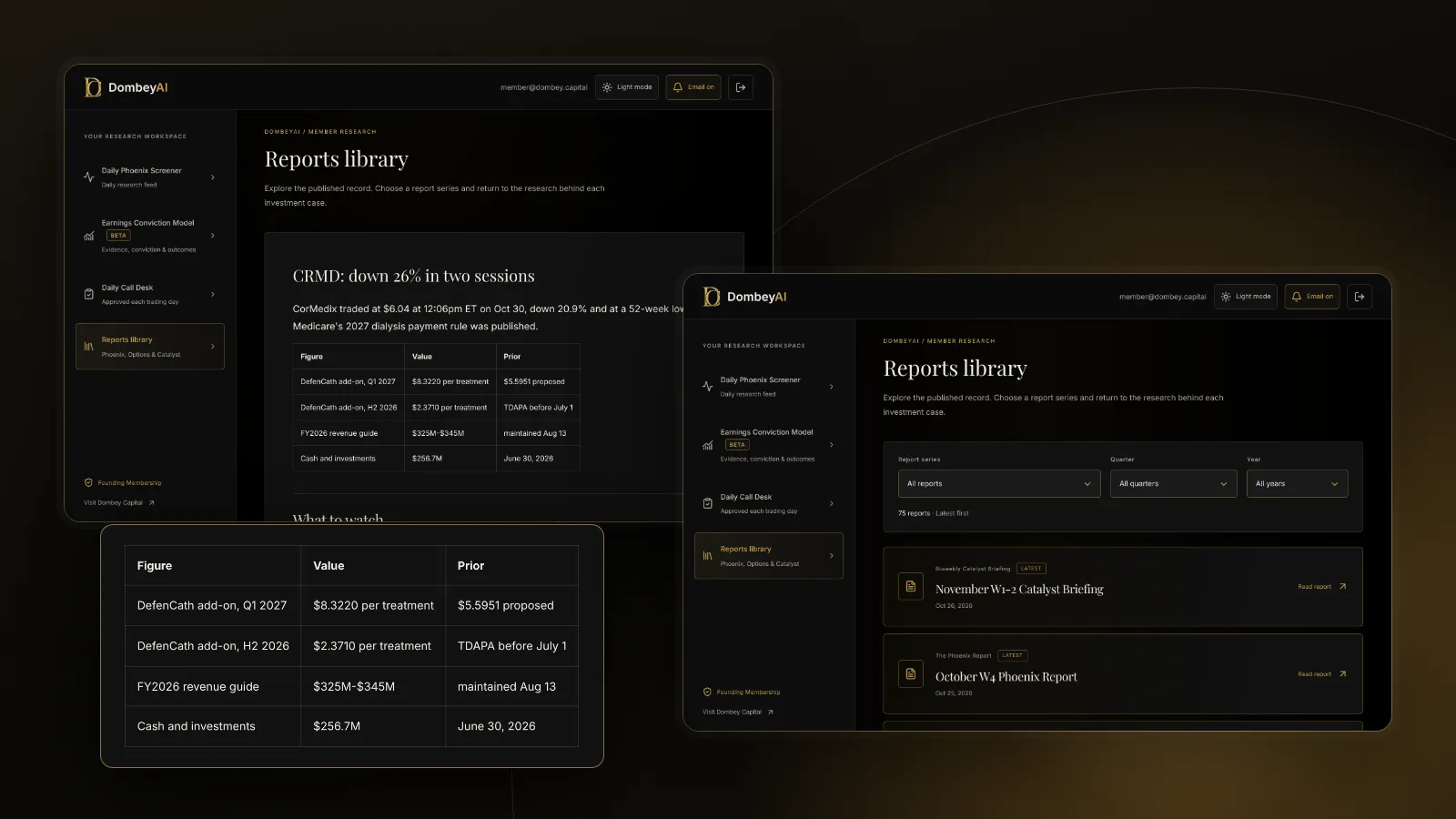
- The 2027 rate. The add-on for DefenCath is $8.3220 per treatment in the first quarter of 2027, and CMS estimates the same amount for every quarter of 2027. The proposed rule in June estimated $5.5951. The rate paid in the third and fourth quarters of 2026 is $2.3710.
- Quarterly updates. CMS finalized its proposal to recalculate the add-on every quarter, using the latest sales price data, instead of once a year. CMS said it made the change after commenters argued that the 2026 amount relied on 2024 data that understated DefenCath's use. Only the first-quarter 2027 amount is final; later quarters can move.
- Payment depends on price reporting. CMS kept its rule that the add-on is paid only while the maker keeps submitting average sales price data.
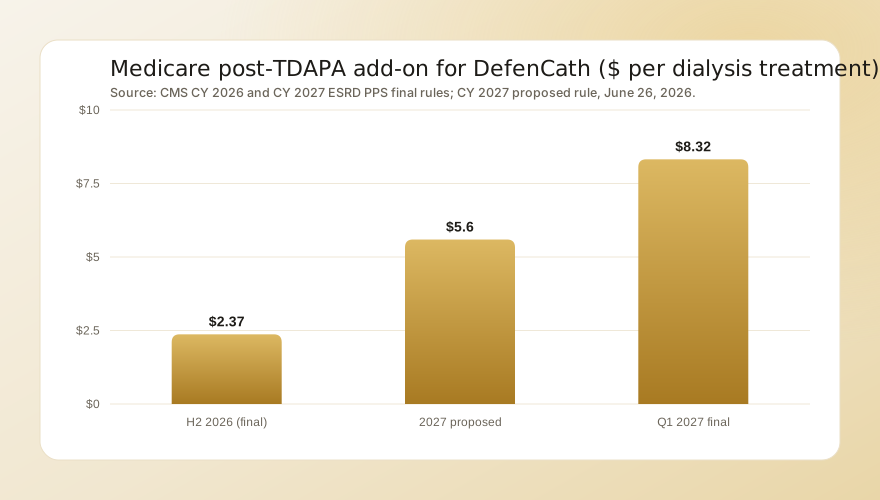
On paper this is the outcome CorMedix asked for. In its second-quarter 10-Q, the company said the July 1 switch "significantly declined" reimbursement to clinics and would lower DefenCath's net pricing in the second half of 2026, and that the 2027 payment "could increase meaningfully above the payment rate for the second half of 2026." The final number is above the proposal. What the rule cannot tell investors is how much DefenCath clinics will buy at that rate, and the quarterly updates mean the rate now moves with price and volume. For how a rule like this works as a catalyst, see regulatory approvals as catalysts and hard vs soft catalysts.
The numbers the third quarter will test
In the second quarter CorMedix reported revenue of $101.9 million, made up of $66.1 million of DefenCath sales and $35.8 million from the Melinta portfolio it bought in August 2025. Net income was $26.0 million and adjusted EBITDA $58.7 million. It kept its 2026 revenue guide at $325 million to $345 million and raised its adjusted EBITDA guide to $125 million to $140 million. It also signed a supply agreement with another large dialysis operator, which it said gives it contracts with all of the top five U.S. dialysis providers, with a pilot starting in the third quarter. The third quarter is the first full quarter at the $2.3710 rate, so lower DefenCath sales are expected; the question is whether they land inside the guide. For a framework on cash and runway in a company like this, see how to estimate cash runway and EV/EBITDA explained.
The risks
CorMedix's revenue depends on a few dialysis chains and on one Medicare payment. If a large customer slows DefenCath use while the add-on is low, the second half of 2026 could miss, and the quarterly method means lower use would also lower the future rate. Unexplained heavy selling is a risk in itself until the company speaks. On the other side, REZZAYO's prophylaxis decision in the first quarter of 2027 is a second catalyst, covered in our primer on FDA decision dates.
What comes next
CorMedix has not confirmed a date for third-quarter results; calendars list Nov 11 and Nov 16. That call is the first chance for management to say what the final rule means for 2027 DefenCath pricing and volume. The rest of today's moves are on the biggest stock moves.