

Oct 27, 2026: a beat and a raise lift the stock off a six-week slide
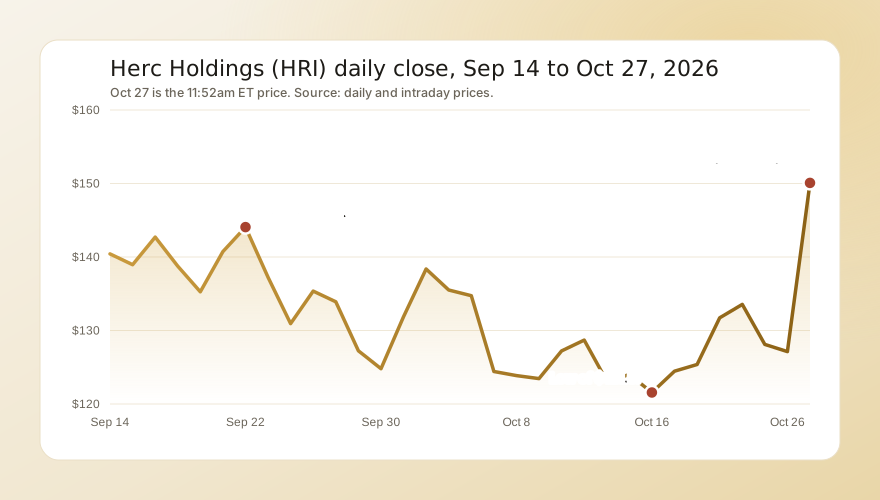
Herc released results before the open and held its call at 8:30am. The stock had closed at $127.13 on Oct 26, the day it announced its chief executive succession, and was down from $144.07 on Sep 22. It opened 9.3% higher at $138.90, slipped to $135.21, then built gains through the morning. At 11:52am it was $150.08, up $22.95, on about 810,000 shares, already 1.2 times its 20-day average for a full day.
What the company reported:
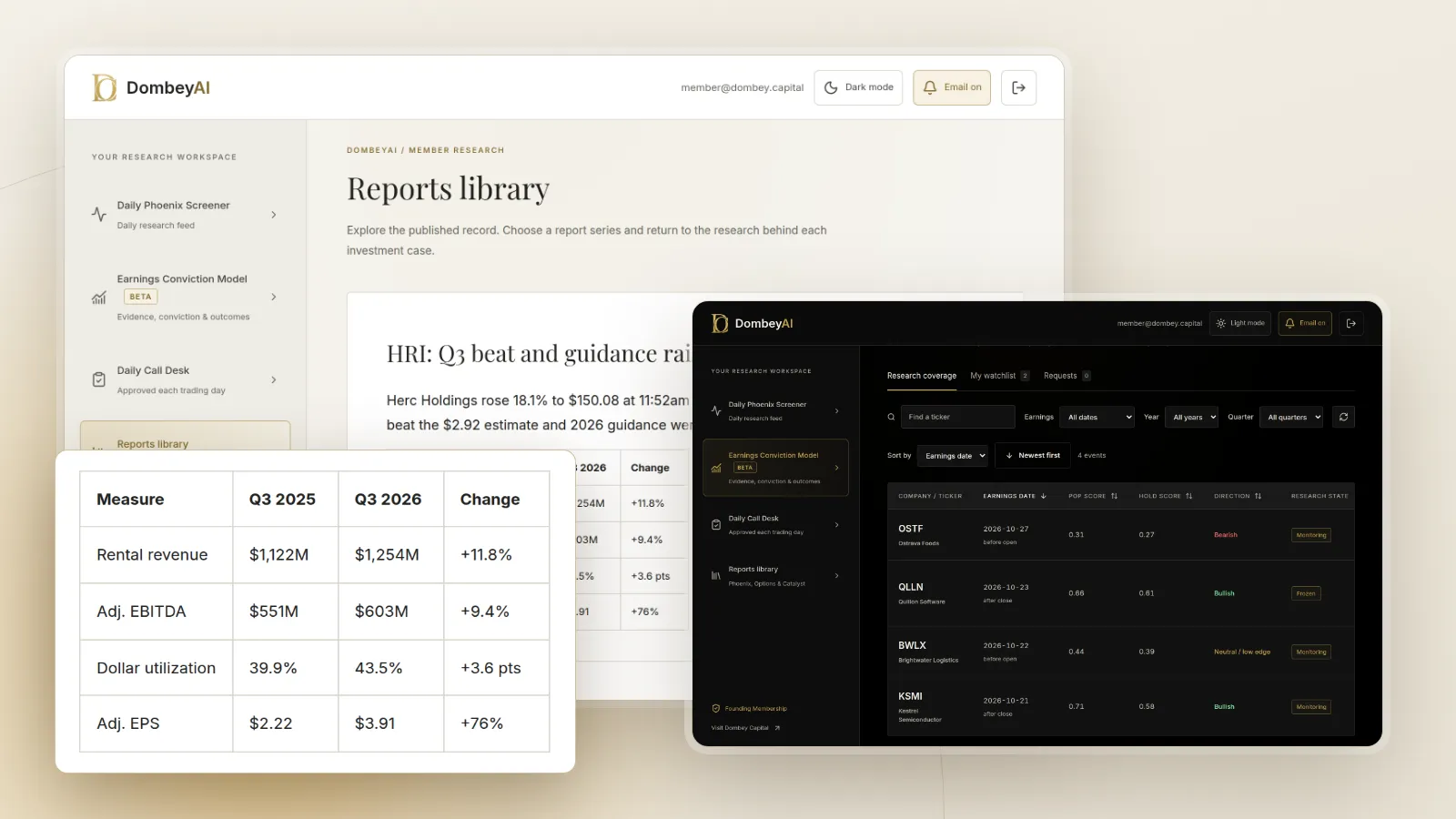
- Earnings. Net income was $104 million, or $3.10 a diluted share, against $30 million, or $0.90, a year earlier. Adjusted net income was $131 million, or $3.91 a share, against $2.22.
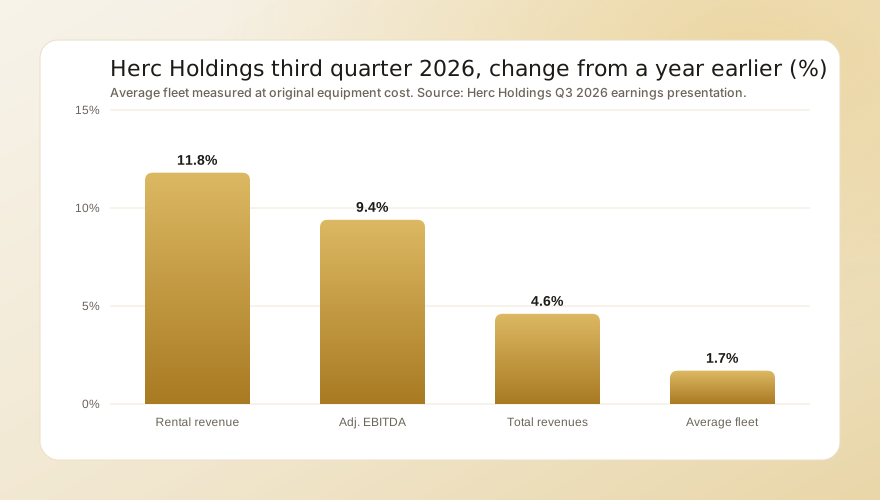
- Revenue. Total revenues rose 5% to $1.364 billion, against an estimate of $1.346 billion. Equipment rental revenue rose 12%. Sales of used equipment fell by $66 million, because Herc sold more fleet a year ago after buying H&E.
- Profit. Adjusted EBITDA rose 9% to $603 million, and the margin rose 1.9 points to 44.2%.
- Guidance. Higher ranges for rental revenue, adjusted EBITDA and capex, as in the table below.
| 2026 outlook | Previous guidance | Updated guidance |
|---|---|---|
| Equipment rental revenue | $4.375B to $4.475B | $4.475B to $4.550B |
| Adjusted EBITDA | $2.05B to $2.125B | $2.10B to $2.15B |
| Net rental capex | $850M to $950M | $1.0B to $1.1B |
| Gross capex | $1.25B to $1.40B | $1.45B to $1.60B |
After the move, RSI(14) stood at 64, the shares sat 8% above their 50-day average of $139.41 and 8% above their 200-day average of $139.01, and they were 20% below the 52-week high. More of the day's big moves are in today's biggest stock moves.
Why the numbers mattered more than the headline revenue
Total revenue grew only 5%, so the reaction rests on the mix underneath it. Chief executive Larry Silber said rental revenue rose 12% "on an average OEC fleet that increased less than 2%, resulting in a 360 basis point improvement in dollar utilization." OEC is the original cost of the equipment. Growing revenue without buying more fleet is the cheapest growth a rental company can get, and it is why adjusted EBITDA margin rose even as costs climbed.
Three drivers stood out:
- Mega projects. Silber said growth in the large-project pipeline "continues to exceed our expectations," across data centers, infrastructure, manufacturing facilities and energy. National accounts were 45% of third-quarter revenue.
- Specialty rentals. The specialty business, which includes power generation, climate control and pumps, grew revenue at a double-digit rate, helped by a branch network 25% larger after the H&E deal.
- The H&E deal. Herc expects $100 million to $120 million of extra revenue in 2026 from cross-selling and broader fleet access after the deal, and $125 million a year of cost savings by year end.
Costs were the soft spot. Direct operating expenses rose to 42.4% of rental revenue from 41.6%, on higher transport and fuel costs and incentive pay, and the margin on the core rental business, which Herc calls REBITDA, fell 0.7 points to 45.2%.
Why the stock had been weak
The shares closed at $180.81 on Feb 11 and fell as low as $88.45 on April 2. After second-quarter results on July 28, the stock fell 7.3% in a day even though earnings beat. By Oct 26 it had dropped 12% from its Sep 22 close. A raised outlook from a company that had disappointed on guidance before is the kind of guidance change that moves a stock, and analysts will now revise estimates for 2026 and 2027.
The bull case
- Utilization can hold. Most of the quarter's gain came from using the same fleet harder, not from one-time items.
- The pipeline is long. Herc's slides show the pipeline of mega-project starts, projects above $250 million, still building into 2027.
- The valuation was low going in. At $150.08 the shares trade at about 21 times the 2026 estimate of $7.10 and 13.7 times 2027; see our page on forward and trailing P/E.
- Leverage should fall as EBITDA grows. Guidance of $2.10 billion to $2.15 billion of adjusted EBITDA compares with $1.8 billion in 2025.
The risks
- Debt. Net debt of $8.0 billion and leverage of 3.90 times leave little room if demand cools. Interest expense was $126 million in the quarter.
- Cash. Free cash flow guidance stayed at $250 million to $350 million because capex went up.
- Costs. Fuel and transport costs are expected to stay high through the rest of 2026.
- Leadership change. Aaron Birnbaum, now president, takes over as chief executive on Jan. 1, 2027, with Silber moving to executive chairman. He has been chief operating officer since 2020, so this is continuity, but the first outlook under a new chief executive is a risk.
- Local demand. Herc called local markets "stable," with commercial demand moderating.
What comes next
- The dividend. Herc pays $0.70 a quarter; last year's December dividend was declared on Dec 5.
- United Rentals and other peers' updates on large-project demand before year end.
- Fourth-quarter results and a 2027 outlook, expected mid-February. Watch net leverage, free cash flow and whether dollar utilization stays above last year's level. Our guide on how to read an earnings release covers what to check first.