

How estimates and the consensus work
Sell-side analysts publish forecasts for the companies they cover: earnings per share, revenue and often margins and cash flow, for the next quarters and years. The consensus is the average or median of those forecasts. It is what a result is measured against when a company "beats" or "misses."
Estimates change for three main reasons:
- The company says something new, through results, guidance changes, a pre-announcement or comments at a conference.
- The world changes, through currency moves, input costs, interest rates or demand data.
- Peers report, and their results or comments imply something about the company.
Regulation FD, adopted by the SEC in 2000, stopped companies from telling analysts material information privately, so most revisions follow public disclosures. The skill is in how analysts translate that information into a forecast, and how quickly they do it.
Why revisions move share prices
A stock's value depends on the earnings and cash flows investors expect. If the expected earnings rise, the value rises, even at an unchanged multiple. A forecast cut from $2.00 to $1.80 a share takes 10% off the value at the same forward P/E, before any change in sentiment.
Revisions also tend to move in runs. Analysts rarely change a forecast all at once. They adjust after the guidance, again after the results, again after a peer's report and again when management speaks at an industry conference. Each step can move the price a little, which is why a downward trend in estimates can weigh on a stock for weeks.
Academic work on post-earnings-announcement drift, going back to studies by Ray Ball and Philip Brown in the 1960s and Victor Bernard and Jacob Thomas around 1990, found that prices tend to keep moving in the direction of an earnings surprise for some time afterward. One explanation is that analysts and investors update slowly, which is what revision runs look like from the outside.
Reading a revision: size, breadth and horizon
Not every revision carries the same information. Four questions sort them.
| Question | What to look at | Why it matters |
|---|---|---|
| How large? | Percentage change in the consensus over 30 or 90 days | Small drifts are noise; large moves change value |
| How broad? | Number of analysts revising up versus down | Shared revisions suggest shared information |
| Which period? | Current quarter, current year, next year | Next year's estimates drive most valuation |
| Why? | The note, the call, the guidance | Revisions tied to new facts carry more weight |
A useful check is whether the revisions follow information or follow the share price. Analysts sometimes raise estimates after a stock has already risen, partly to justify a higher target. Revisions that come right after a filing or a guidance change are more informative than those that trail a price move.
A worked example
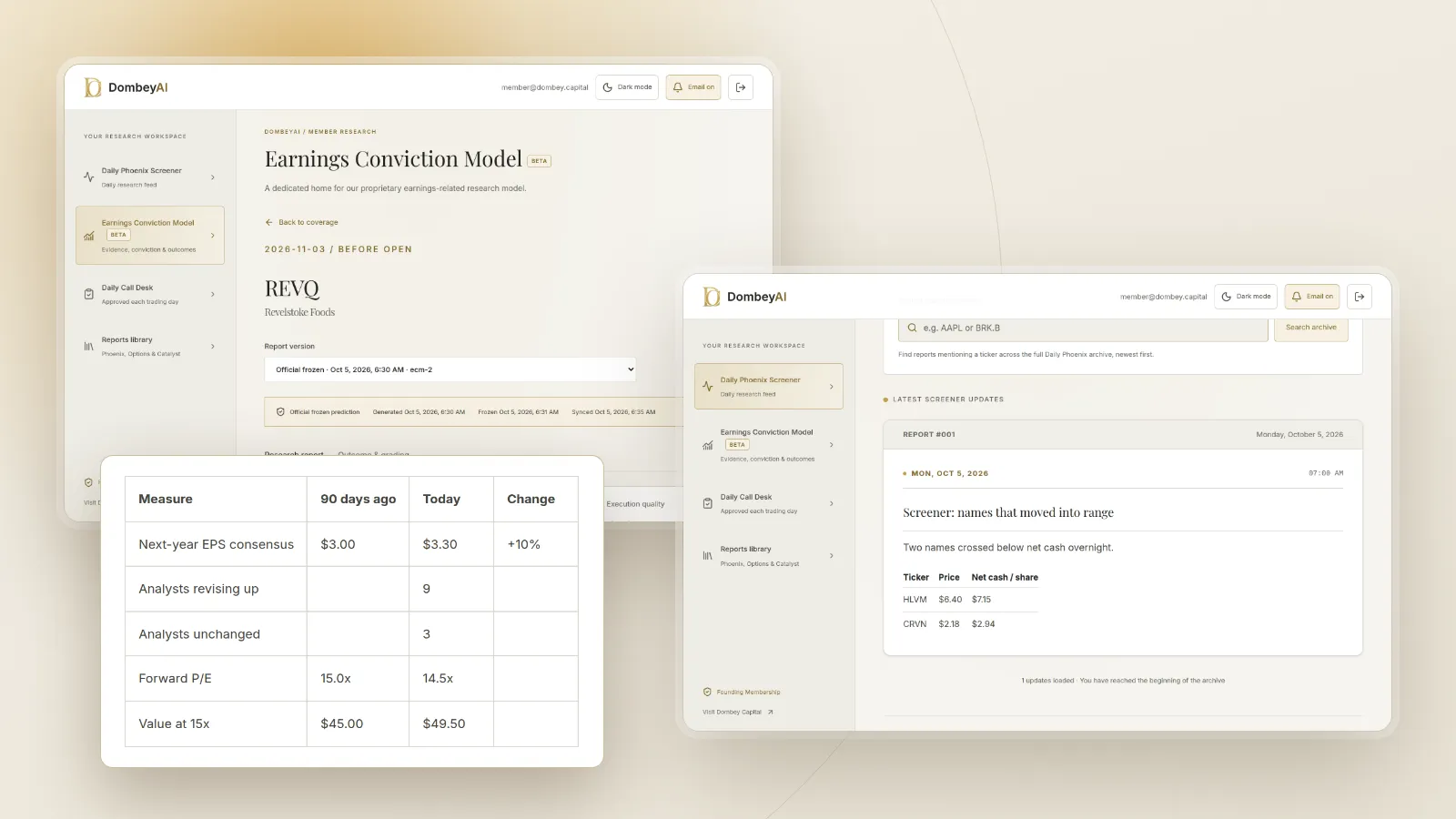
The example shows the double effect. Rising estimates lifted the value, and they also raised the hurdle for the next result. A company that reports exactly what it guided can disappoint if analysts went further than the guidance.
Revisions and the earnings bar
Before a report, the consensus is the public bar. Many investors also watch the direction of revisions in the weeks before, because they hint at where the informal expectation sits. Three patterns are common:
- If estimates have been cut steadily into a report, the bar is low, and a result in line with the reduced numbers can lift the stock.
- If estimates have been raised steadily, the bar is high, and an in-line result can disappoint.
- If estimates are flat but the stock has moved sharply, the market's expectation may differ from the published consensus.
That gap between the published consensus and what the market really expects is where variant perception lives. Our guide to preparing for an earnings catalyst covers the checklist for the days before a report, and how to analyze an earnings call transcript covers where analysts find the changes that drive their revisions. Our market coverage follows large moves after reports, many of which reflect a change in what analysts expect next.
Using revisions in event-driven research
Revisions are a soft catalyst: they have no fixed date, and their effect depends on how the market reads them. They become useful when tied to a dated event:
- Before a report, the trend in revisions shows where the bar is.
- After a report, the size of the revisions shows how much the result changed the outlook, which often explains why a stock keeps moving for days.
- Around a guidance change, the gap between the guidance and the revised consensus shows whether analysts believe it.
- For small companies with one or two analysts, a single revision can move the consensus a long way, so read the note.
A stock catalyst changes what investors expect. Estimate revisions are one of the clearest records of that change.
Revisions in thinly covered companies
Small companies often have one to three analysts, and some have none. That changes how revisions work. A single analyst's change can move the consensus by 20% in a day, and the stock may react to the note itself rather than to the business. When there is no coverage at all, the only public bar is the company's own guidance, and the first analyst to initiate can move the price simply by publishing a number.
The same small, under-followed companies are where small caps misprice events more often, which is part of why event-driven investors watch them.
Where this goes wrong
- One analyst moves the average. In thinly covered companies, a single forecast can swing the consensus. Look at the range, not only the mean.
- Stale estimates. Some analysts update rarely. A consensus that includes old forecasts may lag what most analysts now think.
- Adjusted versus reported figures. Analysts usually forecast adjusted earnings. If the company changes its definition, the revision may be an accounting change, not a business change.
- The move is already priced. By the time the consensus has changed, the price often has too. Revisions explain moves more reliably than they predict them.
- Revisions that chase price. Raises after a rally can reflect target-setting more than new information.
Dombey's published research sets out what the market expects before each catalyst it covers; see the research archive.
The bottom line
Earnings estimate revisions are changes to analysts' profit forecasts, and they move stocks because they change the earnings investors expect. They tend to come in runs, and they set the bar a company must clear on results day. Read them by size, breadth, horizon and cause, and check whether they follow new information or just the share price. Treat them as a record of changing expectations, not a forecast of the next move.