

Oct 16, 2026: a gap up on the beat, then a steady hold
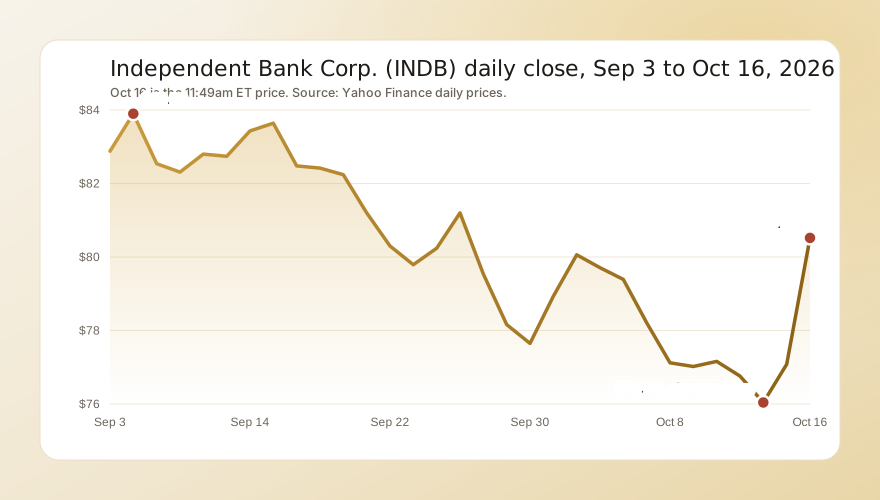
No premarket trades showed in Yahoo's intraday data for the stock, which trades about 390,000 shares a day. It opened near $78.14, up 1.4% from the $77.08 close, and that was the low of the session at $78.06. Buyers pushed it above $80 within 15 minutes. It reached a high of $81.21 around 10:35am, during the 10am conference call, then settled between $80.26 and $81.02 for the rest of the morning.
After the gain, RSI stood at 55, the shares sat 1.2% below their 50-day average and 0.4% above their 200-day average, volume by late morning was about 0.4 times its 20-day full-session average, and the price was 7.9% below the 52-week high of $87.50, according to Yahoo Finance daily prices.
What pushed it up:
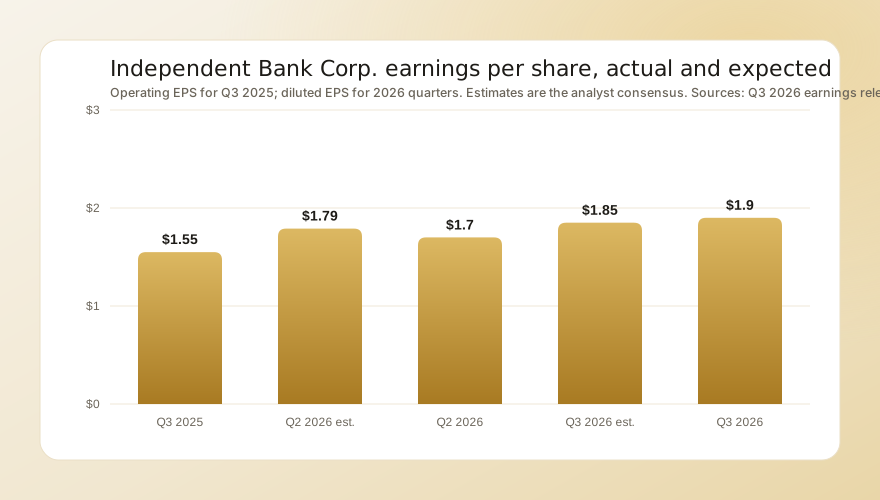
- A clean beat after a miss. EPS of $1.90 topped the $1.85 consensus. In July, second-quarter EPS of $1.70 had missed a $1.79 estimate, per Financial Modeling Prep.
- Better returns. Return on average assets rose to 1.42% from 1.34%, and return on average tangible common equity rose to 15.43% from 14.05%.
- Lower costs. Noninterest expense fell 1.3% to $138.4 million, and the efficiency ratio improved to 52.84% from 55.37%.
- Buybacks. The company bought about 679,000 shares for $57.4 million at an average of $84.60, about 5% above where the stock traded on Oct 16.
How the sector did at the same time, using Yahoo Finance prices near 11:49am ET:
| Ticker | Company | Change on Oct 16 |
|---|---|---|
| INDB | Independent Bank Corp. | +4.5% |
| CAC | Camden National | +1.2% |
| EBC | Eastern Bankshares | +1.1% |
| WASH | Washington Trust Bancorp | +1.0% |
| NBTB | NBT Bancorp | +0.9% |
| BBT | Beacon Financial | +0.6% |
| KRE | Regional bank ETF | +0.7% |
The gap is about 3.8 percentage points over the ETF, so this was not a sector day. The decline before it was. From its Sep 4 close of $83.90 to its Oct 14 close of $76.04, the stock fell 9.4%, while KRE fell 8.9% over the same dates. The beat gave holders a company reason to reverse part of a sector slide.
The numbers
| Measure | Q3 2025 | Q2 2026 | Q3 2026 |
|---|---|---|---|
| Diluted EPS | $0.69 | $1.70 | $1.90 |
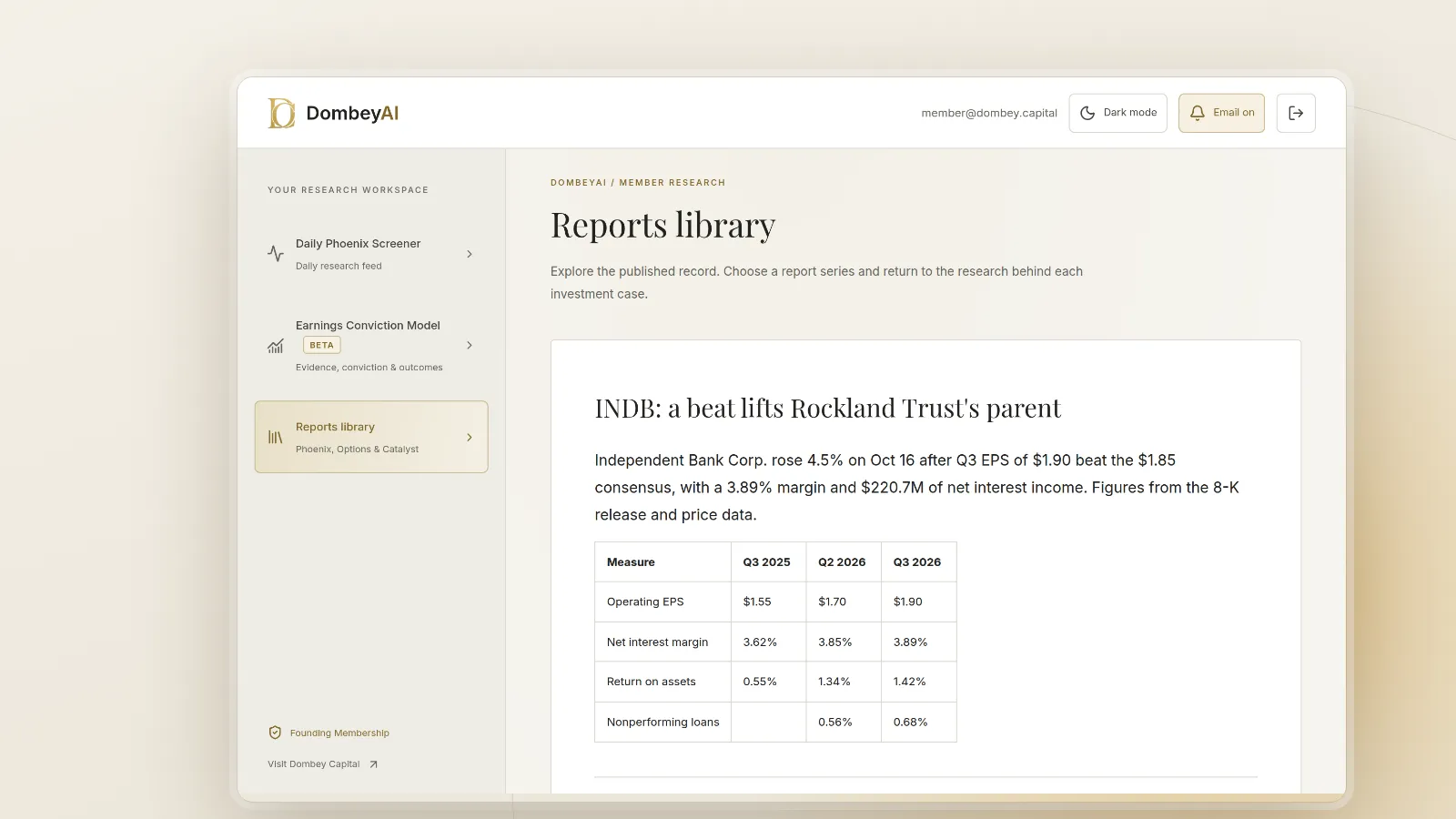
| Operating EPS | $1.55 | $1.70 | $1.90 |
| Net interest margin | 3.62% | 3.85% | 3.89% |
| Return on assets | 0.55% | 1.34% | 1.42% |
| Efficiency ratio | 65.99% | 55.37% | 52.84% |

The year-ago diluted figure was cut by $23.9 million of merger expense and a $38.5 million credit provision, so operating EPS is the cleaner comparison.
The margin gain came from the asset side. The total loan yield rose 11 basis points to 5.80%, while the cost of deposits rose 6 basis points to 1.42%. Net interest income rose $9.7 million from the second quarter, which did most of the work. Noninterest income fell 2.6% to $41.3 million.
The balance sheet grew slowly. Loans rose 0.9% to $18.6 billion and deposits rose 0.7% to $20.5 billion. The mix moved: construction loans rose 7.9%, home equity rose 3.0%, and commercial real estate loans fell 1.1% as paydowns outran new lending. Core deposits rose 1.4% and made up 84.6% of the total.
Revenue of $261.9 million beat estimates by less than 1%, and StockStory called the quarter softer than the headline because the revenue and net interest income beats were narrow.
The case for the stock
- Returns are moving up. A 1.42% return on assets is the best of the three quarters shown, and the 52.84% efficiency ratio is the lowest.
- Credit losses are still small. Net charge-offs were $1.2 million, or 0.02% of average loans annualized.
- The valuation is modest. FinViz shows a forward P/E of 9.8 and a price to book of 1.1. On the $47.89 tangible book value per share in the release, the stock trades at about 1.7 times. Our explainer on tangible book value shows why banks are usually valued this way.
- Capital is being returned. The common equity tier 1 ratio was an estimated 12.69%, about $93 million remains on the $200 million buyback plan, and the dividend is $0.64 a quarter, a yield near 3.2%. For when repurchases actually move a stock, see buybacks as catalysts.
- Analysts see more room. FMP shows a price target consensus of $96, and MarketBeat's average target is $91.86, with six Buy or Strong Buy ratings and one Sell.
The risks
- Bad loans rose. Nonperforming loans rose $22.1 million to $125.7 million, or 0.68% of loans, from 0.56%. Commercial real estate accounted for $20.8 million of the increase, and the company tied most of it to one office loan. Charge-offs are low today, but a second office loan going bad would change the picture quickly.
- Book value fell. Tangible book value per share slipped $0.45 to $47.89, and the CET1 ratio eased from 12.81%. Buying back stock at $84.60, above today's price, used capital at more than 1.7 times tangible book.
- The margin has little room. The loan yield rose more than deposit costs this quarter. If deposit costs keep climbing and loan yields flatten, the 3.89% margin will not hold.
- A system change is coming. The release describes an upcoming core system conversion that cost $2.2 million in the third quarter and $2.1 million in the second. It gives no date. Conversions can raise costs and disrupt customers for a quarter or two.
- The beat was narrow. Five cents above consensus is a modest margin, and the stock is still below its 50-day average.
What comes next
- Fourth-quarter results, listed for January 28, 2027. Consensus is $1.95 per share, per Financial Modeling Prep. Watch nonperforming loans, the margin and tangible book value. Our guide to preparing for an earnings report covers what to check on the day.
- The office loan. A sale, payoff or charge-off of the loan behind the increase would show up in the fourth-quarter credit figures.
- The core system conversion date. The company has not given one. A date and a cost estimate would remove one source of doubt.
- The pace of buybacks. With about $93 million left on the plan, the share count in the next release will show whether the company kept buying below $84.60. Our piece on price to book explains why that matters for a bank.
- The regional bank sector. KRE fell with the stock from early September. A further sector selloff could erase the day's gain whatever the company reports.