

Nov 4, 2026: the pricing fix shows up
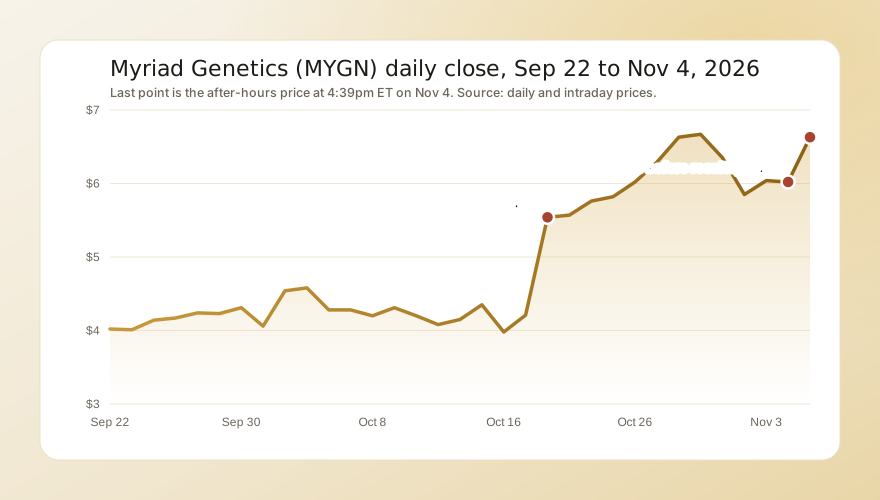
Myriad opened at $6.09 on Nov 4, traded between $5.90 and $6.20 and closed at $6.02, down 0.3% on about 2.1 million shares, while the SPDR S&P Biotech fund rose 2.7%. It released results at 4:05pm ET and hosted a call at 4:30pm. The first after-hours trades came at $6.59 to $6.60 at 4:06pm. The stock reached $6.85, up 13.8%, at 4:25pm during the call, and was $6.63, up 10.2%, at 4:39pm.
What moved the stock:
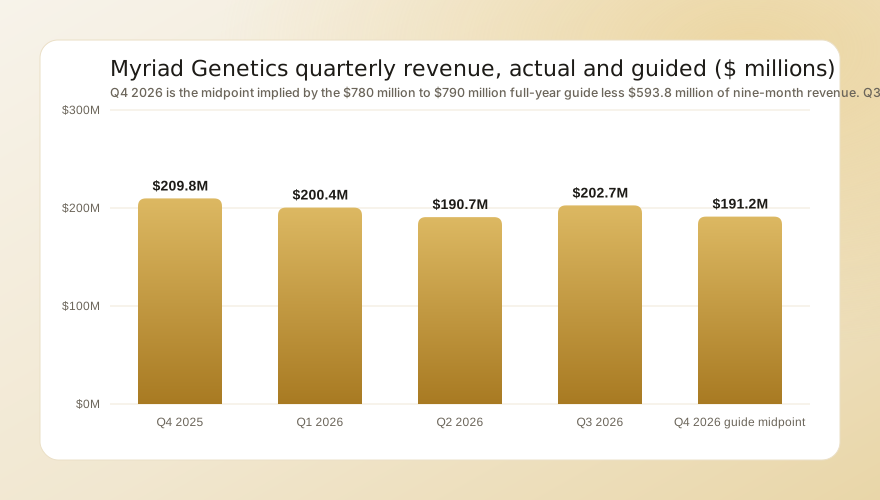
- Revenue beat by about $11 million. Revenue of $202.7 million was down 1% from a year earlier but well above the roughly $191.3 million consensus, which had assumed a decline of about 7%. In the second quarter Myriad had missed the revenue consensus by about $15 million.
- Pricing turned up. Average revenue per test rose 1% from a year earlier and 7% from the second quarter. Chief executive Sam Raha said the gain "reflects our team's ongoing work and early progress with payer engagement and revenue cycle management initiatives." In hereditary cancer, revenue per test rose 9% from the second quarter and volume rose 6% from a year earlier.
- The guide went up, a little. The revenue range moved to $780 million to $790 million from $770 million to $790 million. Raha said the company raised the midpoint "modestly," balancing a strong quarter against the timing of the prenatal sale.
- The loss was smaller than feared. The adjusted loss of $0.11 a share compared with a consensus loss of about $0.20. StockStory, which reported the stock up 10.7% just after the release, said the new revenue midpoint of $785 million was 0.9% above the analyst consensus.
After the regular session, RSI(14) stood at 63, the shares sat 37.4% above their 50-day average and 30.6% above their 200-day average, volume ran 0.7 times its 20-day average, and the stock was 25.6% below its 52-week high. The rest of the session's movers are in today's biggest stock moves.
The numbers
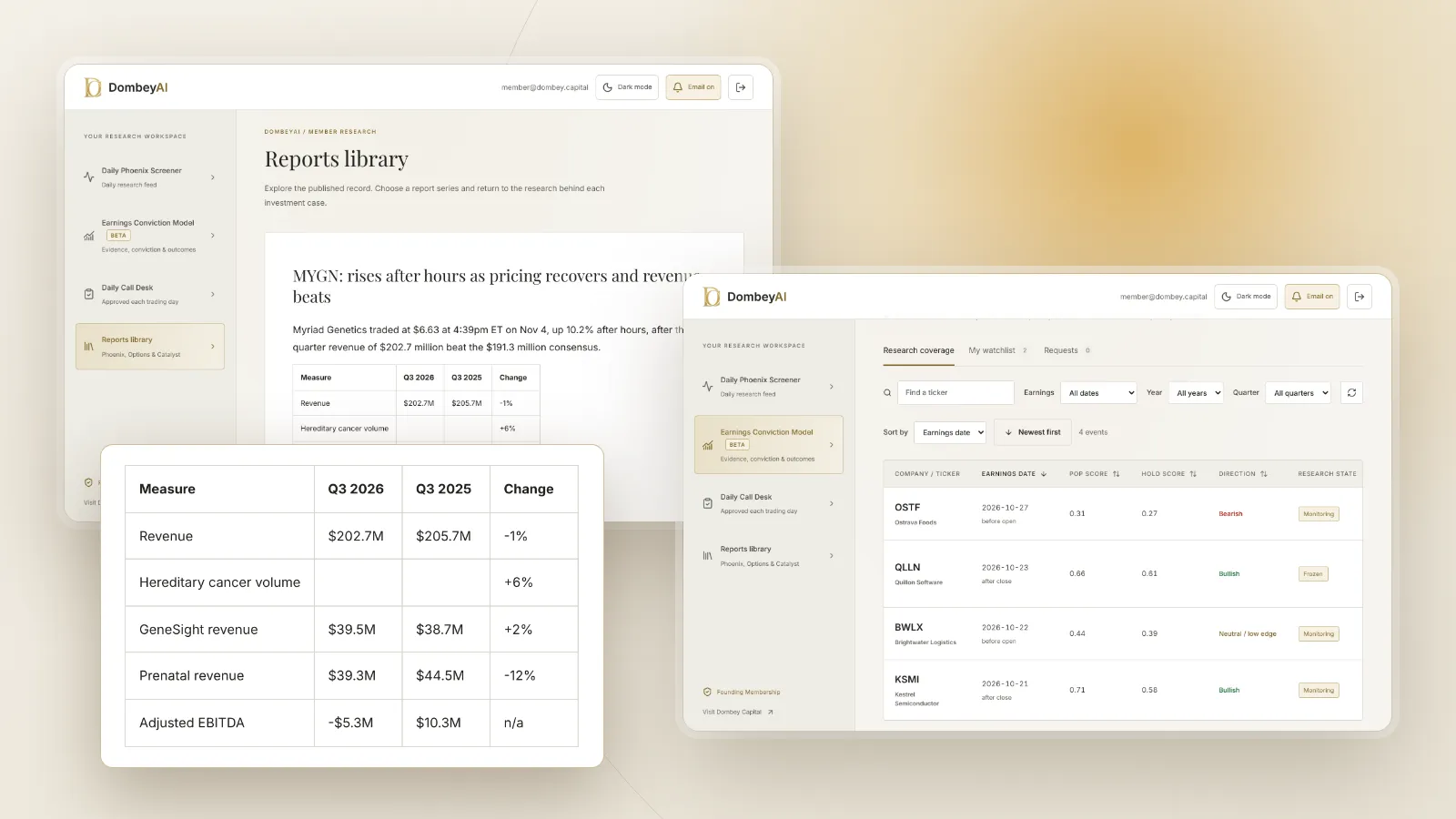
| Measure | Q3 2026 | Q3 2025 | Change |
|---|---|---|---|
| Total revenue | $202.7 million | $205.7 million | -1% |
| Cancer Care Continuum | $123.9 million | $122.5 million | +1% |
| Mental Health (GeneSight) | $39.5 million | $38.7 million | +2% |
| Prenatal Health | $39.3 million | $44.5 million | -12% |
| Adjusted gross margin | 68.2% | 70.1% | -1.9 points |
| Adjusted EBITDA | -$5.3 million | $10.3 million | n/a |
Total test volume fell 2% to 377,000, as prenatal volume dropped 11% and cancer care and mental health volume rose 3% to 239,000. GeneSight volume grew 3% while its revenue per test slipped 1%. Adjusted operating expenses rose to $149.9 million from $140.0 million, with sales and marketing up to $83.9 million from $71.0 million, while research and development and general and administrative costs both fell. Myriad booked $12.2 million of strategic realignment costs in operating expenses, mostly severance and consulting fees. The GAAP net loss was $43.9 million, or $0.46 a share, against $27.4 million, or $0.29, a year earlier. Adjusted free cash flow was $1.6 million, and cash ended the quarter at $107.1 million, with $121.1 million of long-term debt. Our guide on how to read an earnings release covers how to separate adjusted figures like these from GAAP results.
The bull case
The July report was a pricing shock. Second-quarter revenue fell 11% to $190.7 million against about $206.0 million expected, hereditary cancer revenue fell 13% even as volume rose 8%, and the company cut its revenue guide and suspended adjusted EBITDA guidance. The stock fell 46.7% on Jul 31. This quarter, hereditary cancer revenue was close to flat on 6% more tests, so the gap between volume and revenue narrowed sharply.
The prenatal sale is the second support. Labcorp agreed on Oct 19 to pay $210 million in cash plus inventory for a unit whose revenue fell 14% over nine months. TD Cowen said the price was "likely well ahead" of what Myriad investors expected, MedTech Dive reported. Labcorp owes Myriad a $10.5 million fee if the deal fails on certain regulatory grounds. Once it closes, Myriad keeps the growing cancer and mental health tests and gets cash worth more than a third of its market value. Our explainer on asset sales and divestitures covers why a sale like this can reset how the market values what remains, and our guide to a sum-of-the-parts valuation shows how to weigh the pieces.
The risks
The fourth-quarter guide is the obvious gap. Nine-month revenue was $593.8 million, so the $780 million to $790 million range implies $186.2 million to $196.2 million for the last quarter, below the $202.7 million just reported and under the $209.8 million of the fourth quarter of 2025. Either the guide is conservative or pricing gains are not yet secure. Our page on guidance changes explains why the market often reads the implied quarter more closely than the headline range.
Profit and cash are also weaker. The adjusted gross margin fell 1.9 points as lower volume and lab hiring raised costs, and adjusted EBITDA swung to a loss. Cash fell by $42.5 million in nine months, and the prenatal proceeds do not arrive until the deal closes, expected by early 2027 and subject to antitrust and state approvals. The stock has more than doubled from its $2.86 close on Jul 31 and trades well above the average analyst target of $4.82, so further gains likely need earnings estimate revisions to follow. Medicare coverage for its Precise MRD test in breast cancer is still pending, and Myriad gave no date.
What comes next
Management speaks at the UBS Global Healthcare Conference on Nov 10, the Stephens Investment Conference on Nov 18 and the Piper Sandler Healthcare Conference on Dec 2, and the fourth-quarter report and 2027 outlook are due around late February. Before then, watch for analyst target changes after the call, any filing on regulatory clearance for the Labcorp sale, and whether the stock can close above the $6.85 after-hours high once regular trading resumes; a close above that level would undercut the Bearish case. Our page on post-earnings announcement drift covers why a clear change in a company's key number can keep moving a stock after the first day.