

Oct 26, 2026: a flat premarket, then a steady climb
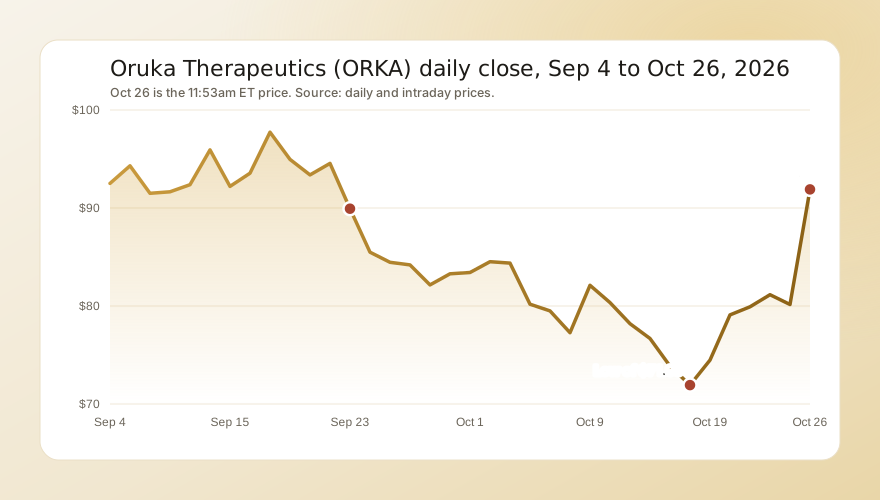
Oruka published the EVERLAST-B results at 7am ET and hosted a call at 8am. The stock traded between $78.55 and $81.87 before the open, close to Friday's $80.15 close. It opened at $81.98, which was also the day's low, and rose through the morning to $91.98 at 11:50am. At 11:53am it was $91.90 on about 0.7 million shares, near its 20-day average for a full day.
What the company reported:
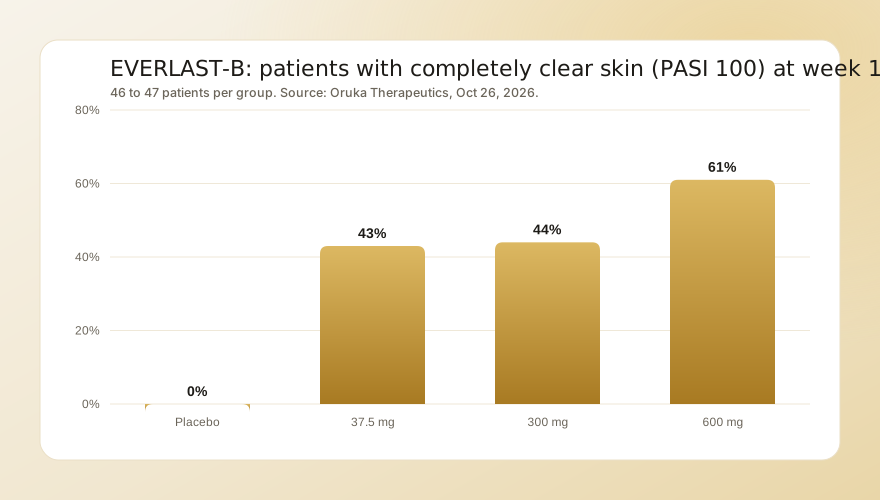
- Efficacy. Response rose with dose. PASI 100 at week 16 was 43% at 37.5 mg, 44% at 300 mg and 61% at 600 mg, against 0% on placebo (p<0.0001). PASI 90 was 70%, 85% and 86%.
- Safety. At least one side effect occurred in 39% of the high-dose group against 43% on placebo. The only side effects in 5% or more of treated patients were upper respiratory infections and headache. No serious side effects occurred in the high-dose group, and none elsewhere were judged related to the drug.
- Plans. Oruka will discuss Phase 3 with regulators and plans to start Phase 3 in the first half of 2027 at 600 mg. It expects 52-week EVERLAST-A results in December 2026 and 52-week EVERLAST-B results in the second half of 2027.
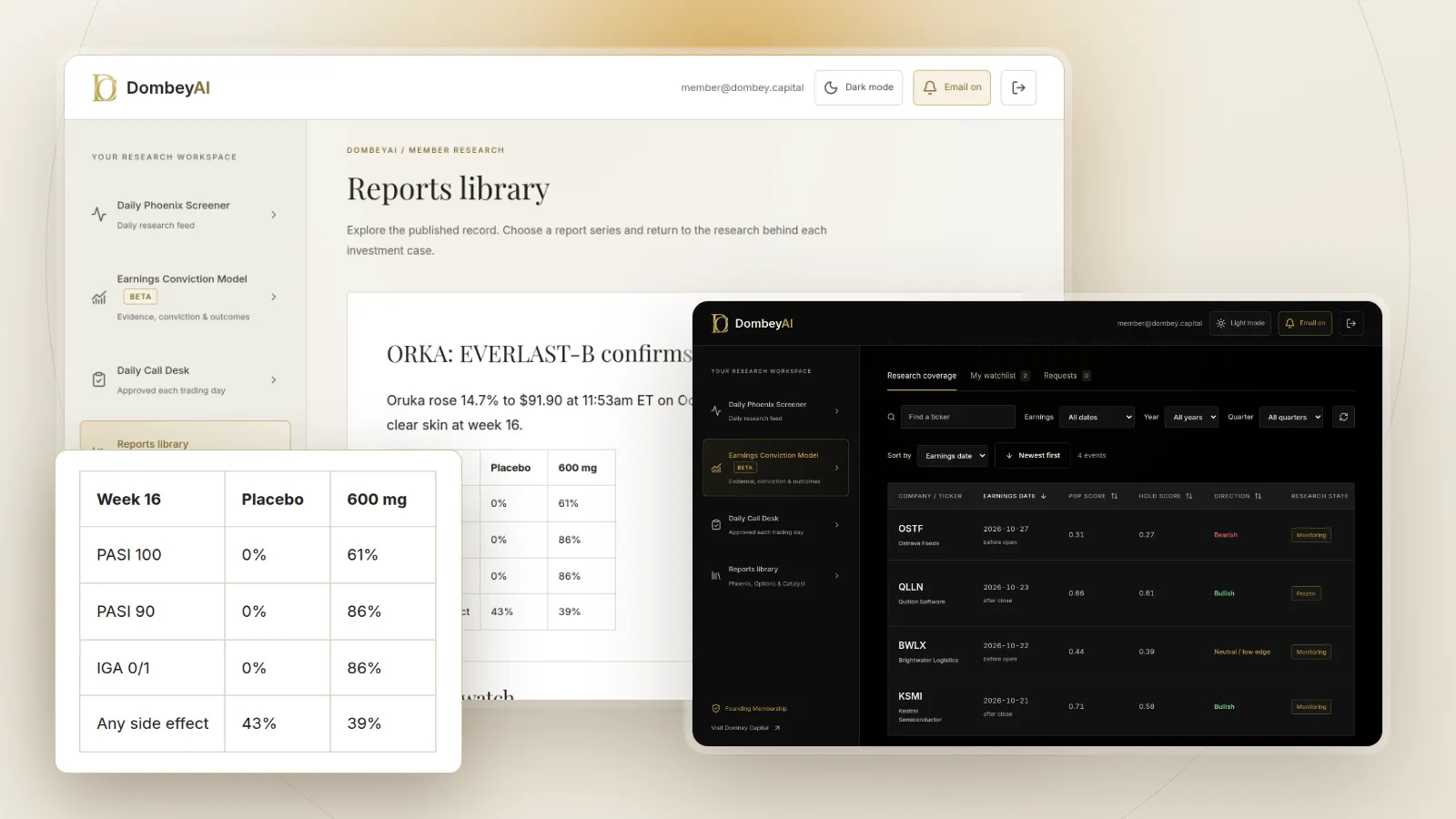
| Week 16 | Placebo | 37.5 mg | 300 mg | 600 mg |
|---|---|---|---|---|
| Patients | 47 | 47 | 47 | 46 |
| PASI 100 | 0% | 43% | 44% | 61% |
| PASI 90 | 0% | 70% | 85% | 86% |
| IGA 0/1 | 0% | 74% | 85% | 86% |
| Any side effect | 43% | 47% | 60% | 39% |
After the move, RSI(14) stood at 62, the shares sat 3% above their 50-day average and 35% above their 200-day average, and they were 20% below their 52-week high of $115.52. More of the day's moves are in today's biggest stock moves, and we covered another dermatology drug developer in why Arcutis stock rose.
Why a second trial matters
The first trial, EVERLAST-A, gave 63% PASI 100 and 83% PASI 90 at 600 mg in 63 patients. A single strong Phase 2 result can come from a lucky patient group. EVERLAST-B used mostly different sites, enrolled 187 patients across the US, Canada and Europe, and landed within a few points. That replication is what the market was paying for: after the week 28 EVERLAST-A update on Sept 23 the stock fell from $97.73 on Sept 17 to $85.49 on Sept 24, and it had slid to $71.93 by Oct 16. Our page on base rates in investing explains why a second independent result changes the odds more than a bigger first one.
The bull case
- Efficacy is consistent. Two trials, two sets of sites, the same answer.
- Dosing could be rare. Oruka is testing one or two doses a year, against every 8 or 12 weeks for Tremfya and Skyrizi.
- Safety is clean so far. More than 100 patient-years of exposure across trials with no new signal, the company said.
- The balance sheet is large. $1.1 billion of cash at June 30 plus $122.5 million raised in July funds Phase 3 starts.
The risks
- Durability is unproven. The December data test whether yearly dosing holds the response.
- Cross-trial comparisons. The 20-point edge over leading IL-23 drugs comes from separate trials with different designs.
- Competition. Psoriasis already has strong injectables and a daily oral IL-23 drug, Icotyde, which Oruka's own slides list as a comparison.
- Dilution. At-the-market sales add shares when the price is high; our explainer on at-the-market offerings covers how they work.
What comes next
- Third-quarter results, expected around November 11. Watch cash and any further at-the-market sales.
- 52-week EVERLAST-A results in December 2026. The key test of yearly dosing. Our guide to sizing a position before a binary event covers how to think about readouts like this.
- Phase 3 start in the first half of 2027, after regulatory discussions.