

Oct 19, 2026: a second target raise in three sessions
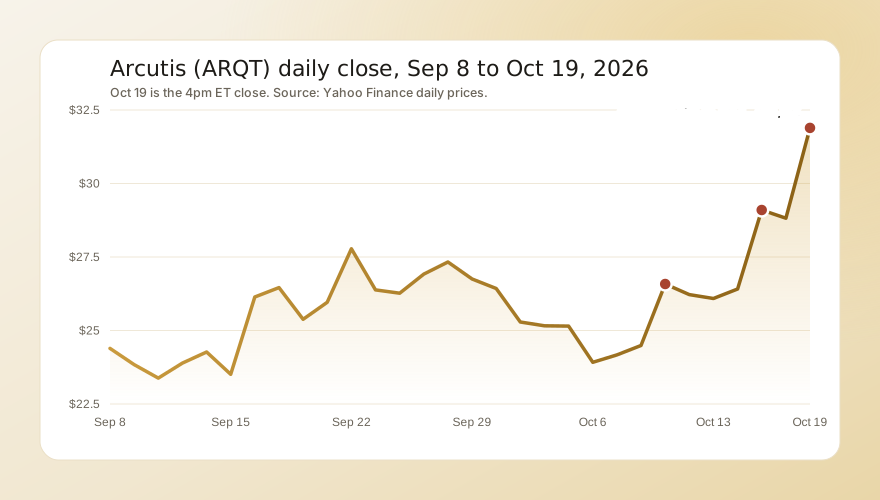
The stock last traded at $29.50 in premarket trading and opened at $29.41, up 2%. It dipped to its low of $28.99 in the first five minutes, then climbed most of the day. It was $31.06 at 11:10am and $32.12 at 11:40am. MarketBeat listed the Guggenheim action in a midday report that had the stock at $31.45, up about 10%, and GuruFocus posted the target change at 1:03pm. The stock reached $33.00 at about 2:30pm, a 52-week high and up 14.5% on the day, then eased in the last hour to close at $31.89.
What pushed it:
- Guggenheim's raise. The move to $44 from $38 is a 15.8% increase in the target.
- Cantor's new coverage. The $48 target from Oct 15 is the highest among recent notes, and its $3.5 billion peak sales figure gave buyers a large number to anchor on.
- Short sellers. About 19.8% of the float is sold short, or 9.5 days of average volume. When a stock with that much short interest rises on news, covering can add to the move. Our explainer on short interest and squeeze risk covers how that works.
An analyst note is a soft catalyst: it changes opinion, not the business. The difference matters for how long a move lasts, as our guide to hard and soft catalysts explains.
Biotech rose too, but by far less. At the close:
| Stock or fund | Change |
|---|---|
| Arcutis (ARQT) | +10.7% |
| Mirum Pharmaceuticals (MIRM) | +2.6% |
| Travere Therapeutics (TVTX) | +1.8% |
| Halozyme (HALO) | +0.5% |
| Incyte (INCY) | +0.2% |
| SPDR S&P Biotech ETF (XBI) | +2.5% |
| iShares Biotechnology ETF (IBB) | +1.0% |
After the gain, RSI(14) stood at 73, the shares sat 24.5% above their 50-day average and 27.1% above their 200-day average, volume of 5.8 million shares ran 2.6 times its 20-day average, and the close was 3.4% below the day's $33.00 high. Our page of today's biggest stock moves covers other names moving on the day.
The run started before the analyst notes. On Oct 9 Arcutis presented Phase 2 data at two dermatology meetings showing rapid disease clearance with Zoryve cream 0.05% in 101 infants aged 3 months to under 2 years, with no serious adverse events, and the stock rose 8.5% that day.
The numbers
| Q2 2025 | Q3 2025 | Q4 2025 | Q1 2026 | Q2 2026 | |
|---|---|---|---|---|---|
| Revenue | $81.5M | $99.2M | $129.5M | $105.4M | $129.9M |
| Net income (loss) | $(15.9)M | $7.4M | $17.4M | $(11.3)M | $15.0M |
| Diluted EPS | $(0.13) | $0.06 | $0.13 | $(0.09) | $0.11 |
Second-quarter revenue of $129.9 million rose 59% from a year earlier and 23% from the first quarter, and beat the $118.9 million analysts expected, MarketBeat reported. EPS of $0.11 compared with about $0.05 to $0.06 expected. By product, Zoryve foam 0.3% brought in $67.4 million, cream 0.3% $35.3 million, cream 0.15% $24.2 million and cream 0.05% $2.9 million. The company credited higher volume and lower gross-to-net deductions.
Costs rose with the sales push. Selling, general and administrative expense was $82.1 million, up from $69.2 million, mostly from the larger dermatology sales force. Arcutis also planned to put a separate primary care and pediatric sales team in the field by the end of August. It had $238.9 million of cash and investments at June 30 and about $109 million of debt.
What Guggenheim is betting on is the next two years of sales.
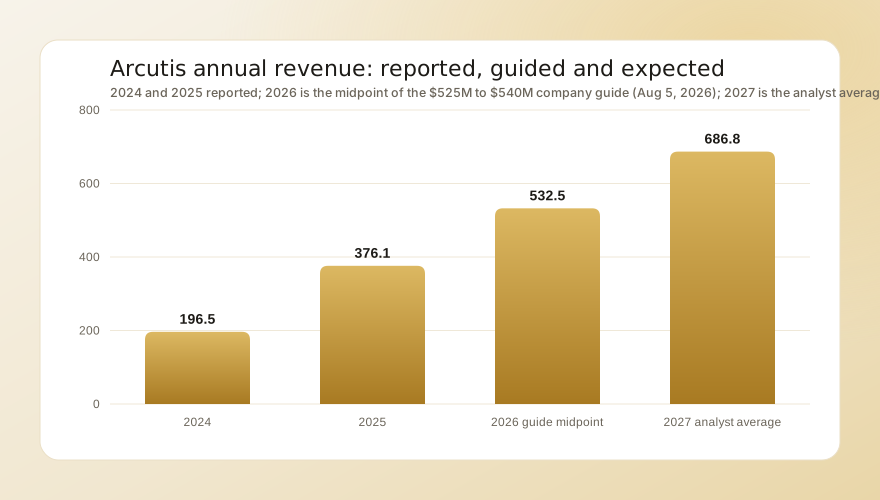
Revenue nearly doubled in 2025 to $376.1 million. The midpoint of the 2026 guide, $532.5 million, implies 42% growth, and the analyst average for 2027 is $686.8 million, about 28% above the 2026 average of $537.8 million. Since the company made $235.3 million in the first half, it needs $289.7 million to $304.7 million in the second half to land inside its range, or roughly $145 million to $152 million a quarter. For why a raised guide can carry a stock for months, see why guidance changes move stocks.
The bull case
- Sales growth is real and recent. Revenue rose 59% in the second quarter and the full-year guide went up $45 million, which is the kind of hard evidence behind the target raises.
- Profit has arrived. Operating income was $16.4 million in the second quarter, against a $14.6 million loss a year earlier. Analysts expect EPS of $1.26 in 2027.
- The valuation is not stretched for the growth. The forward P/E is 24 and the stock trades at 8.6 times trailing sales, with a market value of about $4.0 billion. Our explainer on forward and trailing P/E covers why the forward figure matters more for a company that only recently turned profitable.
- More labels are coming. The FDA approved cream 0.3% for children as young as 2 in June, the company's seventh approval since 2022, and the infant filing would push the cream down to 3 months.
The risks
- One drug. Nearly all revenue is Zoryve, so a pricing or coverage change would hit the whole company.
- Slowing growth, rising costs. Analysts expect growth to slow from 91% in 2025 to about 28% in 2027, while the new sales teams add expense this year. TIKR noted that management expects operating leverage to expand from 2027, after this year's heavy spending.
- The move ran ahead of data. The stock rose 21.6% in five sessions on notes and conference data, and RSI above 70 shows how stretched the short-term run is. Biotech funds rose only 1% to 2.5% on the day.
- Insiders have been selling. MarketBeat counted 79,225 shares sold by insiders in the past three months, worth about $2.0 million, under trading plans.
- Vitiligo is a binary event. The Phase 2 trial of Zoryve foam reads out in the fourth quarter. A miss would not touch current sales but would trim the long-term story behind the higher targets.
What comes next
- Vitiligo Phase 2 results, due in the fourth quarter of 2026. Enrollment is complete, and the company will decide whether to advance the program.
- Third-quarter results. No date had been announced as of Oct 19. The test is whether revenue is on pace for the $525 million to $540 million guide and whether selling costs hold profit above zero. Our guide to preparing for an earnings report covers what to check.
- The FDA decision by February 23, 2027. The agency is reviewing Zoryve cream 0.05% for atopic dermatitis in infants from 3 months old. Our explainer on FDA decision dates covers how these deadlines work.
- More target changes. The consensus is $42.25 with a $38 to $48 range. Watch whether other firms follow Guggenheim and Cantor or hold.
For another biotech that rose on the same day, see why Disc Medicine stock rose.