

Inside view and outside view
The terms come from work by Daniel Kahneman and Dan Lovallo on why planners and executives make overconfident forecasts. The inside view builds a forecast from the specifics of the case: management's plan, the strength of the product, the timeline in the press release. The outside view asks a different question: of all the cases that looked like this one, how did they turn out?
The two often disagree. A turnaround plan can be detailed and plausible while most similar turnarounds fail. A merger can have a strong strategic rationale and still face a regulator that has challenged similar deals.
| Question | Inside view answer | Outside view answer |
|---|---|---|
| Will this deal close? | The parties say it will, and the strategic fit is strong | How often did deals of this type and size, facing this review, close on time? |
| Will this drug be approved? | The trial met its primary endpoint | How often were similar applications approved on the first cycle? |
| Will this company avoid bankruptcy? | Management has a refinancing plan | How often did companies with similar leverage and maturities avoid a filing? |
| Will the spin-off outperform? | The new company has a focused strategy | How did similar spin-offs trade in their first year? |
Why base rates get ignored
Psychologists call the habit base rate neglect. A detailed story about one company is vivid and specific; a frequency across many cases is abstract. Research process makes it worse, because the more time you spend on one company, the more inside-view detail you collect and the less you think about the class it belongs to.
Event-driven investing is especially exposed. Most special situations come with a narrative written by the people who want the event to succeed: the acquirer, the board, the activist. Our explainer on variant perception makes the related point that a view only pays if it differs from the market's for a good reason.
How to build a base rate
- Define the outcome precisely. "The deal closes on the original terms by the outside date" is countable; "the deal goes well" is not.
- Choose the reference class. Pick the features that most affect the outcome: deal type, size, regulator, financing, sector. Our explainer on regulatory approvals as catalysts lists the features that matter for reviews.
- Collect the cases. SEC filings, exchange notices and company announcements are the usual sources. EDGAR full-text search can find past filings of a given form type or containing a given phrase.
- Record outcomes the same way for every case. Decide in advance how to count partial outcomes, such as a deal that closed at a lower price.
- Count and note the sample size. A base rate from eight cases is a rough guide; one from 200 is more stable.
- Check whether the class still applies. Rule changes, new regulators or different market conditions can make older cases a poor guide.
Choosing the reference class
The reference class is the hardest choice. Too broad, and the base rate ignores features that matter: all announced mergers is too wide a group for a deal facing a second request from antitrust regulators. Too narrow, and there are too few cases: mergers in one sub-industry reviewed by one regulator in the past three years might be a handful.
A practical approach is to calculate two or three rates from classes of different widths and see how far they differ. If they are close, the choice does not matter much. If they diverge, the feature that separates them is probably important, and you need to judge which class your case truly belongs to.
Adjusting from the base rate
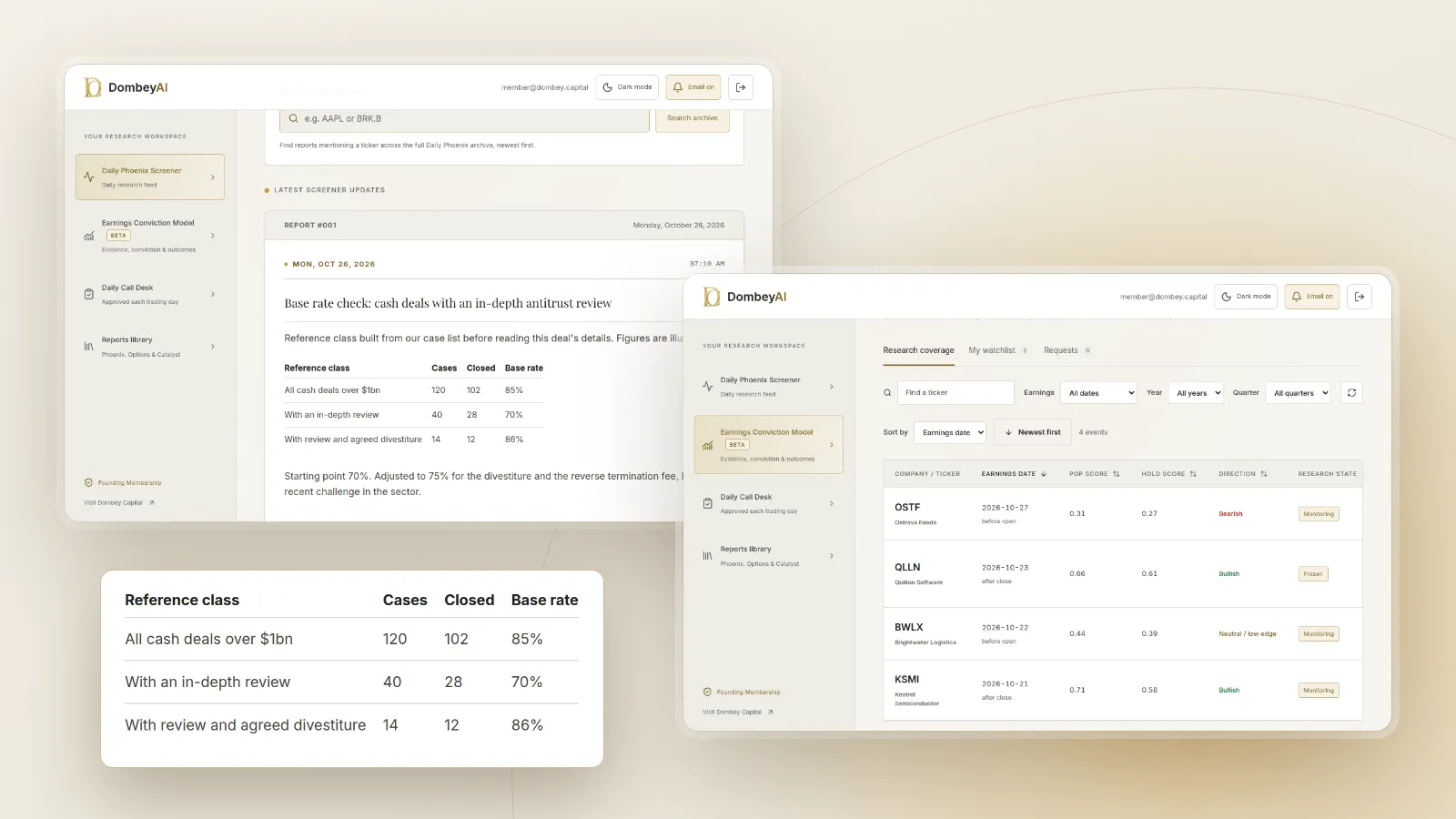
The outside view is a starting point, not a final answer. Move away from the base rate only for evidence that distinguishes this case from the class, and in proportion to how strong that evidence is.
The adjustments in the example are modest. That is typical: specific evidence rarely justifies moving from 70% to 98%, yet that is exactly the jump an inside-view story invites.
The final probability feeds directly into probability-weighted valuation and the base and worst case for the position. For merger situations, our merger arbitrage explainer shows how the probability of completion and the spread fit together.
Where base rates help most
- Merger completion and the time to close.
- Regulatory decisions with a long public record, such as drug approvals and antitrust reviews.
- Distress outcomes, such as how often companies with a going-concern warning file for bankruptcy within a year.
- Corporate actions that recur, such as strategic reviews ending in a sale or tender offers being extended.
- Your own record. How often your own theses of a given type played out. A dated investment thesis makes that count possible.
Many of the platforms in our list of the 12 best stock research tools for individual investors make it quicker to pull the past filings and events that a case list needs.
Where this goes wrong
- The wrong class. A base rate for all deals says little about a hostile bid facing a poison pill.
- Too few cases. A rate from a handful of examples can swing widely with each new case.
- Survivorship. Cases that ended badly are often harder to find, because the company stopped filing or was delisted. A list built from surviving companies overstates good outcomes.
- Changed rules. A new merger review process or listing rule can make older cases a poor guide.
- Treating the rate as a forecast. A 70% base rate does not mean this deal has a 70% chance. It means similar deals closed 70% of the time, before considering anything specific.
- Never adjusting. The outside view is not an excuse to ignore real evidence about the case.
Dombey's published research states the probability behind each event and the reasons for it; see the research archive.
The bottom line
A base rate is how often an outcome happens across similar past cases, and the outside view uses it as the starting point for a forecast. Define the outcome, choose a reference class that captures what drives it, count the cases and check that the class still applies. Then adjust deliberately for evidence that sets this case apart, and write each adjustment down. The habit protects a forecast from the pull of a good story and gives you a record to learn from.