

What you need
- The event date, or a window, and the source that confirms it.
- A price for the stock if the event succeeds and a price if it fails, with your reasoning for each.
- A probability for success, ideally starting from how similar events turned out.
- Your portfolio value and the maximum loss you will accept on one event.
- The option chain, if you plan to use options to limit the loss.
- A place to write the plan down before the event.
Step 1: Confirm the event and its date
Check that the event is real, dated and binary enough to model this way. A PDUFA date, a scheduled court hearing, a shareholder meeting or a statutory review deadline qualifies. Our explainer on FDA decision dates covers how drug review dates are set, and our catalyst calendar guide shows how to track them.
Note what could move the date. A delayed decision is a third outcome that many models leave out.
Step 2: Price both outcomes
Estimate what the stock is worth if the event succeeds and if it fails, using the same method for both. For the failure case, look at what the company is worth without the event: cash, other assets and the remaining business. Our guide on how to build a base and worst case sets out the method.
| Outcome | Price | Change from today | How it was estimated |
|---|---|---|---|
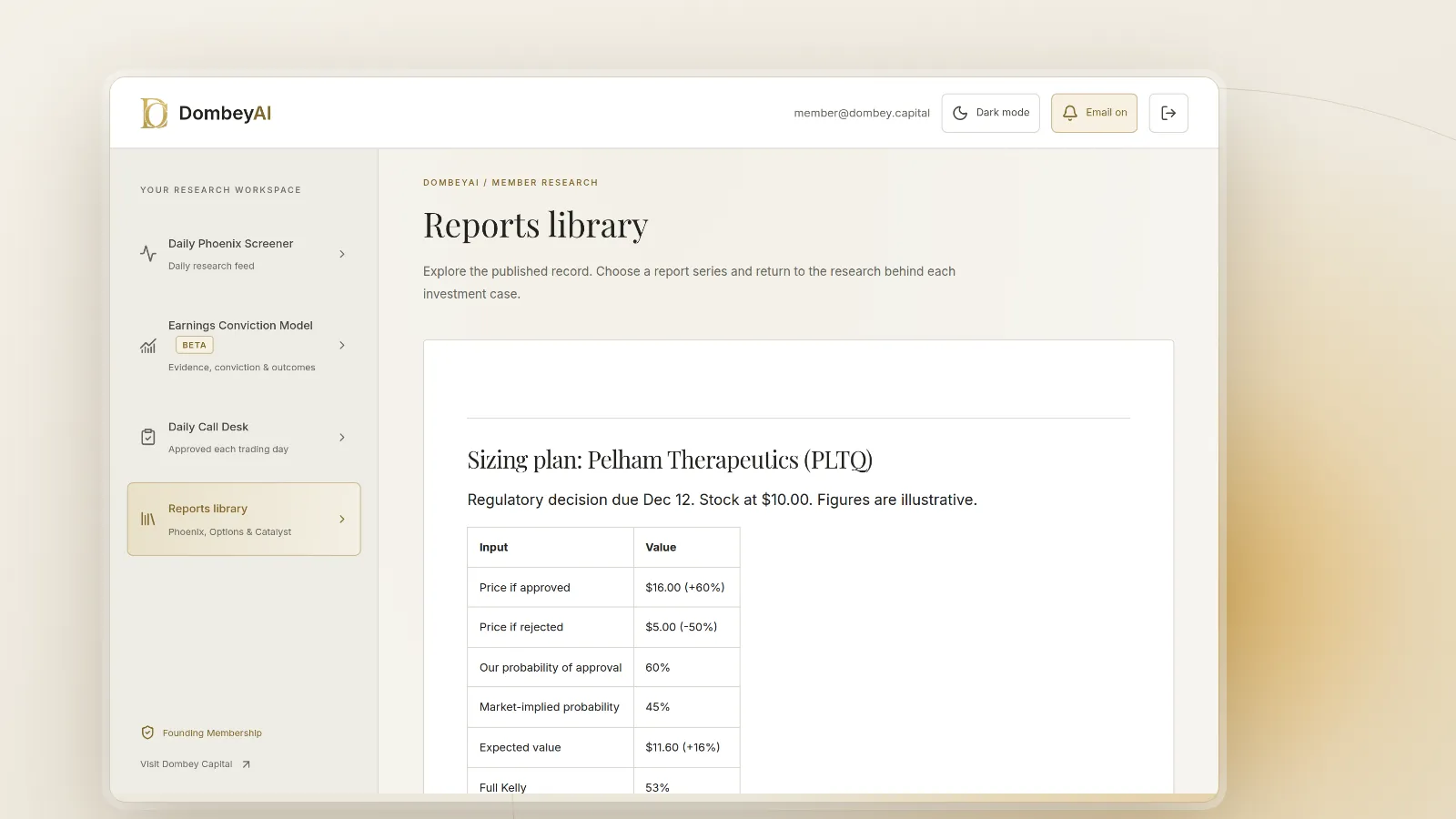
| Success | $16.00 | +60% | Peer multiples on expected sales |
| Failure | $5.00 | -50% | Net cash plus remaining pipeline |
| Today | $10.00 | Market price |
Step 3: Set a probability and check the expected value
Assign a probability to success. Start from how often similar events succeeded, then adjust for evidence specific to this case. Write the reasons down.
With a 60% chance of success, the expected value is 0.6 x $16.00 + 0.4 x $5.00 = $11.60, or 16% above today's price. Our explainer on probability-weighted valuation covers this calculation in more detail.
Then work out the probability the market is implying. At $10.00, the price equals p x $16.00 + (1 - p) x $5.00, so p is about 45%. Your edge is the gap between your 60% and the market's 45%. If you cannot explain why you know more than the market, assume you do not.
Step 4: Set your loss budget
Decide the most you are willing to lose on this one event as a share of the portfolio, before thinking about the upside. Many investors use a figure between 1% and 3% for a single event, but the right number depends on how many such positions you hold and how much a loss would affect you.
Divide the loss budget by the failure-case decline:
| Loss budget | Failure decline | Maximum position |
|---|---|---|
| 1% of portfolio | 50% | 2% of portfolio |
| 2% of portfolio | 50% | 4% of portfolio |
| 3% of portfolio | 50% | 6% of portfolio |
| 2% of portfolio | 80% | 2.5% of portfolio |
The deeper the failure case, the smaller the position for the same loss budget. A stock that could fall 80% deserves a much smaller position than one that could fall 30%.
Step 5: Check against a fraction of Kelly
The Kelly formula gives the size that maximizes long-run growth for a bet with known odds. For a position that gains g if right and loses a if wrong, with probability p of success, the Kelly fraction is p / a - (1 - p) / g.
For Company A, with p = 0.6, g = 0.6 and a = 0.5, Kelly suggests 0.6 / 0.5 - 0.4 / 0.6, or about 53% of the portfolio. That is far too large for most investors, and it shows the problem with full Kelly: it assumes the probability and payoffs are exactly right.
Rerun it with a probability of 50% instead of 60%, and Kelly falls to about 17%. A 10-point error in the probability cut the size by two thirds. That sensitivity is why investors who use Kelly usually take a quarter or a half of it, and treat even that as a ceiling. Here a quarter of the 60% case is about 13%, and the loss budget from Step 4 gives 4%. The smaller figure wins.
Step 6: Decide whether to use options
Options can set the maximum loss in advance, which changes the sizing problem. Buying calls or a call spread limits the loss to the premium paid. Buying a protective put on a stock position sets a floor.
The cost is the catch. Before binary events, implied volatility is often high, because the market expects a large move. Our guide on how to estimate a move from options shows how to read what the options price in. Compare the cost of protection with the loss it removes, and check options liquidity in the strikes you need.
| Approach | Maximum loss | Cost | Main risk |
|---|---|---|---|
| Stock sized to loss budget | Loss budget, if the failure price is right | None beyond the shares | Failure price worse than estimated |
| Stock plus put | Set by the put strike and premium | Put premium | High implied volatility before the event |
| Call spread | Premium paid | Net debit | Event delayed past expiration |
Step 7: Plan for a delay and for each outcome
Write down what you will do in each case before the event:
- If it succeeds: hold, trim or sell at a price you name now.
- If it fails: sell, hold for the remaining value or add, with the reason.
- If it is delayed: decide whether the thesis still holds and whether options positions need rolling.
Deciding in advance keeps the outcome from rewriting your view of the decision. Our guide on how to write a dated investment thesis shows a format.
Step 8: Record the decision and review it later
Record the size, the probabilities, the two prices and the reasons. After the event, compare the result with the plan. A good decision can produce a loss, and a poor one can produce a gain; the record lets you judge the process, not the luck. Dombey's market coverage shows how event setups like these are written up before the outcome.
Common mistakes
- Sizing from confidence. Feeling sure is not a probability. Start from the loss budget.
- Using an optimistic failure price. If the failure case is worse than you assumed, the loss budget is breached. Use the low end of your estimate.
- Relying on stop orders. They do not work across a gap.
- Using full Kelly. It assumes you know the odds exactly. Small errors make it far too large.
- Ignoring correlation. Several positions tied to the same regulator or court can fail together. Add their loss budgets.
- Forgetting the delay case. Options expire, and a delayed decision can leave the stock in limbo for months.
- Adding after the event without a plan. Averaging down after a failure should be a decision you made before it, not a reaction.
The bottom line
Size a position before a binary event from the loss you will accept if it goes wrong. Price both outcomes, estimate the probability, check the expected value, then divide your loss budget by the failure-case decline. Use a fraction of Kelly as a ceiling, not a target, and remember that stops do not protect across a gap. Options can define the loss in advance at a cost. Write the plan down before the event, so you can judge the decision on its merits afterward.