

Oct 26, 2026: a gap down at the open, then a partial recovery
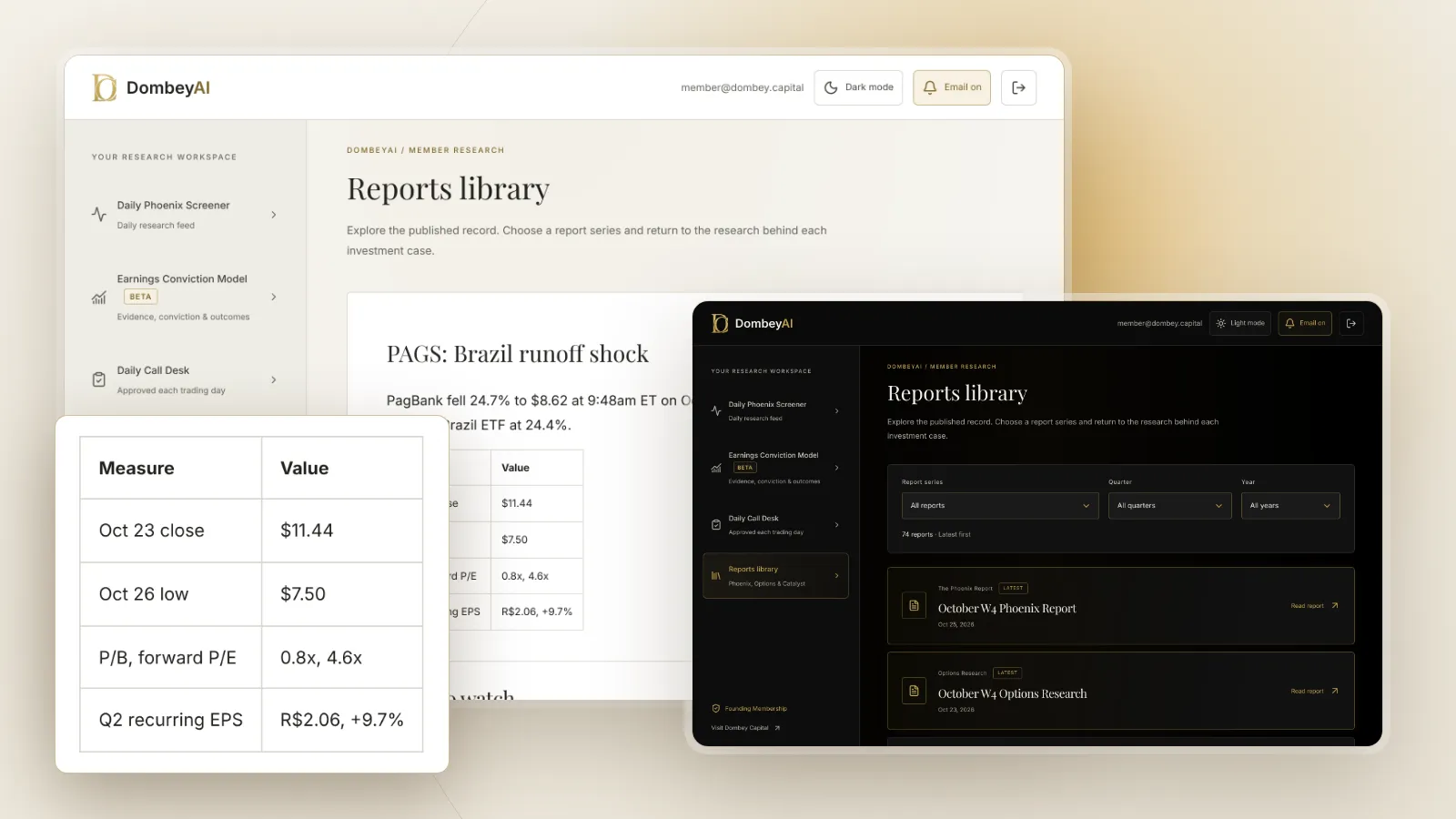
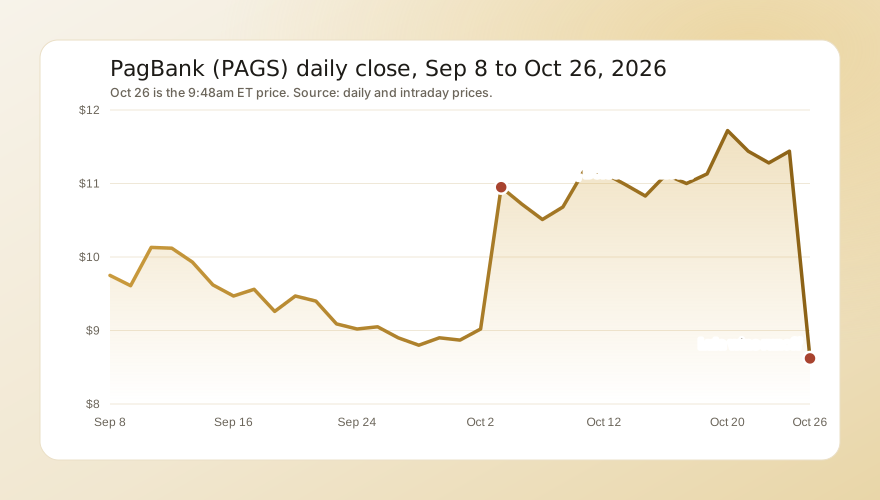
Dollar futures on the real rose about 10% on Sunday evening, and Investing.com reported PagBank at $8.00 before the open, down 30.1%. ZeroHedge had it down 28% in premarket trading. The shares opened at $7.75, 32% below the Friday close, and hit $7.50, below the $8.42 52-week low cited before the open. Buyers stepped in at once: by 9:40am the stock was $8.92, and at 9:48am it was $8.62 on 5.0 million shares, about the size of a full day's average volume (4.8 million over the last 20 sessions).
What pushed it down:
- The surprise. Brazil's electoral court gave Lula about 51.8% of the vote. The Rio Times noted that the market had hoped for a more business-friendly government, and that early repricing in thin trading is often the most extreme.
- The real. Real futures fell about 9% on Sunday night, from a Friday spot rate near R$4.98 to the dollar. A company that earns in reais loses dollar value when the currency drops.
- Rates and debt. Brazil's public debt is 83% of GDP, up from 71.7% when Lula took office in January 2023. Its dollar bonds due 2037 yielded 19 basis points more at 6.44%. A strategist at one bank expects the central bank to raise rates 100 to 150 basis points.
- A challenge to the result. Flávio Bolsonaro said he would seek to annul the runoff. UBS called that unlikely to succeed.
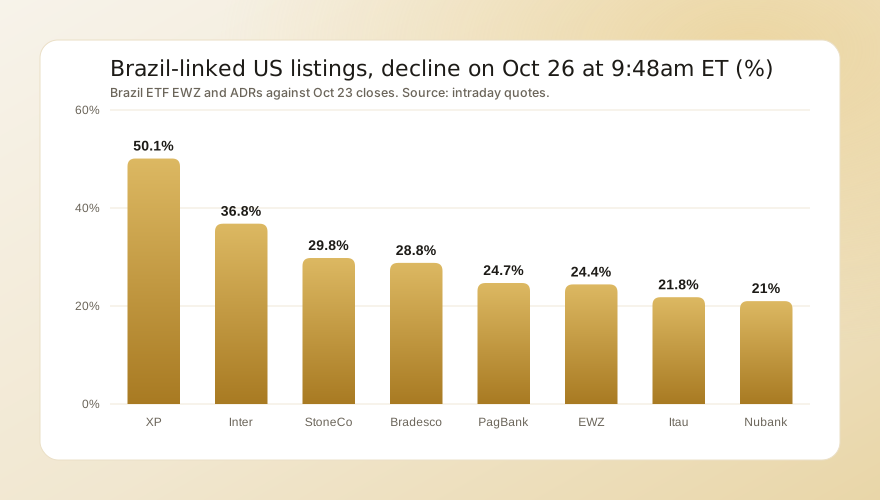
PagBank fell in line with its peers:
| Stock or fund | Oct 23 close | Oct 26, 9:48am | Change |
|---|---|---|---|
| XP | $30.41 | $15.16 | -50.1% |
| Inter & Co | $7.19 | $4.55 | -36.8% |
| StoneCo (STNE) | $11.48 | $8.06 | -29.8% |
| Bradesco (BBD) | $4.07 | $2.90 | -28.8% |
| PagBank (PAGS) | $11.44 | $8.62 | -24.7% |
| Brazil ETF (EWZ) | $42.59 | $32.21 | -24.4% |
| Itaú (ITUB) | $9.67 | $7.56 | -21.8% |
| Nubank (NU) | $15.16 | $11.98 | -21.0% |
| S&P 500 fund (SPY) | $759.97 | $763.05 | +0.4% |
After the drop, RSI(14) stood at 34, the shares sat 12% below their 50-day average and 13% below their 200-day average, and they were 30% below their 52-week high of $12.32. More of the day's swings are in today's biggest stock moves.
What the last report shows
PagBank's second-quarter report, filed in August, is the latest evidence of how the business runs:
| Measure | Q2 2026 | Change from Q2 2025 |
|---|---|---|
| Revenue excluding interchange | R$3.38B | +1.7% |
| Gross profit | R$2.0B | +2.8% |
| Recurring net income | R$576M | +1.9% |
| Diluted EPS, recurring | R$2.06 | +9.7% |
| Credit portfolio | R$5.1B | +30.7% |
| 90-day delinquency | 3.4% | from 2.5% |
| Deposit cost, share of CDI | 83.3% | from 89.2% |
Profit grew slowly, per-share earnings grew faster on buybacks, and the loan book is still small next to R$42.8 billion of deposits. The company returned R$2.0 billion to shareholders over the last twelve months and held a regulatory capital ratio of 22.5% against its 18% to 22% target range. It paid special dividends of $0.26 a share in June and $0.28 on Sept 30. Our explainers on how a special dividend is taxed and priced and when buybacks matter cover how to read those payouts.
The bull case
- The move is the market's, not the company's. PagBank fell about as much as the Brazil ETF and less than StoneCo, Inter and XP, with no company news.
- The election gain is gone. The shares closed at $8.87 on Oct 1 and $9.02 on Oct 2, jumped to $10.95 on Oct 5 after Bolsonaro's strong first round, and now sit below both. The price has already moved back past where it was before that hope arrived.
- The valuation is low. At 0.8 times book, the stock trades under the value of its equity; see price to book explained and how to value a company below book. The trailing P/E is 6 and the forward P/E is 4.6.
- The next report predates the vote. Third-quarter results cover July to September, so they should show the business before the shock.
- Capital returns are large. The company returned R$2.0 billion over twelve months and plans R$1.4 billion of payouts in 2026, and the consensus price target is $10.70, 24% above the price, though those targets were set before the vote.
The risks
- Higher rates. Deposits cost 83.3% of the CDI, so a higher rate path raises funding costs. The Q2 average Selic rate was 14.54%.
- A weaker real. Goldman Sachs expects USD/BRL between 5.4 and 5.8, which lowers the dollar value of every real earned.
- Credit quality. Delinquency rose to 3.4% from 2.5% before the vote, and a weaker economy rarely helps.
- More selling. One strategist said Brazilian stocks could fall another 10% to 15%. Short interest is 11.6% of the float.
- Policy. Lula needs a coalition in a more right-leaning Congress, and Goldman said markets want changes to the spending cap, not trims to social programs.
What comes next
- The US Federal Reserve decision on Wednesday, Oct 28 at 2pm ET. It moves the dollar, which drives the real.
- Lula's economic team and budget plan. None had been named by Sunday night. Markets will read the first appointments closely.
- Third-quarter results, expected November 16. Watch delinquency, deposit costs and any change to the 2026 payout plan; our guide to preparing for an earnings report covers what tends to move a stock that day.
- The annulment effort. A court ruling that the runoff stands would remove one risk; our note on short interest and squeeze risk explains why a heavily shorted stock can move fast either way.