

Oct 16, 2026: a fast drop at the open, then no bounce
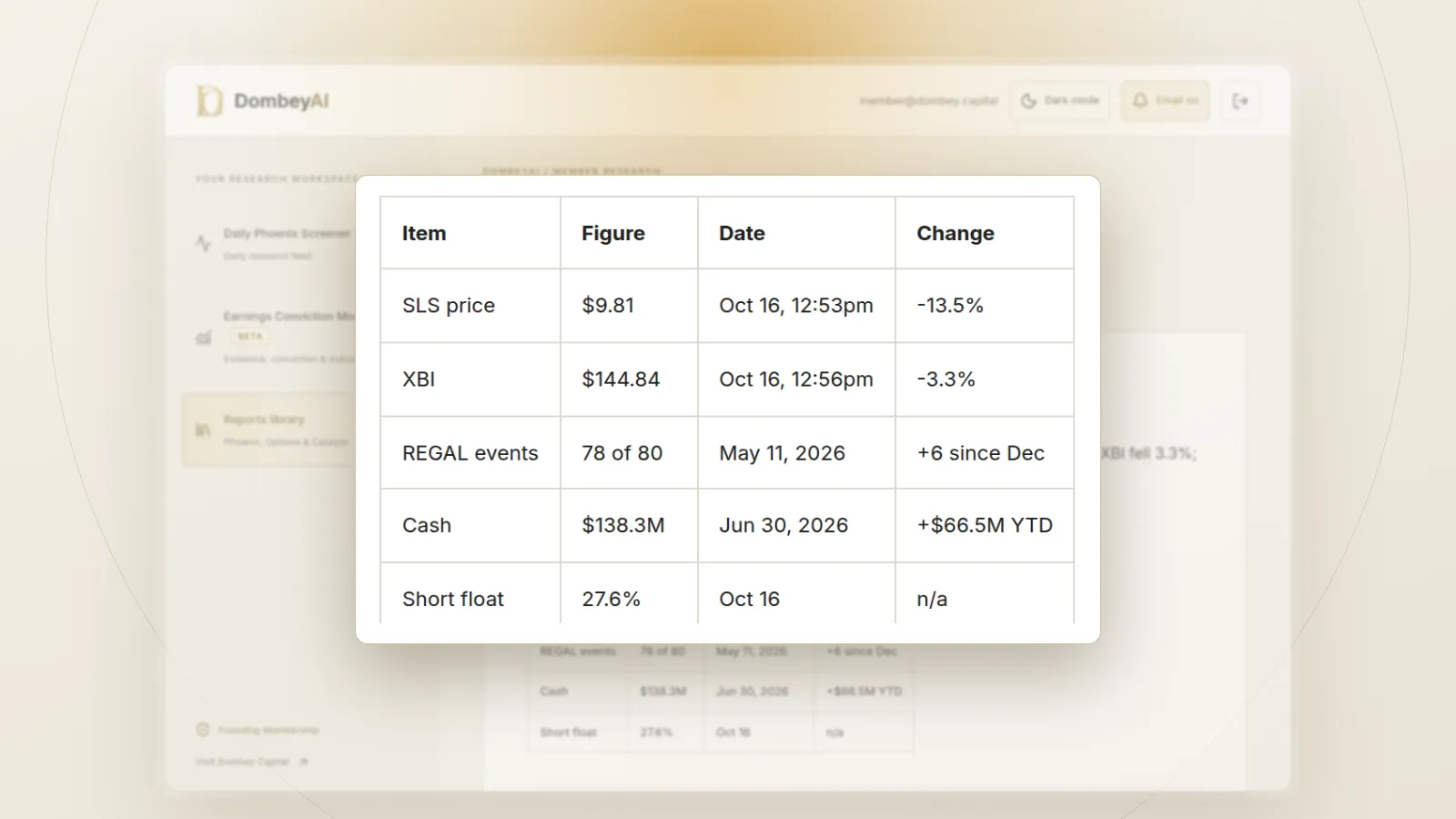
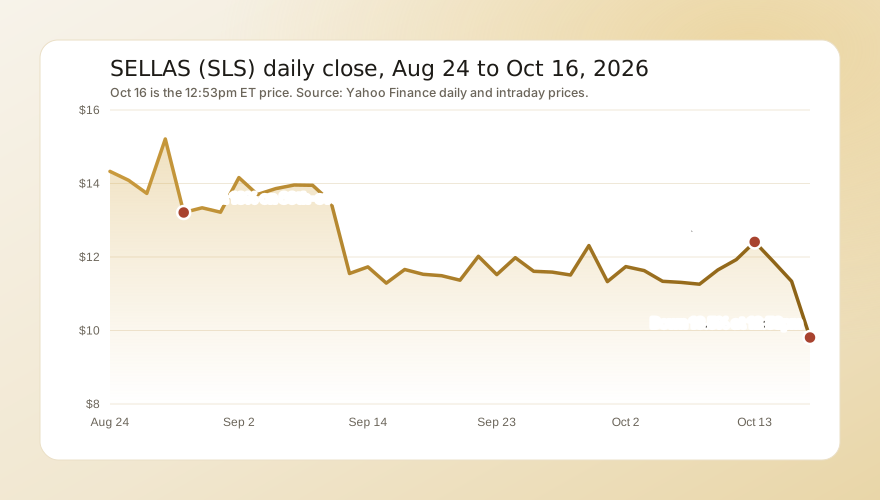
SELLAS traded between $11.28 and $11.38 in thin premarket trading, close to the prior close. It opened at $11.17, touched $11.24, and fell quickly: from $10.79 at 9:40am it dropped to $9.75 just before 9:55am, with about 1.6 million shares changing hands in those ten minutes. It bounced to $10.35 by 10:15am, then drifted lower for the rest of the morning and was at $9.81 at 12:53pm. Volume had reached 10.5 million shares, about twice the 20-day average.
What pushed it down:
- A broad biotech selloff. At 12:56pm:
| Stock or fund | Change |
|---|---|
| SELLAS (SLS) | -13.4% |
| Syndax Pharmaceuticals (SNDX) | -4.0% |
| Kura Oncology (KURA) | -3.6% |
| SPDR S&P Biotech ETF (XBI) | -3.3% |
| Geron (GERN) | -2.9% |
| iShares Biotechnology ETF (IBB) | -2.3% |
| Invesco QQQ (QQQ) | -1.8% |
| SPDR S&P 500 ETF (SPY) | -0.8% |
Syndax and Kura also sell or develop leukemia drugs, and Geron sells a blood cancer drug, so they are the closest listed comparisons. All fell less than 5%.
- No company news. SEC EDGAR shows no 8-K since Aug 11, and the most recent company release was preclinical pancreatic cancer data on Sep 25. Same-day reports from MarketBeat and Tickeron gave no specific cause either. Tickeron pointed to the sector selloff and to holders unwilling to carry the stock into a binary trial result.
- An old overhang resurfacing. StocksToTrade and other sites ran items on Oct 16 about the Pomerantz LLP investigation. The firm's notices date from Oct 1 to Oct 7, so nothing in them was new today.
- A crowded, volatile stock. Short sellers held 55.1 million shares, 27.6% of the float, and the shares had run up from $11.26 on Oct 8 to $12.41 on Oct 13 as retail traders talked up a possible buyout, a theory Stocktwits reported but no company or buyer has supported. A stock with that setup tends to fall harder than its sector on a down day.
After the drop, RSI(14) stood at 35, the shares sat 21% below their 50-day average and 20% above their 200-day average, volume ran 2.0 times its 20-day average, and the stock was 38% below its 52-week high of $15.88.
The gap between SELLAS and its peers is real, but we could not tie it to any new fact. The most likely reading is that a high-beta stock with a large short position fell hardest on a weak day for biotech.
The REGAL trial: two deaths from the trigger, five months on
REGAL is a randomized, open-label Phase 3 trial of galinpepimut-S, a peptide vaccine aimed at the WT1 protein, against the best available treatment as maintenance therapy for acute myeloid leukemia patients in second complete remission. The primary endpoint is overall survival, and the final analysis is triggered when the trial records its 80th death across both arms.
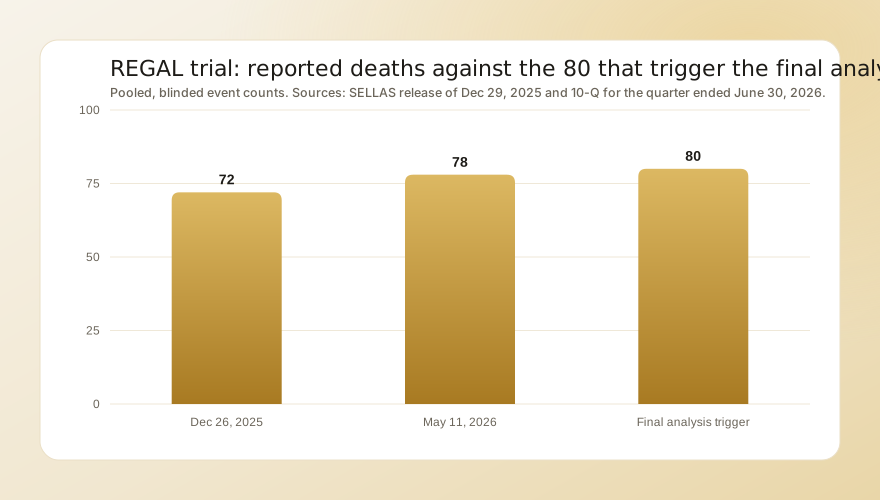
The count has moved slowly. SELLAS reported 72 events as of Dec 26, 2025, and said then that it had expected the 80th before year-end. The contract research organization reported 78 as of May 11, 2026, per the 10-Q. On Aug 11, CEO Angelos Stergiou said the company was "approaching the pre-specified 80th event" and that a successful result could lead to "a potential BLA submission to the FDA." The company says it remains blinded to outcomes and will announce the 80th event when it occurs. The independent data monitoring committee recommended the trial continue without changes after its pre-specified interim analysis.
Slow event accrual in a survival trial can mean patients in one or both arms are living longer than planned, but the company cannot see which arm, and neither can investors. That is why the readout is binary. Our explainer on probability-weighted valuation for binary events shows how to think about a stock priced on one outcome.
Two outside claims muddied the timeline. On Aug 21 the stock rose about 15% after a German financial site reported the trial had reached 80 events, per Stocktwits, and on Aug 28 it fell 13.15% to $13.21 after another news report said the same, per Pomerantz. SELLAS confirmed neither. Pomerantz's Oct 1 notice says it is investigating whether the company and some officers or directors engaged in securities fraud; it is an investigation, not a filed lawsuit.
The numbers
| Item | Figure | Source |
|---|---|---|
| Cash and equivalents, June 30, 2026 | $138.3 million | 10-Q |
| Cash, Dec 31, 2025 | $71.8 million | 10-Q |
| Operating cash used, first half 2026 | $16.4 million | 10-Q |
| Q2 net loss | $9.6 million | 10-Q |
| Q2 R&D / G&A expense | $6.3 million / $4.4 million | Q2 release |
| Warrant exercise proceeds, first half 2026 | $82.9 million | 10-Q |
| Shares outstanding, Aug 10, 2026 | 201.9 million | 10-Q |
| Market value at $9.81 | about $1.98 billion | Market data |
The company says its cash will fund planned operations "for at least the next twelve months." At the first-half burn rate, $138.3 million would last more than four years by our arithmetic, though costs will rise if REGAL succeeds and a license application follows. Cash comes to about $0.69 a share, so roughly 93% of the market value rests on the pipeline, mostly REGAL.
The dilution risk sits in one program. SELLAS has a $150 million at-the-market facility with TD Cowen, set up in March 2026, and had sold nothing under it as of the 10-Q. Our guide to dilution and share count changes covers why an unused program still weighs on a stock.
The bull case
- The readout is close. Two more deaths trigger the final analysis, and the company has said it is preparing for a possible license application.
- The balance sheet is clean. Debt is near zero, cash nearly doubled this year without any at-the-market sales, and the company does not need to raise money before the readout.
- A second shot. A randomized 80-patient Phase 2 trial of SLS009 (tambiciclib) in newly diagnosed AML had enrolled 28 patients by Aug 10, and SELLAS expects topline data in the fourth quarter of 2026.
- Analyst targets sit well above the price. The consensus target of $35, though it rests on a single estimate.
The risks
- One binary outcome. If REGAL fails on overall survival, most of the market value goes with it.
- Timing keeps slipping. The company expected the 80th event in 2025. It has not arrived ten months later.
- Legal overhang. The Pomerantz investigation could turn into a class action, which would add cost and distraction.
- Dilution. The $150 million at-the-market program gives the company room to sell stock, especially if a positive result raises the price.
- Crowded trading. With 27.6% of the float sold short and a beta near 2.7, the stock can move far more than its news on any given day. The short interest and squeeze risk explainer covers how that cuts both ways.
What comes next
- The 80th event announcement. It has no date. It starts database lock and unblinding; topline results would follow later. See our guide to regulatory approvals as catalysts for how the steps after a readout usually run.
- Third-quarter results, expected around Nov 12. Watch the event count, cash, any at-the-market sales and the share count.
- SLS009 topline data, guided for the fourth quarter.
- The ASH annual meeting, Dec 12 to Dec 15 in New Orleans, where SELLAS has a booth, per Stocktwits.