

How a covered call works
You start with the stock. You then sell (write) one call contract per 100 shares, choosing a strike and an expiry. The buyer pays you a premium for the right to buy your shares at the strike until expiry.
At expiration there are two broad outcomes:
- The stock is below the strike. The call expires worthless. You keep the shares and the premium, and you can write another call.
- The stock is above the strike. The call is exercised and you are assigned. You sell the shares at the strike and keep the premium.
The position is called covered because the shares cover the obligation. If you are assigned, you deliver stock you already own. A call written without the stock is a naked call, and FINRA notes that its maximum loss is theoretically unlimited. The covered version does not carry that risk, but it carries all of the stock's own risk.
Standard US stock options are American style. FINRA's options page states that for sellers of equity options, assignment can happen at any time, not only at expiration. That matters most around catalysts, as the sections below show. If you are new to reading strikes, premiums and expiries, start with how to read an option chain.
The payoff in four numbers
Four figures describe a covered call:
- Premium received. Your income from the trade, kept in every outcome.
- Breakeven. The stock price you paid minus the premium. Below this, the position loses money.
- Maximum profit. The strike minus your stock cost, plus the premium. You reach it at any price at or above the strike.
- Maximum loss. Your stock cost minus the premium, if the stock goes to zero.
The asymmetry is the point to hold on to. The premium is usually a few percent of the share price. The downside is the whole share price. A covered call is a way to sell some of the stock's upside for cash today; it is not a hedge against a fall.
Why catalysts change the trade
Implied volatility rises into a dated event because the options have to price a possible jump. For a covered call writer, that means a higher premium for the same strike and expiry. It is the same event premium that buyers lose to IV crush after the report; here you are on the selling side of it.
The higher premium comes with a matching change in risk. The market is paying you more because a large move is more likely. If the move is up and large, you give it up above the strike. If the move is down and large, the premium covers only a small part of it. The writer is selling a lottery ticket on the upside while keeping the full risk on the downside.
| Catalyst | What it does to the call | Main risk for the writer |
|---|---|---|
| Earnings report | Raises the premium on the first expiry after the date | Gap down cushioned only by the premium; gap up capped at the strike |
| Takeover bid or merger | Call jumps in value if the bid is above the strike | Shares called away at the strike, below the deal price |
| Ex-dividend date | Raises the chance of early exercise on in-the-money calls | Assignment the day before ex-date, losing the dividend |
| Special dividend | May lead to an adjustment of the contract terms | Mismatch between what you expected to keep and what the adjusted call delivers |
| Binary ruling or approval | Very high premium on near expiries | One-day move far larger than the premium |
A worked example around earnings
Here is the position at expiration across a range of outcomes.
| Stock at expiry | Stock alone | Covered call | Difference |
|---|---|---|---|
| $30 | -$1,000 | -$820 | +$180 |
| $38 | -$200 | -$20 | +$180 |
| $42 | +$200 | +$380 | +$180 |
| $44 | +$400 | +$580 | +$180 |
| $50 | +$1,000 | +$580 | -$420 |
| $56 | +$1,600 | +$580 | -$1,020 |
Three things stand out. Below the strike, the covered call beats the stock by exactly the premium, no more. At $30, a 25% fall, the premium recovers $180 of a $1,000 loss. Above the strike, the gap widens with every dollar: at $56 the writer gave up $1,020 of gain for $180 of premium. And the breakeven moved only from $40 to $38.20.
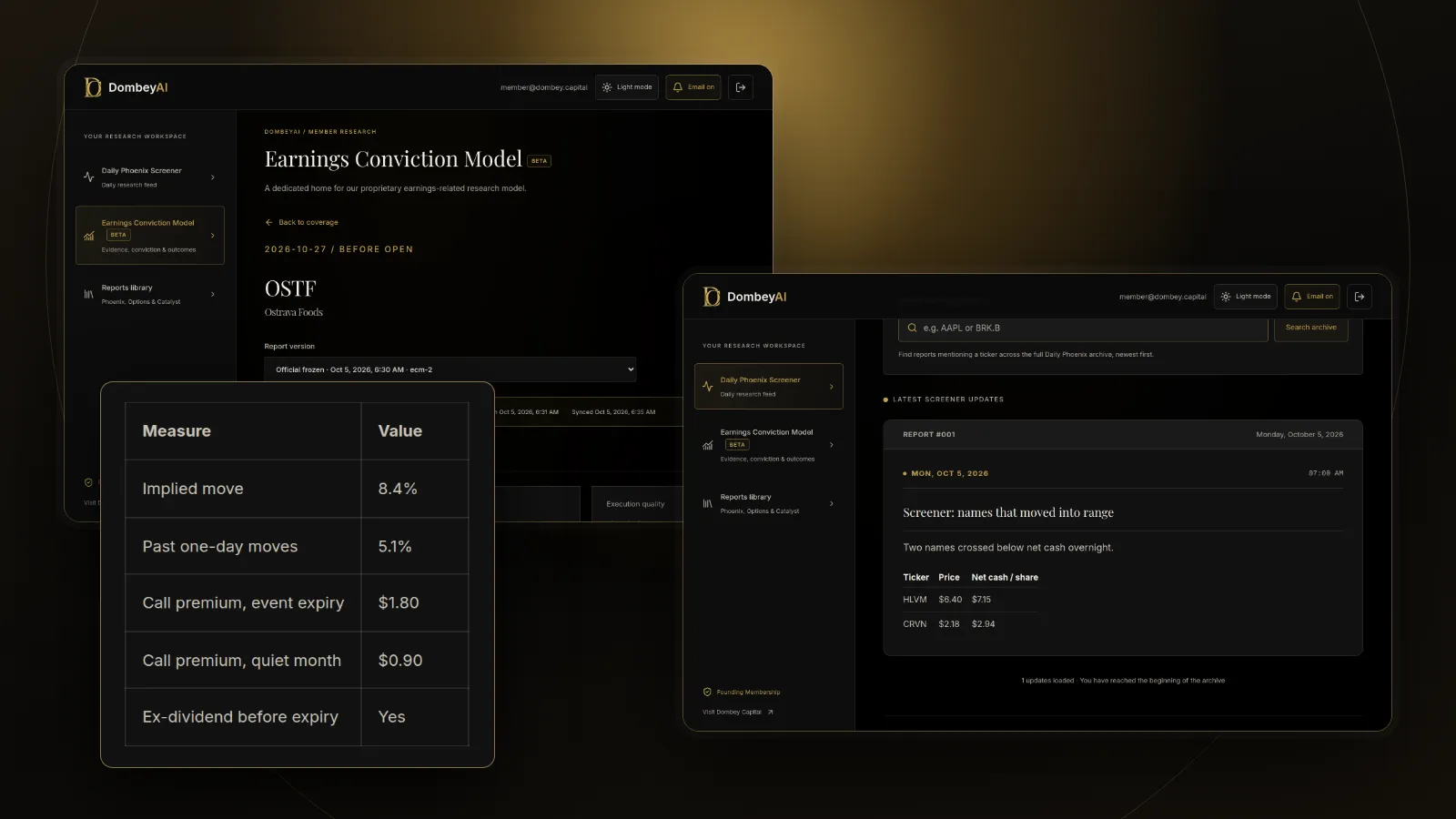
The event premium doubled the income compared with a quiet month. Whether that was a good trade depends on whether a move past $44 or below $38 was more likely than the options implied. The expected move from the at-the-money straddle is the number to compare against.
Takeover bids and pending deals
A bid is the catalyst that hurts covered call writers most. Suppose Company B trades at $25 and you have written a $28 call. A buyer offers $36 cash. The stock jumps toward $36, the call goes deep in the money, and you will most likely be assigned at $28. You keep the premium, but the $8 between the strike and the deal price goes to the call holder.
Takeovers arrive without a schedule, which is why the risk is easy to forget. Stocks that screen cheap, such as those below cash or book, are often the ones that draw bids. Writing calls on them trades away the outcome that may be the main reason to own them.
Once a deal is announced the situation changes. The stock tends to trade at a spread to the deal price, as covered in merger arbitrage explained, and call premiums on strikes above the deal price usually shrink, because a move beyond the offer needs a higher bid. If a cash deal closes, listed options are generally adjusted so that they settle in the deal consideration. The Options Clearing Corporation publishes a memo for each adjustment, and that memo, not the original contract terms, is what governs the call.
Dividends and early assignment
FINRA notes that the risk of assignment is higher the day before a stock's ex-dividend date, because call holders may exercise early to collect the dividend. The logic is simple. A holder who exercises becomes the shareholder of record and receives the dividend. If the dividend is larger than the time value left in the call, exercising early can be worth more than holding the option.
For the writer, that means:
- If your call is deep in the money and the ex-dividend date falls before expiry, expect a real chance of assignment the day before.
- If you are assigned, you sell at the strike and do not receive the dividend.
- If the call still has meaningful time value, early exercise is less likely, but not impossible.
Special dividends add a further step. A large one-time cash payment can lead to an adjustment of the option's strike or deliverable. Regular quarterly dividends generally do not. When a special dividend is declared, read the clearing house memo on whether and how the contract changes. For how the payment itself affects the share price and your taxes, see what a special dividend is.
How to check a covered call before an event
Before writing a call with a dated event inside the expiry:
- Find the event date and confirm it is inside the expiry. An earnings date, vote, ruling or ex-dividend date changes the risk only if it falls before the call expires.
- Compare the premium with a quiet month. The difference is the event premium you are being paid.
- Read the implied move. If the strike sits inside the move the straddle prices, assignment is a live outcome.
- Ask what the good outcome is worth. If the reason you own the stock is a possible bid or a positive ruling, the call sells that outcome.
- Check liquidity. Wide bid-ask spreads on smaller names can take a large share of the premium; see why wide spreads distort signals. Open interest at your strike tells you how easily you can close the call later.
- Know your tax position. Writing calls against stock you hold can affect holding periods under the straddle rules. IRS Publication 550 covers qualified covered calls.
Dombey's published research notes the dated catalysts in each name it covers; see the research archive.
Where this goes wrong
Treating the premium as protection. The premium is income, not insurance. A covered call on a stock that falls 30% loses nearly as much as the stock.
Writing calls on the reason you own the stock. If the thesis is a sale of the company or a favorable ruling, a call below the likely outcome price gives that outcome to someone else.
Forgetting American-style exercise. Planning around expiration alone misses early assignment, which is most common just before an ex-dividend date.
Chasing the event premium. Higher premium before earnings reflects a higher chance of a large move. It is payment for risk, not free income.
Ignoring contract adjustments. After a special dividend, spin-off or merger, the call may deliver something other than 100 shares at the original strike. The adjustment memo decides what you owe.
Rolling into losses. Buying back a call that has gone in the money and selling a later, higher one can turn a capped gain into a series of debits if the stock keeps rising.
The bottom line
A covered call is owning stock and selling a call on it: you take a premium now and give up gains above the strike, while keeping almost all of the downside. Catalysts sharpen both sides. The premium rises before earnings and other dated events, but a bid or a gap up can take your shares at the strike, a gap down is cushioned only by the premium, and early assignment is most likely before an ex-dividend date. Before writing a call with an event inside the expiry, compare the premium with the implied move and decide whether you are willing to sell the outcome you are holding the stock for. Options carry substantial risk; this article is education, not a recommendation.