

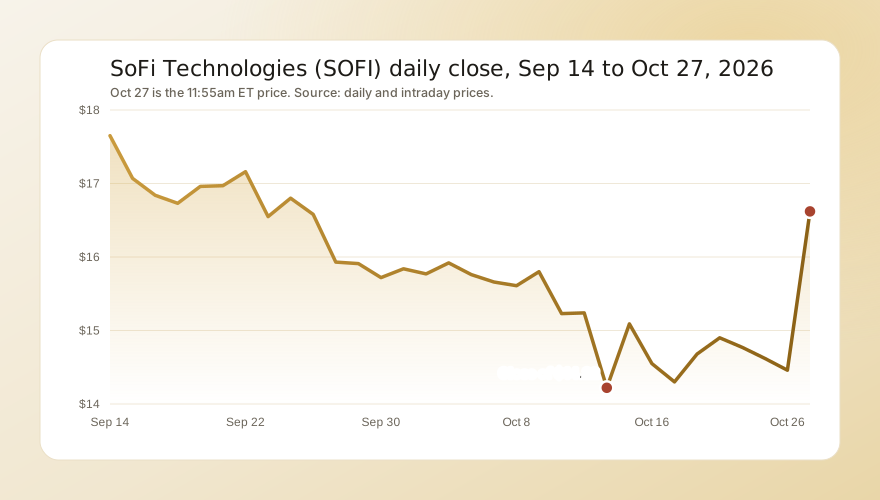
Oct 27, 2026: a premarket jump that held into midday
SoFi traded near $14.35 before 7am, then jumped to about $15.35 in the first minutes after 7:00am as the results came out. It reached $16.41 at about 8:30am, during the 8am webcast, and opened at $15.98. It slipped to $15.67 in the first five minutes, the low of the day, then climbed steadily to $16.65 at about 11:25am. At 11:55am it was $16.62.
What the company reported:
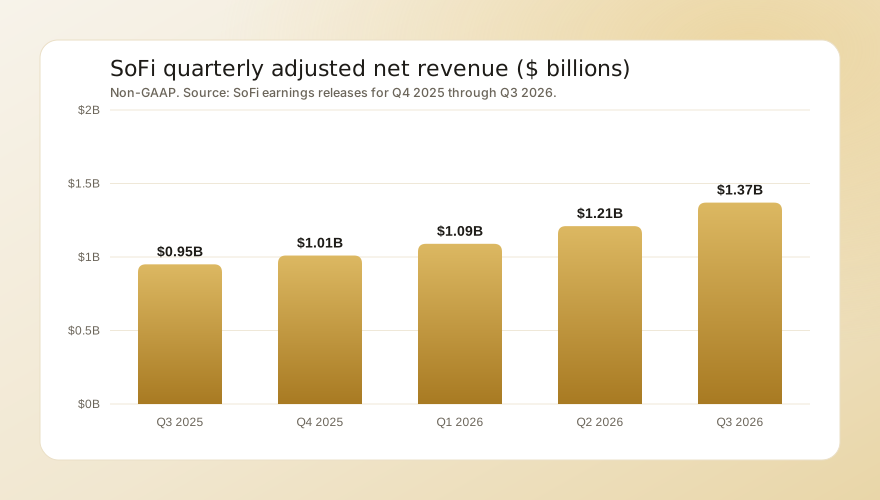
- Revenue and profit. Adjusted net revenue of $1.37 billion rose 44% from $949.6 million. Adjusted EBITDA rose 70% to $469.8 million, a 34% margin. GAAP net income was $241.0 million, or $0.18 a diluted share, up from $0.11.
- Members and products. SoFi added a record 1.2 million members, to 17.1 million, and a record 2.2 million products, to 26.7 million. Products per member rose to about 1.56 from 1.47.
- Lending. Originations were a record $16.9 billion, up 71%, including $12.6 billion of personal loans and $2.9 billion of student loans. Lending adjusted net revenue rose 68% to $807.4 million.
- Fees. Fee-based revenue reached $570.6 million, 42% of the total, and was up 21% from the second quarter.
- Funding. Deposits rose $5.8 billion in the quarter to $51.3 billion, and net interest margin rose 16 basis points to 6.14%.
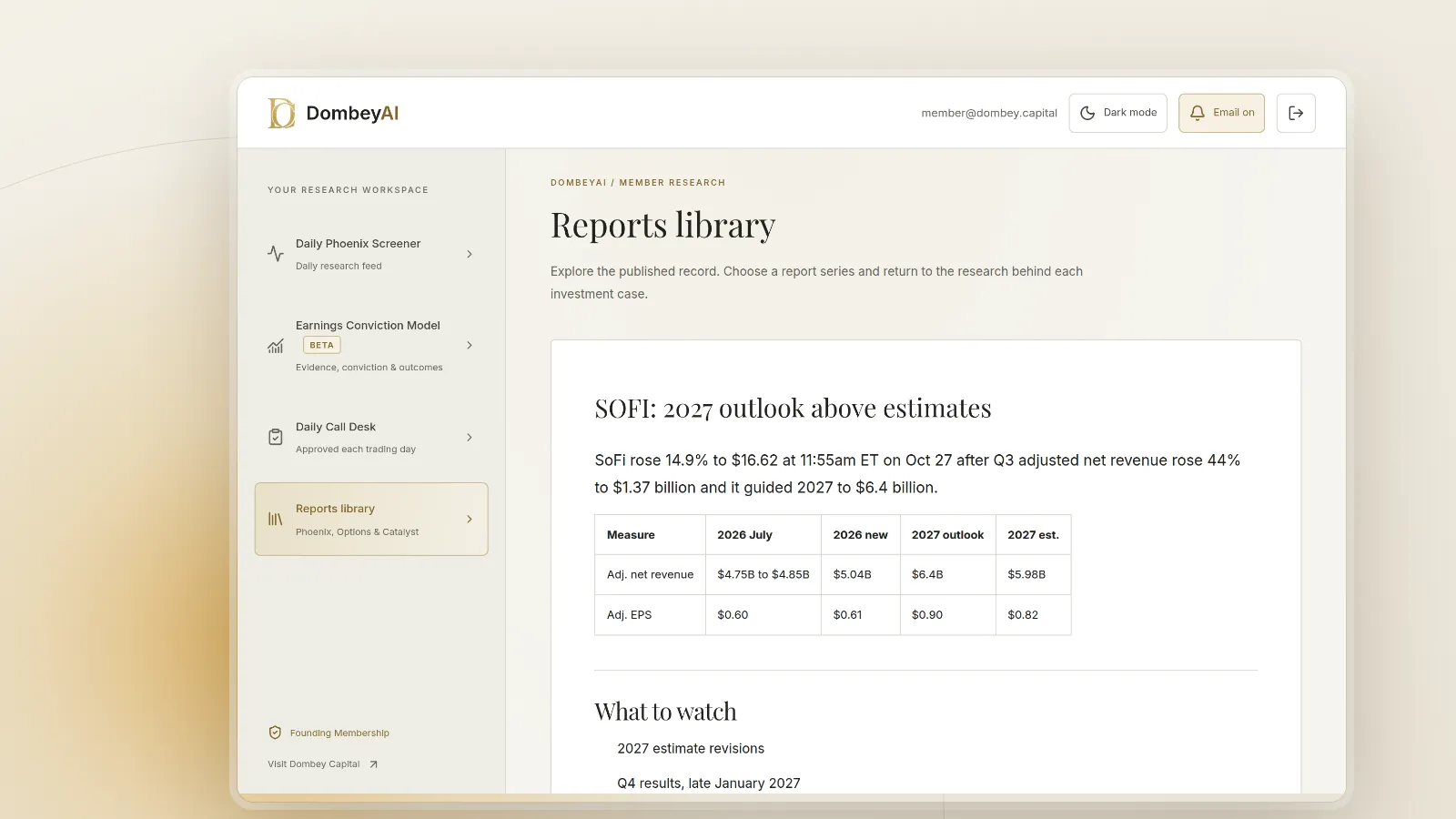
| Measure | 2026, July forecast | 2026, new forecast | 2027 outlook | 2027 consensus |
|---|---|---|---|---|
| Adjusted net revenue | $4.75B to $4.85B | $5.04B | $6.4B | $5.98B |
| Adjusted EBITDA | $1.6B | $1.66B | $2.24B | n/a |
| Adjusted EPS | $0.60 | $0.61 | $0.90 | $0.82 |
After the move, RSI(14) stood at 59, the shares sat at their 50-day average and 7% below their 200-day average, and volume of about 95 million shares by midday was already 2.1 times the 20-day average for a full session. More of the day's big moves are in today's biggest stock moves.
Why the outlook mattered more than the beat
SoFi has beaten revenue estimates for several quarters in a row, and the stock still fell 6.4% on Jan 30, 15.4% on Apr 29 and 8.9% on Jul 29. Beats alone were not enough. What changed today is the 2027 number. Management guided to about 27% revenue growth and a net income margin of about 20%, against roughly 17% for 2026. According to MarketBeat's call summary, the CFO said the 2027 plan assumes two rate hikes and a 24% tax rate, and that existing capital and organic earnings can fund it without raising capital. Our page on why guidance changes move stocks covers why a new year's outlook tends to count for more than one quarter.
The bull case
- Estimates have to rise. If analysts move toward $0.90 of 2027 EPS from $0.82, the multiple at today's price falls. Our explainer on earnings estimate revisions shows why that process often runs for weeks.
- Credit is improving. Loans from late 2022 through 2025 show net cumulative losses of 4.71% with 33% of principal left, against 6.62% at the same point for the 2017 group, the last one that came close to SoFi's 7% to 8% loss tolerance.
- Book value is growing. Tangible book value per share rose 25% in a year to $7.48, so the shares trade at about 2.2 times tangible book. Our guide on how to value a bank stock explains why that ratio matters for a lender that holds a bank charter.
The risks
- A flat fourth quarter. The $5.04 billion forecast less $3.66 billion for the first nine months leaves about $1.38 billion for the fourth quarter, close to the third quarter's $1.37 billion.
- Capital use. Risk-weighted assets rose to $56.2 billion from $33.5 billion a year earlier, and the common equity tier 1 ratio fell to 16.9% from 20.0%. Fast loan growth uses capital, and a raise would cut against the bull case.
- Rates and credit. The 2027 plan assumes higher rates. A weaker consumer would show up first in personal loans, which were $30.9 billion of unpaid principal at quarter end.
- The technology platform. Segment revenue fell 24% from a year earlier to $87.4 million after a large client left, though SoFi said it grew 18% excluding that client.
What comes next
- Analyst estimate changes over the next two weeks. Watch whether the 2027 consensus moves toward $6.4 billion and $0.90. Our guide on how to analyze an earnings call transcript helps separate guidance from tone.
- Fourth-quarter results, expected around late January 2027. Watch the 2027 outlook, capital ratios and charge-offs. Earlier fintech moves on our site, such as PagBank's drop, show how quickly lender sentiment can turn.
- Rate decisions. The 2027 plan already assumes two hikes; a sharper path would test funding costs and loan values. Our page on tangible book value explains the floor many investors use for lenders.