

What you need
- The new transcript, or the webcast replay if no transcript is out yet.
- The earnings release, usually furnished as an exhibit to a Form 8-K under Item 2.02, and any slide deck.
- Last quarter's transcript and release, and ideally the one from a year ago.
- The latest 10-Q or 10-K, for the full financial statements.
- Your thesis notes, with the questions you wanted the call to answer.
- About 30 to 45 minutes for a routine call, longer if the quarter brought a guidance change or a transaction.
Step 1: Set the baseline before you read
Read the earnings release first. It has the reported numbers, and the call will mostly explain them. Then reread last quarter's transcript, or at least your notes on it. You want three things written down before you start: the guidance management gave last time, the two or three metrics it chose to emphasize, and any promises it made with a date attached.
This turns the call from something you read into something you check. Without a baseline, every sentence sounds new and reasonable. With one, you notice that a metric management highlighted for four quarters has quietly gone missing.
If you prepared for the report in advance, as in how to prepare for an earnings report, bring your thresholds for what would confirm or weaken the case.
Step 2: Map the structure of the call
Most calls follow the same order:
- Safe harbor statement. A reminder that forward-looking statements are subject to risks, with a pointer to the risk factors in the filings. Skim it, but note if the list of named risks has changed.
- Prepared remarks. Usually the chief executive on strategy, then the chief financial officer on the numbers and the outlook. This part is scripted and reviewed in advance.
- Question and answer. Analysts ask, management answers. This is the least scripted part and usually the most informative.
Note who spoke. A new speaker, a missing chief financial officer, or a chief executive who takes every finance question can each be worth a line in your notes. Companies hold these calls open to the public partly because Regulation FD bars selective disclosure of material nonpublic information to analysts and large holders. That means what management says on the call is, in principle, what everyone else heard too.
Step 3: Check every number against the filings
Pull each figure management quotes and tie it to the release or the 10-Q. Revenue, margins, cash, debt and share count should match. Where they differ, find out why: a different period, a segment rather than a total, or an adjusted figure.
Pay close attention to non-GAAP measures such as adjusted EBITDA, adjusted earnings per share or free cash flow as the company defines it. SEC rules require a company that publicly discloses a non-GAAP measure to present the most directly comparable GAAP measure and a reconciliation between them. On a call, the company typically meets this by pointing to the reconciliation in the release or on its website. Find it, and look at what was added back this quarter that was not added back before.
Step 4: Compare guidance and wording with last quarter
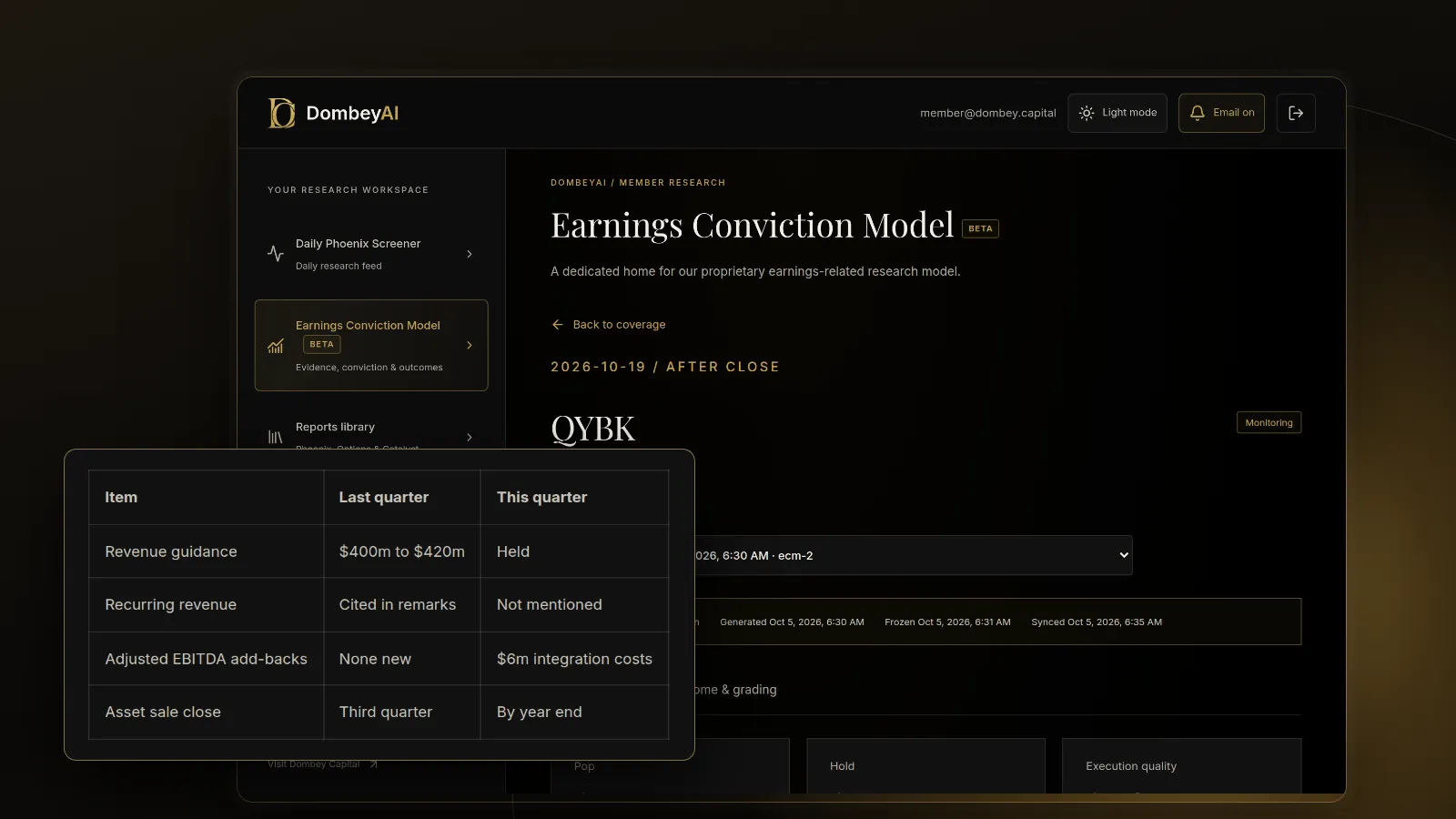
Put this quarter's outlook next to last quarter's, line by line. Note whether each item was raised, held, cut, narrowed, widened or dropped. A dropped item is often the most telling, because companies rarely announce that they have stopped guiding to something. For how markets react to each kind of change, see why guidance changes move stocks.
Then compare the words. Management teams reuse phrases from quarter to quarter, so a change in a stock phrase usually reflects a decision. Search both transcripts for the key terms in your thesis and read each mention in context.
| Phrase change | What it can signal | What to check |
|---|---|---|
| "Confident" becomes "comfortable" or "on track" | Less conviction in a target | Whether the target itself changed |
| A metric highlighted last quarter is not mentioned | The metric got worse | The 10-Q segment or KPI table |
| "Expect" becomes "aim" or "hope" | A firm plan becoming a goal | Guidance table in the release |
| A new risk named in prepared remarks | Something management wants on the record | Risk factors in the next 10-Q |
| A date becomes "later this year" or "in due course" | A delay in a dated event | Any 8-K on the event |
| New definition of an adjusted measure | Comparability break | The non-GAAP reconciliation |
None of these is proof on its own. Each is a reason to check the filing.
Step 5: Read the Q&A for what analysts press on
The questions tell you what the market is worried about. If three analysts ask about the same customer, margin or contract, that is the debate, whatever the prepared remarks focused on.
Sort each answer into one of four kinds:
- Direct. A number, a date or a clear yes or no.
- Redirected. The answer addresses a different question from the one asked.
- Deferred. "We will give more detail at the investor day" or "we can take that offline."
- Declined. "We do not comment on that" or "we do not break that out."
A pattern matters more than a single answer. A management team that answers margin questions directly but redirects every question about one segment is telling you where the problem is. Also note questions that were not asked. If the obvious question about a debt maturity or a pending deal never came up, the market may not be paying attention to it, which can matter more than any answer.
Step 6: Flag hedges, new risks and what was left out
Go back through the prepared remarks and mark qualifiers: "assuming", "subject to", "if conditions hold", "excluding". Each one is a condition on the outlook. Write the conditions down, because they are what you will check next quarter.
Then list what was missing. Common omissions include a segment that was discussed every quarter, a customer that used to be named, a product timeline, and the share buyback. The transcript cannot tell you why something was left out, so treat an omission as a question, not an answer. Check the 10-Q, which carries far more detail. Our guide on reading a 10-Q for special situations covers where to look.
Step 7: Pull out dates and commitments
For event-driven work, the most useful sentences on a call are the ones with dates. Look for expected closings, regulatory decisions, refinancing plans, product launches, asset sales, buyback pace and investor days. Record each one with the exact wording and how firm it is: a stated date, a quarter, or a vague window.
Add each date to your catalyst calendar with the transcript as its source and a note to confirm it in a filing. A closing date mentioned on a call should later appear in an 8-K or a proxy; if it does not, the date was softer than it sounded. For checking those filings when they arrive, see how to read an 8-K for catalysts.
Step 8: Write the call note
Close every call with a short note in the same format each quarter. Keeping the format fixed makes the next comparison quick.
| Step | What to check | Where to find it |
|---|---|---|
| Numbers | Reported figures match; non-GAAP add-backs | Release, 10-Q, reconciliation |
| Guidance | Raised, held, cut, dropped | Release and prepared remarks |
| Wording | Changed phrases on thesis items | This and last quarter's transcript |
| Q&A | Direct, redirected, deferred or declined | Transcript Q&A |
| Dates | Each new date and how firm it is | Transcript, then 8-K or proxy |
| Verdict | Thesis stronger, weaker or unchanged | Your judgment |
Add the verdict to your thesis as a dated update rather than rewriting the original, as described in how to write a dated investment thesis. Dombey's published research reads each call against the dated catalyst it covers; see the research archive.
Where this goes wrong
A transcript records what was said, not what is true. Management chooses the topics, the order and the emphasis, and the prepared remarks are written to present the quarter well. Treat the call as the company's account and the filings as the record.
Wording analysis can find patterns that are not there. Executives change, speechwriters change, and a new chief financial officer may simply talk differently. A single changed phrase is a prompt to check, not a signal to act on.
Transcripts from third-party services can contain errors, especially in numbers and names. When a figure matters, confirm it against the webcast or the filing. And the market often reacts during the call itself, so by the time you have finished a careful read, the obvious changes may already be in the price. For the size of move options were pricing beforehand, see how to estimate an earnings move from options.
Finally, a call can be most useful for what it leaves out, and that is the hardest thing to see without a baseline. If you skip Step 1, most of this method stops working.
Common mistakes
- Reading the call without the release. The release has the numbers. Read it first, or you will take management's framing as the facts.
- Taking adjusted figures at face value. Find the reconciliation every quarter and track what is added back.
- Reading the new transcript alone. The value is in the comparison with last quarter. One transcript in isolation tells you little.
- Stopping at the prepared remarks. The Q&A is where the scripted story meets the questions the market cares about.
- Treating a spoken date as firm. Record it, grade it, and wait for a filing to confirm it.
- Trusting a summary without checking. A summary from a service or an AI tool is a starting point. See primary vs secondary sources in equity research for why the filing comes first.
The bottom line
An earnings call transcript is most useful as a comparison, not a read-through. Set the baseline from the release and last quarter's call, check every number against the filings, and look for changes in guidance, wording and the way management answers questions. Pull out every date and grade how firm it is. End with a short call note in the same format each quarter, and add it to your thesis as a dated update.