

Oct 16, 2026: the rebound fades with the AI data center group
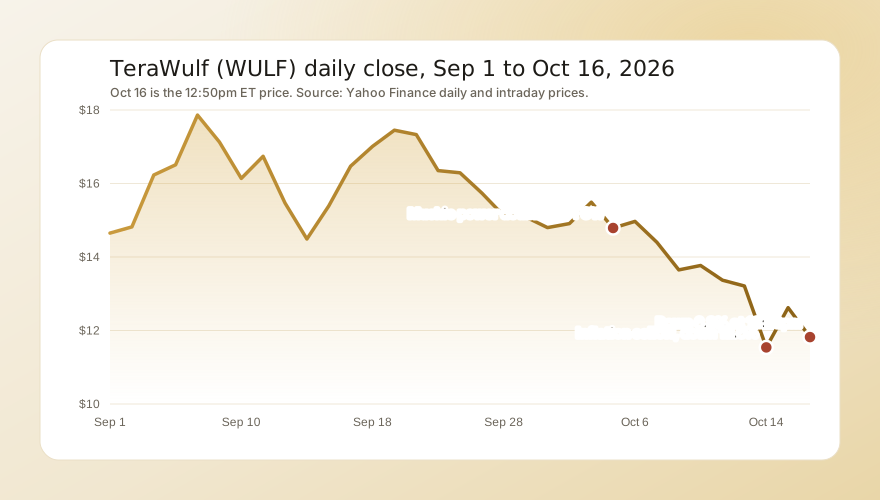
The stock opened premarket at $12.72 at 4am, above the $12.62 close, then drifted lower and traded near $12.29 just before the bell. It opened at $12.29, dipped to $12.14 in the first five minutes, and briefly turned positive with a high of $12.65 around 10am. From there it slid most of the session, broke below $12 just after noon and hit a low of $11.79 shortly before 12:50pm. About 25.9 million shares had traded by then.
What pushed it down:
- The sector sold off again. At 12:50pm:
| Stock or fund | Change |
|---|---|
| TeraWulf (WULF) | -6.3% |
| Cipher Mining (CIFR) | -9.0% |
| Iren (IREN) | -8.8% |
| Hut 8 (HUT) | -8.8% |
| Riot Platforms (RIOT) | -7.8% |
| CleanSpark (CLSK) | -7.8% |
| Core Scientific (CORZ) | -5.0% |
| CoreWeave (CRWV) | -11.1% |
| CoinShares bitcoin miners ETF (WGMI) | -7.8% |
| Invesco QQQ (QQQ) | -1.7% |
| Bitcoin (BTC-USD) | -1.0% |
- CoreWeave's debt scare returned. The worry that started with CoreWeave's bonds trading near 15% yields came back on Oct 16. We covered that in detail in why CoreWeave stock fell. TeraWulf is a smaller version of the same model: borrow heavily to build data centers, then repay from long leases to AI companies.
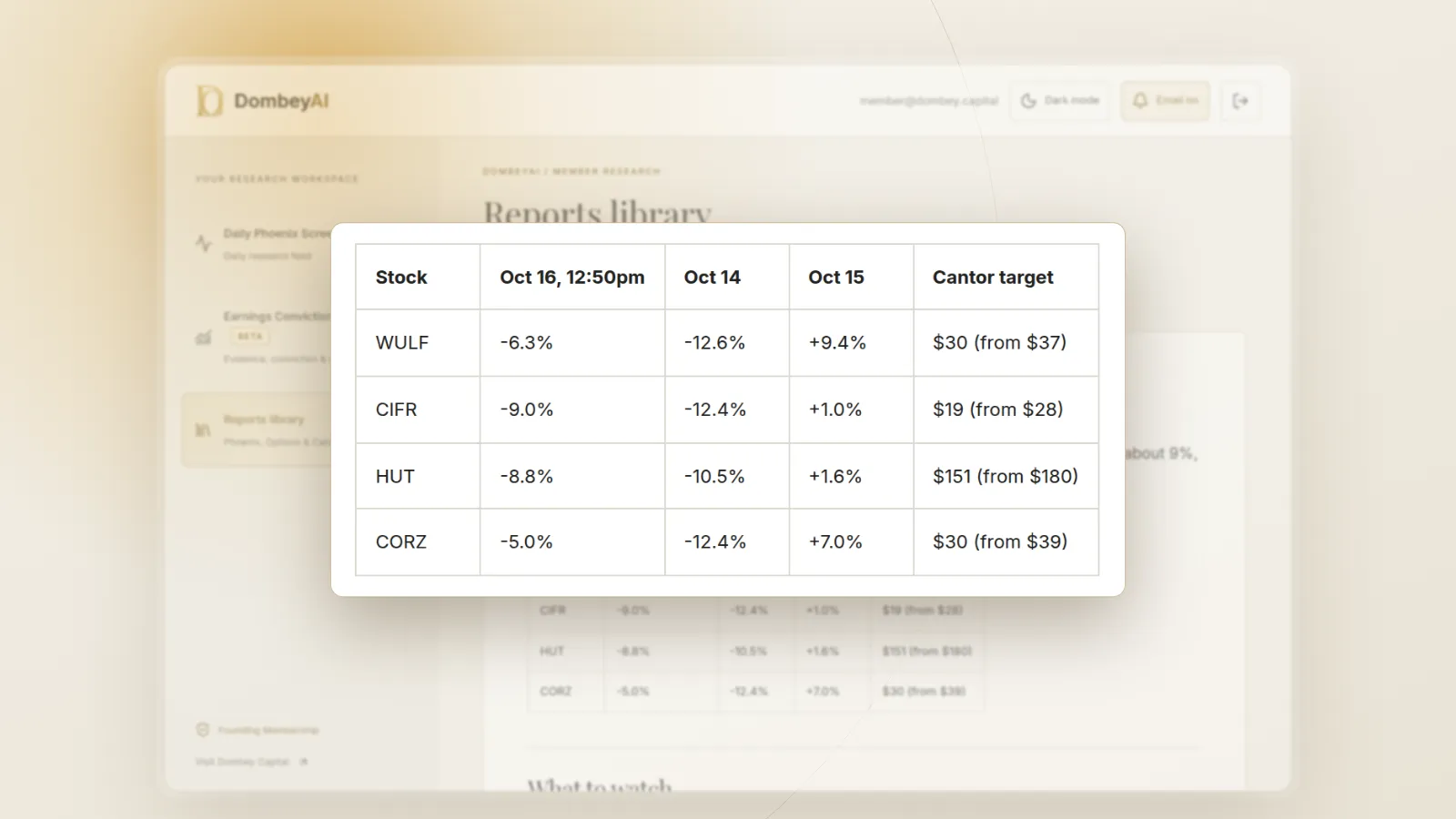
- Cantor cut targets across the group. Analyst Brett Knoblauch lowered TeraWulf to $30 from $37, Hut 8 to $151 from $180, Core Scientific to $30 from $39 and Cipher to $19 from $28, citing rising rates, pressure on the valuations of data center assets, possible cost overruns and local opposition to data centers, per Stocktwits. He still called TeraWulf, Hut 8 and Core Scientific a "generational buy."
- Rates stayed high. The 10-year Treasury yield was 5.13% at 12:50pm, up from 5.09% on Oct 15.
- No company filing. SEC EDGAR shows no TeraWulf 8-K since Oct 5.
After the drop, RSI(14) stood at 33, the shares sat 24% below their 50-day average and 35% below their 200-day average, volume by 12:50pm was 0.8 times its 20-day average of 32.7 million shares, and the stock was 60% below its 52-week high of $29.84.
TeraWulf fell less than Cipher, Iren and Hut 8, so we read the day as a sector move rather than new trouble at the company.
Oct 14 and 15, 2026: the inflation drop and the rebound
On Oct 14 TeraWulf fell 12.6% to $11.54 on 58 million shares, the largest drop among the miners Cointelegraph listed, after September consumer prices rose 3.7% from a year earlier against a 3.6% forecast. The S&P 500 fell 1.1% and the Nasdaq 1.9% that day.
On Oct 15 it fell about 6% before the open and then reversed to close up 9.4% at $12.62 on 108 million shares, its heaviest volume in three months. CoinDesk reported that CEO Paul Prager posted on X that it had been "a brutal few days across the AI infrastructure sector," that financing costs are central to lease negotiations, and that Lake Mariner construction costs were tracking about $9 million per megawatt of IT capacity, inside the company's $8 million to $10 million guidance. TipRanks reported that Morgan Stanley reiterated an Overweight rating that day.
The debt, in numbers
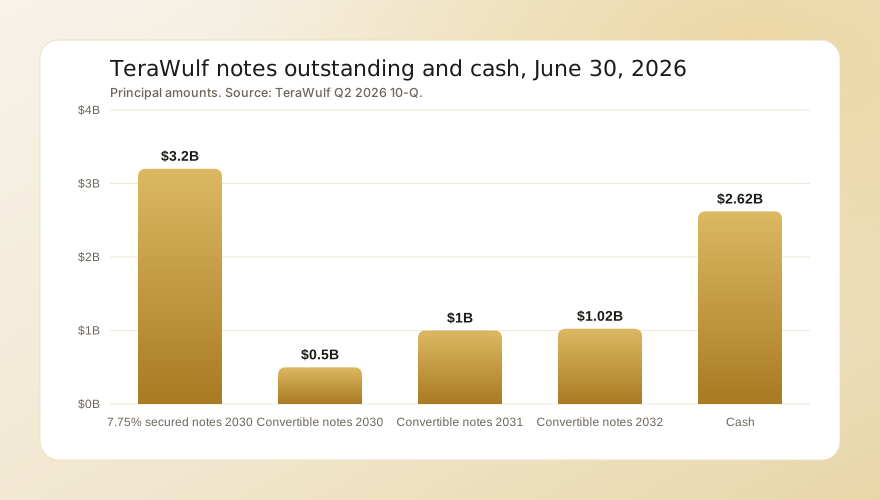
TeraWulf has borrowed $5.7 billion against a business that produced $44.8 million of revenue in the second quarter, per its 10-Q.
| Security | Principal | Coupon | Matures |
|---|---|---|---|
| Senior secured notes | $3.2 billion | 7.75% | 2030 |
| Convertible notes | $500 million | 2.75% | 2030 |
| Convertible notes | $1.0 billion | 1.00% | 2031 |
| Convertible notes | $1.025 billion | 0.00% | 2032 |
The secured notes cost about $248 million a year in interest, paid each April 15 and October 15. Second-quarter interest expense was $56.4 million, more than total revenue, and the net loss was $939.9 million, of which $755.7 million was a non-cash charge for the rise in value of Google's warrants. The 10-Q lists the 2030 and 2031 convertibles as short-term, which left working capital at negative $957.4 million at June 30.
The company is not done borrowing. In its Oct 5 filing it said it plans to enlarge its revolving credit facility and seek more senior secured debt to cover letters of credit owed to utilities, with no assurance it will get it. It has already posted $360.7 million of letters of credit for its Muskie campus in Kentucky. For why that matters when credit tightens, see our explainer on the debt maturity wall and on what counts as a high debt-to-equity ratio.
The case for the stock: who pays the rent
- Google stands behind Fluidstack. If Fluidstack defaults on its Lake Mariner leases or becomes insolvent, Google must either pay the termination fee or pay the rent and take over the lease, per the 10-Q. The delivery of the CB-3 building in July made $600 million of that support effective. In return Google holds warrants for 73.58 million shares at $0.01 each.
- Anthropic signed for 20 years. In July TeraWulf agreed to lease about 401 MW at its Justified campus in Kentucky to Anthropic, worth about $19 billion over the initial term and up to about $33 billion with both extensions. Delivery starts in the second half of 2027.
- More capacity is coming. It had 102 MW earning rent at Lake Mariner in July, with 336 MW more under construction in CB-4 and CB-5, and it raised contracted power at Muskie to 1 GW on Oct 5.
- It sold an asset for cash. It agreed to sell its 50.1% stake in the Abernathy joint venture for about $530 million.
Analysts remain positive: the analyst consensus target is $34.92, with a low of $15.
The risks
- Financing costs. Every new campus needs new debt, and lenders just repriced the sector. A raise at a much higher rate would cut into the returns on the leases.
- Timing. Most of the contracted revenue starts in 2027 and 2028. Until then, interest runs ahead of rent.
- Dilution. The Google warrants, the convertibles and any new share sale add to a share count that averaged 485.7 million in the second quarter. Our guide to dilution covers how that weighs on a stock.
- Crowded shorts. Short sellers held 34.2% of the float, and the stock trades at 35.7 times sales and 40 times book value. That makes sharp swings in both directions likely, as our explainer on short interest describes.
What comes next
- Third-quarter results, expected November 6. The consensus revenue estimate is of about $64.6 million. Watch whether CB-4 rent has started, the cash balance after the October interest payment, and costs per megawatt.
- New secured debt. The rate on the borrowing flagged on Oct 5 will show what lenders now charge TeraWulf. Our guide to preparing for an earnings report covers what to check on the day.
- CoreWeave's bonds. The group has traded with CoreWeave's credit all week, so a recovery there would likely lift TeraWulf too.
- The Abernathy sale closing. The roughly $530 million in cash would add to liquidity before the next build.