

Nov 4, 2026: an in-line quarter and a guide that turns negative
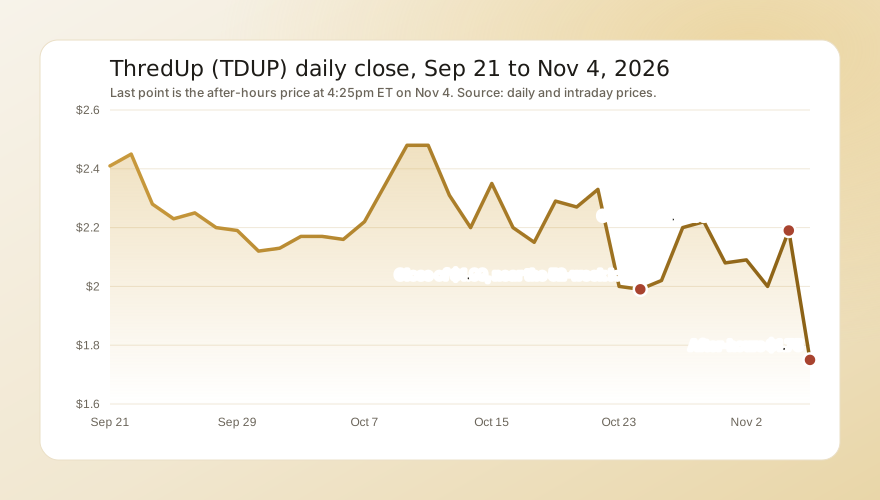
ThredUp closed Nov 3 at $2.00, a few cents above the 52-week low of $1.91 it set in late October. It traded at $2.05 before the open, opened at $2.11, made its low of $2.06 in the first minute and reached $2.285 at 2:23pm. It closed at $2.19, up 9.5%, on about 2.9 million shares, as retail stocks rallied: the SPDR S&P Retail fund rose 5.5%, The RealReal 6.9%, Etsy 7.1% and eBay 5.5%.
The release came out at 4:05pm. The stock printed $2.05 at 4:06pm, $1.82 at 4:08pm and $1.66 at 4:14pm, touched $1.64 at 4:18pm and was $1.75 at 4:25pm.
What moved the stock:
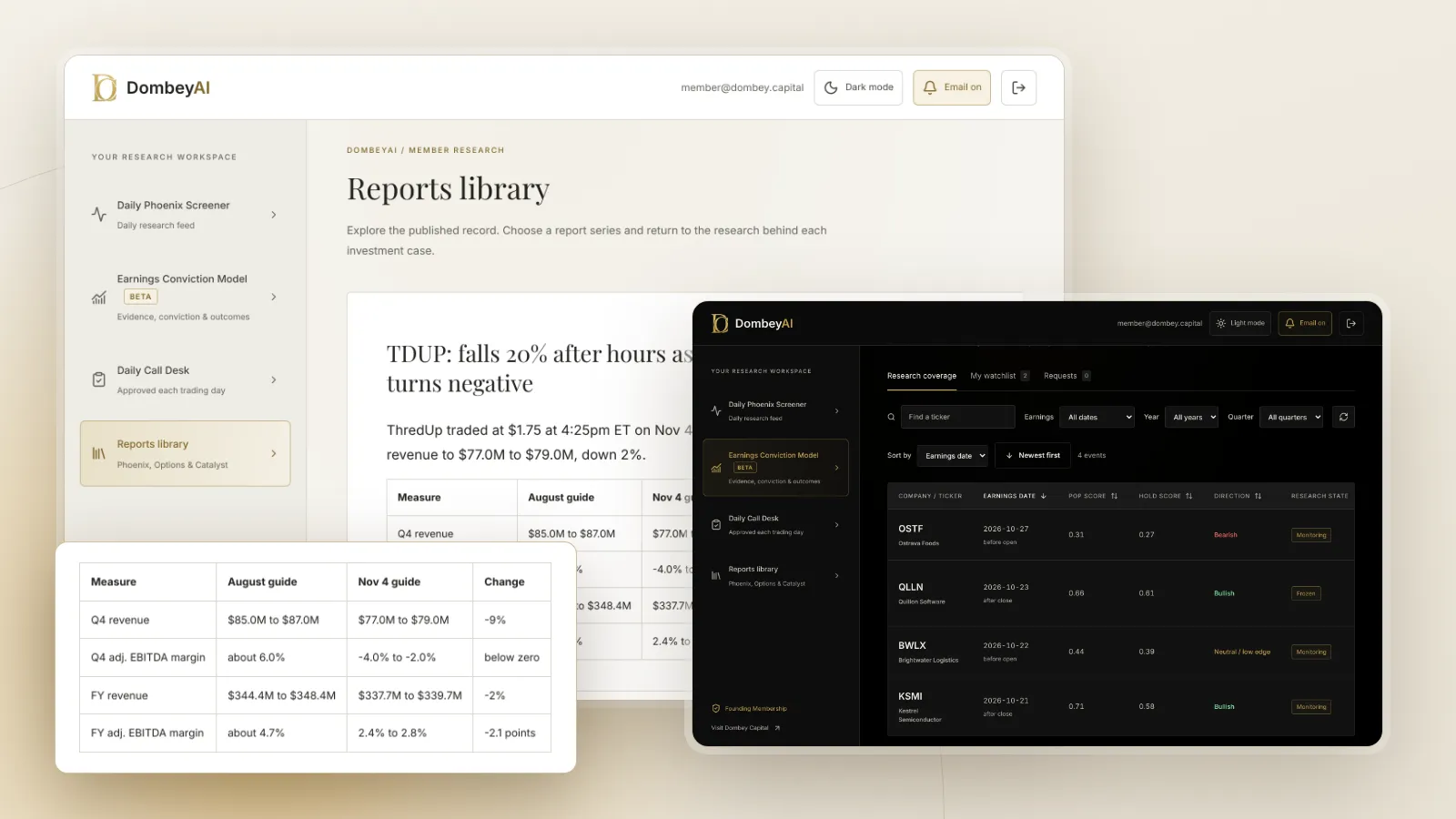
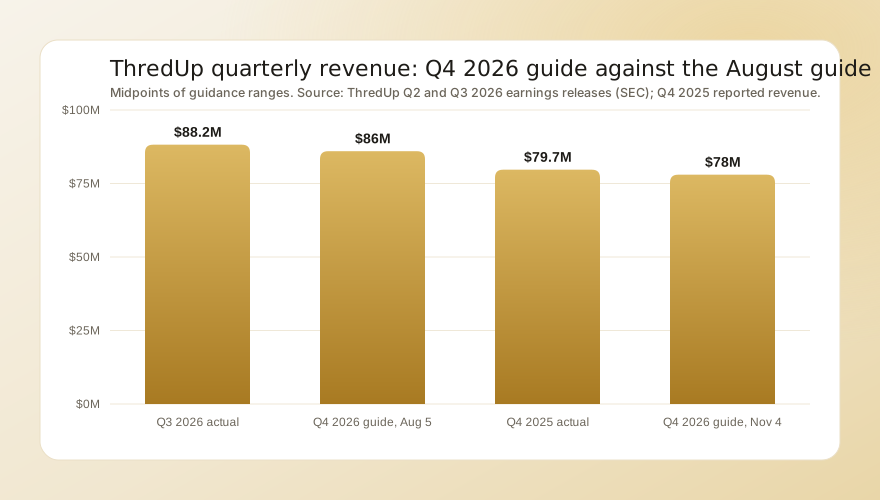
- The fourth quarter now shrinks. The midpoint of the new revenue range is $78.0 million, below the $79.7 million ThredUp reported for the fourth quarter of 2025 and 9% below the $86.0 million midpoint it gave in August.
- The margin goes below zero. The fourth-quarter adjusted EBITDA margin guide fell to negative 4.0% to negative 2.0%, from about positive 6.0%, and the gross margin guide fell a full point, to 76.5% to 77.5%.
- The year is smaller. Full-year revenue guidance fell to $337.7 million to $339.7 million, 9% growth at the midpoint, from $344.4 million to $348.4 million and 11% growth. The full-year adjusted EBITDA margin guide fell to 2.4% to 2.8% from about 4.7%.
- Shoppers keep coming but spend less. Active buyers rose 16% and orders 17%, but revenue per order fell to about $46.73 from about $51.10 a year earlier. Chief executive James Reinhart called it "a record quarter for active buyers, orders and items sold" and said the company is navigating "a highly competitive environment."
At the close, RSI(14) stood at 48, the shares sat 7.0% below their 50-day average and 46.6% below their 200-day average, volume ran 1.8 times its 20-day average, and the stock was 75.0% below its 52-week high of $8.76. More of the session's swings are in today's biggest stock moves.
The numbers
| Measure | Q3 2026 | Q3 2025 | Change |
|---|---|---|---|
| Revenue | $88.2 million | $82.2 million | +7% |
| Gross margin | 78.2% | 79.4% | -1.2 points |
| Net loss | $5.5 million | $4.2 million | wider |
| Adjusted EBITDA | $3.5 million | $3.8 million | -8% |
| Active buyers | 1.82 million | 1.57 million | +16% |
| Orders | 1.89 million | 1.61 million | +17% |
Growth slowed sharply from the second quarter, when revenue rose 17% and active buyers 21%. Marketing spending rose 12% to $18.2 million, and operations, product and technology costs rose 10% to $42.5 million, both faster than revenue. Sales, general and administrative costs fell 8%. The net loss was $0.04 a share on 131.8 million shares. Operating cash flow for nine months was $11.2 million and capital spending $8.7 million, for $2.4 million of free cash flow. Our guide to reading an earnings release shows where the outlook table sits and why it often matters more than the quarter.
How the guide got here
In August ThredUp beat its own second-quarter targets but cut its second-half outlook, and the stock fell from $6.28 to $3.11 the next day. On that call Reinhart said the budget shopper, households earning under $60,000 a year and less than 20% of the base, needed heavier discounts to buy, which he tied in part to higher gas prices. Chief financial officer Sean Sobers said the company would discount older inventory to protect buyer engagement and expected that to cost about $7 million of second-half revenue. Reinhart said then that the company "likely could have maintained our original second half outlook" but chose a lower bar to protect investor confidence.
The third quarter landed on that lower bar. The fourth quarter did not. The new midpoint sits about $8 million below the August figure on its own, so the reset now runs well beyond the $7 million of promotions management described. Our explainer on guidance changes covers why a second cut usually hits harder than the first: it tells the market the first one was not conservative enough.
The bull case
The unit numbers are healthy. Record active buyers and 17% order growth mean ThredUp is still adding shoppers, and management has said its newer buyers come from Meta and Pinterest at lower acquisition costs than search ads. The company has also said it is shifting toward higher-income buyers and premium supply, which would lift revenue per order once the discounting on old inventory ends. Its balance sheet is not the problem: cash and securities of $57.6 million cover the $17.7 million of debt more than three times, and it was free cash flow positive through nine months. At about 0.69 times trailing sales after hours, a return to the August outlook would leave room for the stock to recover. Our page on the price-to-sales ratio covers when a low multiple is a signal and when it is a warning.
The risks
The fourth quarter is ThredUp's holiday quarter, and the company now expects to lose money in it. A negative 3% margin on $78 million of revenue is roughly a $2.3 million adjusted EBITDA loss, before $6.0 million of stock compensation and $3.3 million of depreciation. If revenue per order keeps falling while marketing grows faster than sales, more buyers will not translate into more profit. Analysts also have to lower their 2027 numbers, which our guide to earnings estimate revisions explains can weigh on a stock for weeks. The company says tariffs and changes to global trade are a risk factor, though it gave no figure. Our guide to estimating cash runway is the right frame if the losses run longer than one quarter.
What comes next
ThredUp's call with analysts follows the release on the evening of Nov 4, and management's explanation of the fourth-quarter guide, in particular how much comes from discounting and how much from competition, will set the tone for the next session. The fourth-quarter report and 2027 outlook are expected around March 3, 2027. Before then, watch whether the stock holds the $1.64 after-hours low and whether analysts cut their targets. Our guide on post-earnings announcement drift covers why stocks that fall on a guidance cut often keep drifting the same way.