

Oct 26, 2026: a 41% premarket gain cut in half, then a partial recovery
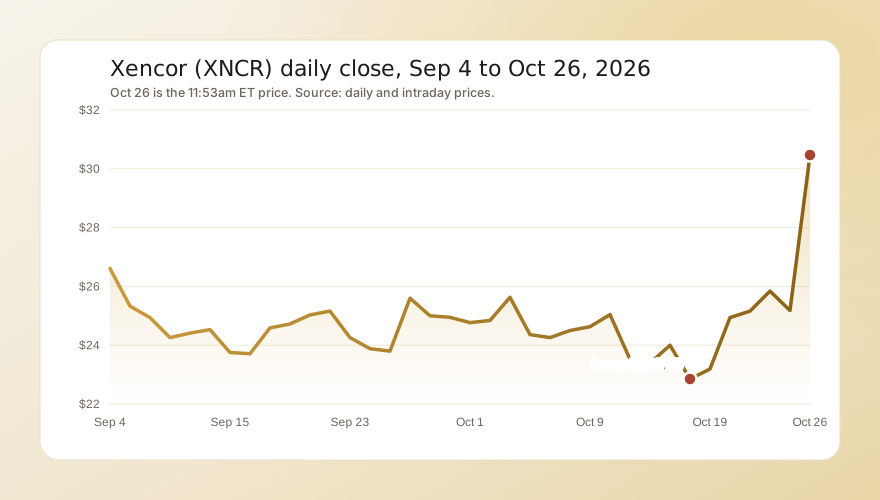
Xencor first traded at $31.01 at 4:15am, already 23% above Friday's close, and climbed to $35.51 at about 7:35am, around the time of the 7am webcast. It drifted back to $32.19 by 9:25am. It opened at $32.29, reached $33.58 in the first minutes, then fell to $28.93 at 9:55am before recovering. At 11:53am it was $30.47 on about 5.8 million shares, four times its 20-day average for a full day.
What the company reported:
- The data. As of the Sept 1 data cut, 119 patients had received XmAb819 across 11 intravenous doses. In the 68 patients at the three expansion doses, the median patient had three prior lines of therapy and 94% were intermediate or poor risk.
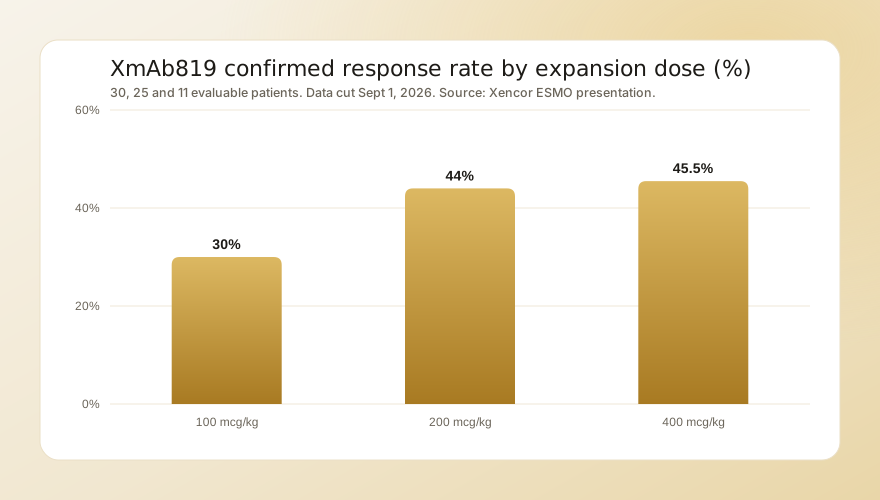
- The dose. Xencor chose 400 mcg/kg for Phase 3, citing a 45.5% confirmed response rate, a 55% unconfirmed response rate and an 82% six-month progression-free survival estimate.
- The plan. A global randomized study of XmAb819 against tivozanib, a VEGFR drug, in patients who have had a PD-1 or PD-L1 drug and a VEGFR drug, and a possible accelerated approval discussion with the FDA in the first half of 2027.
- The cash. An 8-K said Xencor now expects to fund operations into 2029. In August it guided to through 2028.
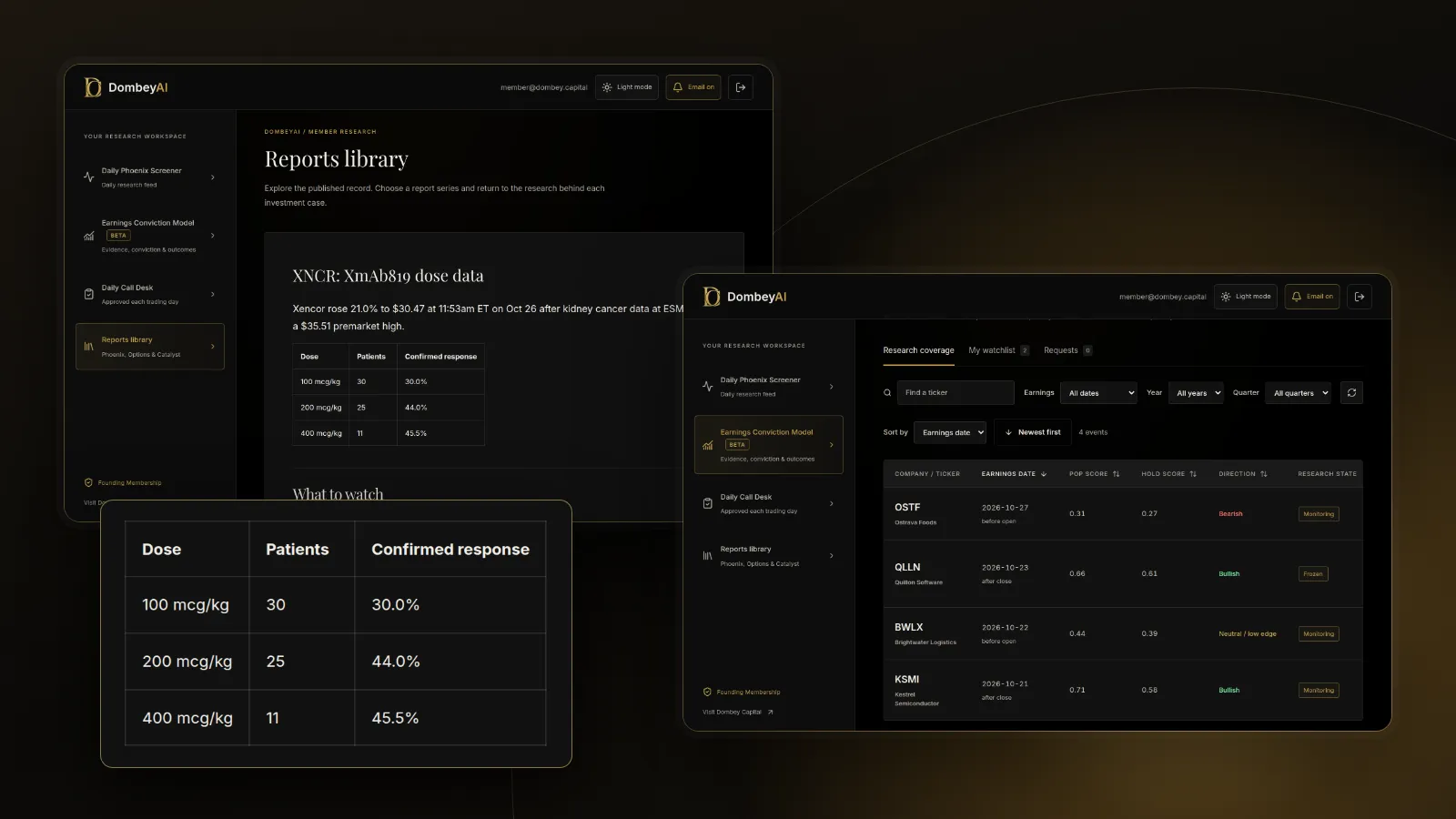
| Expansion dose | Patients | Confirmed response | Disease control | Median follow-up |
|---|---|---|---|---|
| 100 mcg/kg | 30 | 30.0% | 86.7% | 4.1 months |
| 200 mcg/kg | 25 | 44.0% | 64.0% | 4.5 months |
| 400 mcg/kg | 11 | 45.5% | 81.8% | 6.0 months |
Responses also held in harder groups: 34.8% in 23 patients who had a HIF2-alpha inhibitor and 45.2% in 42 who had two or more VEGFR drugs. After the move, RSI(14) stood at 72, the shares sat 19% above their 50-day average and 82% above their 200-day average, and they were 10% below the new 52-week high of $33.58. More of the day's big moves are in today's biggest stock moves.
Why the stock faded
The premarket high priced the best reading of the data. Three things argued for less:
- Small numbers at the chosen dose. Eleven patients is a small base, and a 95% confidence interval of 16.8% to 76.6% means the true rate could be well below the headline. Our page on probability-weighted valuation for binary events shows how to price that range.
- Side effects. In the 68 expansion patients, rash occurred in 91.2% (22.1% grade 3 or higher), cytokine release syndrome in 67.6% (5.9% grade 3 or higher), and raised liver enzymes ALT and AST in 52.9% and 48.5%, with 33.8% and 35.3% grade 3 or higher. The company said liver enzyme rises were asymptomatic and resolved in a median of seven days, and that only 5.9% stopped treatment because of related side effects.
- Time. A registration study starts in 2027. The next hard data on XmAb819 are a year or more away.
The bull case
- The dose response is clean. Higher doses gave higher response rates in a population with few options.
- Responses last. 76% of responders were still responding at the data cut, with a median time on treatment of seven months.
- The balance sheet removes a common overhang. Small biotechs often sell stock after good data. Xencor's runway into 2029 makes that less likely; see how to estimate cash runway.
- Other programs pay royalties. Partnered drugs xaluritamig and ASP2138 are in Phase 3, with up to $225 million and $232.5 million of remaining milestones.
The risks
- The confidence interval. Phase 3 could show a lower rate than 45.5%.
- Safety at scale. Liver enzyme rises and rash need management in larger trials.
- Competition. Kidney cancer has checkpoint drugs, VEGFR drugs and HIF2-alpha inhibitors, and the study design compares XmAb819 with an approved drug.
- Dilution. Any offering would cut against the runway argument; our explainer on secondary offerings covers how those usually trade.
What comes next
- Third-quarter results, expected November 4. Watch cash, the runway and the XmAb819 trial timeline.
- FDA discussions on an accelerated path, first half of 2027. Our page on regulatory approvals as catalysts explains how those steps tend to move a stock.
- The start of the randomized study against tivozanib in 2027.