

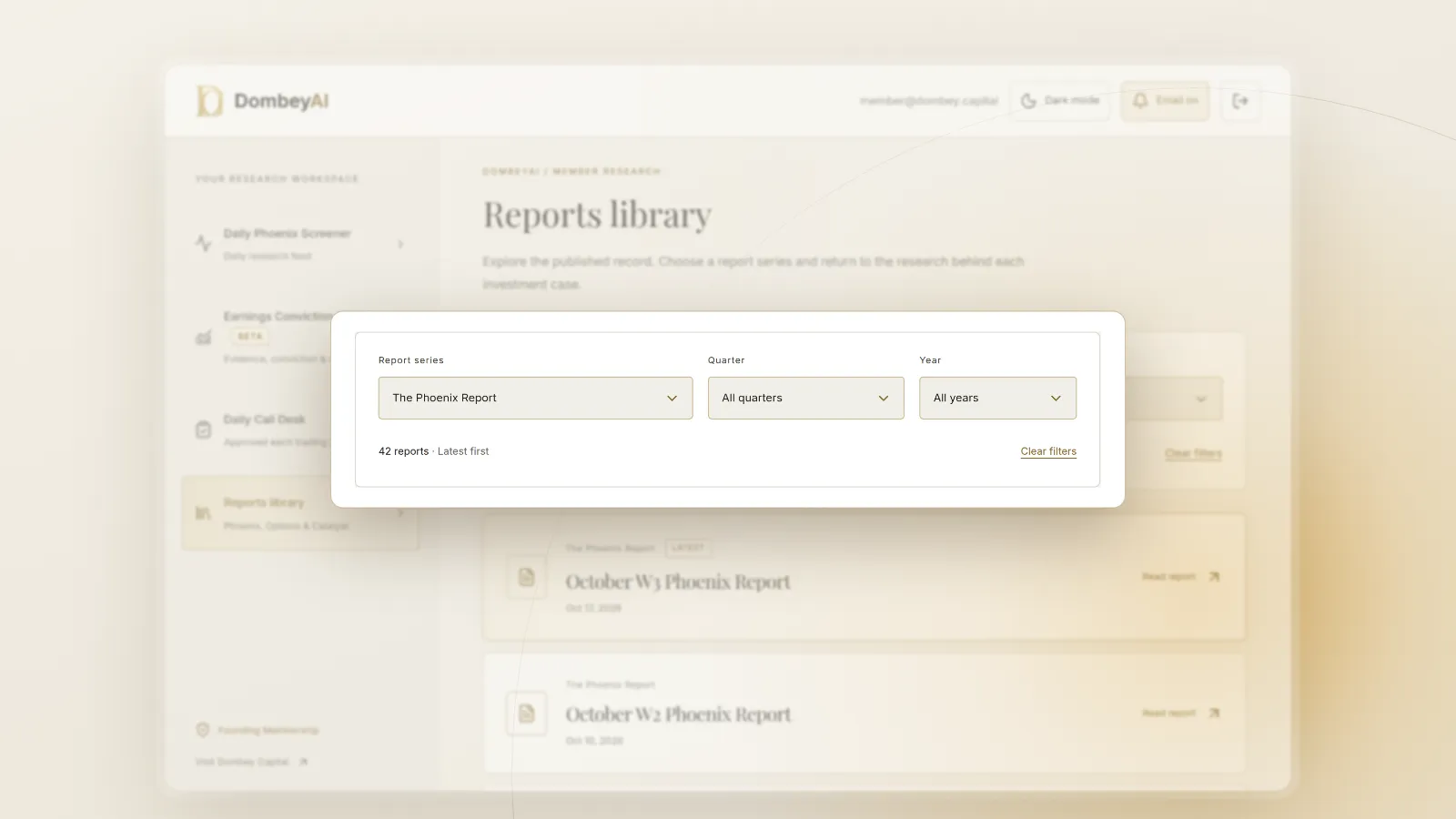


Full disclosure: Dombey Capital is our own research service and our top pick here, for the reasons below. The section on where it falls short is there so you can judge whether it fits your process.
Why value investors look past GuruFocus
GuruFocus is known for two things: GF Value, its own estimate of a stock's fair trading value, and tracking of what well-known investors report holding. We could not confirm its current plans on its own site, so we describe it only by what it is publicly known for and quote no GuruFocus price or plan limit. Our GuruFocus vs Stock Rover vs Koyfin comparison weighs it head to head against two data tools. This piece takes the other angle: if you are leaving GuruFocus, or never started, what replaces each part of it?
Readers usually want one of five things that a single tool does not supply equally well:
| What you used GuruFocus for | Closest replacement here | What you give up |
|---|---|---|
| A fair value figure beside each stock | Stock Rover Premium Plus | GuruFocus's guru pages |
| Following well-known investors' holdings | TIKR | A single fair value number |
| An analyst's judgment, not a formula | Morningstar Investor | Deep custom screening |
| Building your own value measure | Koyfin Premium | Any ready-made fair value |
| A reason for the discount to close, with a date | Dombey CapitalTop pick | Any data platform at all |

The fair value number and the guru list both answer the question "is this cheap, and who agrees?" Neither answers "what will make the price move, and when?" That gap is why our top pick is a research service rather than another database.
Quick comparison
| Tool | Best for | Key features | Price (as of October 2026) |
|---|---|---|---|
| Dombey CapitalTop pick | Value stocks with a dated catalyst | Weekly Phoenix Report, weekly Options Research, Biweekly Catalyst Briefing, DombeyAI Portal with the Daily Phoenix Screener and Earnings Conviction Model | Founding Membership $1,200/year (annual only); Standard Access $80/year or $8/month; Public Archive free |
| Stock Rover | Fair value, screens and portfolio in one tool | 400+ to 800+ metrics, 5 to 20 years of fundamentals, fair value and ratings on Premium Plus | Premium $348/year or $34/month; Premium Plus $588/year or $70/month; Ultimate $948/year or $99/month; Ultimate Pro $1,788/year or $199/month |
| TIKR | Guru holdings and long history | Portfolios of 10,000+ investors, 100,000+ stocks in 92 countries, up to 30 years of financials, valuation model templates | Free; Plus $24.95, Pro $54.95, Ultimate $119.95 a month as listed; 14-day money-back guarantee |
| Morningstar Investor | An analyst's fair value | Fair value and competitive advantage ratings, analyst coverage, screener with 200+ data points | $249/year or $34.95/month; 7-day free trial |
| Koyfin | Building your own value measures | 100K+ global company snapshots, 10 years of financials on Plus, unlimited custom formulas on Premium | Free; Plus $39, Premium $79, Advisor Core $209, Advisor Pro $299 a month as listed |
| Simply Wall St | Visual fair value and portfolio checks | Fair value from expected cash flows, Snowflake screener, Narratives, 120k stocks in 90 markets | See the vendor's pricing page (free plan offered) |
| Finviz | Fast first screens on US stocks | Screener, maps, charts; Elite adds real-time data, 8 years of statements and export | Free; Elite $39.50/month or $299.50/year |
| SEC EDGAR | The primary source behind guru data | Every 10-K, 10-Q and 13F; full-text search | Free |

How we compared these tools
We compared these tools from vendor documentation, pricing pages and public product pages, read on October 22, 2026. We did not run trials of the paid plans, and we make no claims about the accuracy of any fair value model or about investment results.
| Criterion | Weight | What it measures |
|---|---|---|
| Valuation tools | 25% | A fair value estimate, ratings, or the means to build your own measure |
| Catalyst context | 20% | Whether the tool ties a discount to a dated event or leaves that to you |
| Investor holdings | 15% | Whether you can see what other value investors report owning, and how fresh it is |
| Balance sheet depth | 20% | Years of history, line-item detail and access to filings |
| Cost and friction | 20% | Price of the plan you would need, trials, refunds and free tiers |
We weighted valuation and catalyst context most because a value stock needs both a gap and a reason for the gap to close. If you weight investor holdings and history more heavily, TIKR moves to the top of the data tools; if you care only about a fair value number, Stock Rover and Morningstar Investor lead.
Quick picks by job
Best for value stocks with a dated catalyst: Dombey Capital
Dombey's Founding Membership is written research: the weekly Phoenix Report, weekly Options Research, the Biweekly Catalyst Briefing and the DombeyAI Portal. It suits value investors who already have a data source and want an analyst's view of why a stock trades below cash or book and which dated catalyst could close the gap, with each thesis published before the event and kept in the archive.
Best for fair value, screens and portfolio together: Stock Rover
Stock Rover's Premium Plus plan lists unlimited scores, fair value, ratings and warnings, with 700+ metrics and 10 years of fundamentals. It is the nearest single-product replacement for the GuruFocus habit of checking a fair value figure before reading further.
Best for following other investors: TIKR
TIKR says you can see the portfolios of 10,000+ investors and that it goes beyond US 13F filings to track disclosed holdings globally. Its Ultimate plan adds 30 years of financials.
Best for an analyst's fair value: Morningstar Investor
Morningstar Investor lists ratings from fair value and competitive advantage, set by its analysts. It suits readers who would rather weigh a person's reasoned estimate than a formula.
Best for building your own value measure: Koyfin
Koyfin Premium lists unlimited custom formulas, so you can define net current assets or tangible book your own way and run it across a global universe.
Best for visual valuation checks: Simply Wall St
Simply Wall St describes an estimated fair value based on future expected cash flows and a Snowflake screener that filters by value, growth or dividends. It suits readers who want a quick visual read before opening a filing.
Best for a fast first screen: Finviz
Finviz's free screener is quick for US stocks, and Elite adds real-time data, 8 years of statements and export.
Best free source for guru data: SEC EDGAR
Guru trackers draw largely on Form 13F, which is free on EDGAR. Our guide on how to search SEC EDGAR filings shows how to find a manager's filings.
Full reviews
1. Dombey Capital
What it does. Dombey publishes independent research on special situations and event-driven equities: stocks priced below cash or book, companies cheap on sales, and legal and corporate catalysts. Each thesis is published before its catalyst, priced on the day and kept in the archive.
Best for. Value investors who pull their own data and want written analysis of why a discount exists and which dated event could change it.
Pricing. Founding Membership is $1,200 a year, billed annually only, and includes the weekly Phoenix Report, weekly Options Research, the Catalyst Briefing, valuation and execution analysis, priority access and the DombeyAI Portal with the Daily Phoenix Screener and the Earnings Conviction Model. Standard Access is the lower-cost option at $80 a year (about $6.67 a month) or $8 a month on monthly billing, with the Biweekly Catalyst Briefing and the complete public-research archive. The Public Archive is free.
Pros
- It covers the step a fair value number leaves to you: whether a cheap stock has a reason to stop being cheap, and when.
- The research works from the balance sheet, such as net current asset value, adjusted for what the filing notes reveal.
- Theses are dated and archived, so you can compare each case with what followed.
Cons
- No financial database, fair value calculator, charting or whole-market screener.
- Coverage is a short list of situations; most cheap stocks will never appear in it.
- Founding Membership costs more than most data plans here.
Verdict: Our top pick for value investors who want each idea tied to a dated catalyst. Keep one data tool beside it.
2. Stock Rover
What it does. Stock Rover is a research, screening and portfolio platform. Its plans scale from 400+ metrics and 5 years of fundamentals on Premium, to 700+ metrics and 10 years on Premium Plus, to 800+ metrics and 20 years on Ultimate and Ultimate Pro. Premium Plus lists unlimited scores, fair value, ratings and warnings. Its home page describes research reports covering fundamentals, income, risk and peer comparisons.
Best for. Readers who want a fair value view, a screen and a portfolio in one product.
Pricing. Premium $348 a year or $34 month to month; Premium Plus $588 a year or $70; Ultimate $948 a year or $99; Ultimate Pro $1,788 a year or $199. Two-year billing is cheaper. Every plan has a 14-day free trial, and the FAQ says no credit card is requested.
Pros
- Fair value, ratings and warnings on one plan, beside a deep screener.
- Up to 20 years of fundamentals on the top plans.
- A trial without a card.
Cons
- The fair value features start on Premium Plus; Premium caps scores and warnings at 20 a month.
- The plans page does not say whether Ultimate includes Premium Plus's fair value features, so confirm before upgrading.
- No guru holdings pages of GuruFocus's kind are described.
Verdict: The best all-round GuruFocus replacement for readers who lean on a fair value figure.
3. TIKR
What it does. TIKR is a financial data platform covering 100,000+ stocks across 92 countries and 136 exchanges. It describes portfolios of 10,000+ investors, holdings tracked beyond US 13F filings, and templates for building forward-looking valuation models. The free US plan has 5 years of financials; Plus and Pro have 10 years of global data; Ultimate has 30 years and full transcript history.
Best for. Readers who used GuruFocus mainly to follow other investors and want long history.
Pricing. Free; Plus $24.95, Pro $54.95 and Ultimate $119.95 a month as listed on monthly billing. Annual billing is offered. New users get a 14-day money-back guarantee.
Pros
- Investor holdings and long history in one tool.
- Global coverage on paid plans.
- A free plan to start.
Cons
- No proprietary fair value number; you build the model yourself.
- The 30-year history and full transcripts are on the top plan.
Verdict: The best GuruFocus alternative for guru tracking and history.
4. Morningstar Investor
What it does. Morningstar Investor lists ratings from fair value and competitive advantage, coverage by independent analysts, and a screener built on more than 200 data points.
Best for. Readers who want a reasoned fair value from an analyst rather than a formula.
Pricing. $249 a year (listed as $20.75 a month) or $34.95 a month, with a seven-day free trial for new users.
Pros
- An analyst's estimate and a competitive advantage rating on covered stocks.
- Low annual price for the depth of written coverage.
Cons
- No investor holdings pages of GuruFocus's kind are described on the page we read.
- A shorter screener field list than the data platforms.
Verdict: The best pick for readers who want a person's fair value. Our Morningstar alternatives cover the other direction.
5. Koyfin
What it does. Koyfin is a market data and analytics platform. Plus lists 10 years of financials and estimates and 100K+ global company snapshots; Premium adds unlimited custom formulas.
Best for. Readers who would rather build the value measure than borrow one.
Pricing. Free, Plus $39, Premium $79, Advisor Core $209 and Advisor Pro $299 a month as listed. The page says an annual plan saves up to 30%, so check the billing term behind each figure.
Pros
- Custom formulas let you compute exactly the measure you trust.
- Wide global coverage.
- A useful free plan with 2 years of financials.
Cons
- No proprietary fair value estimate is described.
- Custom formulas start on Premium.
Verdict: The best fit for do-it-yourself value measures.
6. Simply Wall St
What it does. Simply Wall St describes an estimated fair value based on future expected cash flows, a Snowflake screener, Narratives for tracking an investment thesis, coverage of 120k stocks in 90 markets with 10+ years of history, and portfolio syncing with 2,000+ brokers. Plans are Free, Premium and Unlimited; Free allows 5 company reports a month, and new accounts get 7 days of full Premium access.
Best for. Readers who want a visual fair value check across a portfolio.
Pricing. See the vendor's pricing page. Its plans page did not list prices when we read it.
Pros
- A fair value estimate presented visually and quickly.
- Broker syncing for portfolio checks.
Cons
- A cash-flow fair value depends heavily on its growth inputs.
- Free plan limits of 5 reports a month and the top 4 screener results.
Verdict: A good visual alternative. Our Simply Wall St alternatives go further.
7. Finviz
What it does. Finviz is a US stock screener with maps and charts. Free has delayed data and 3 years of statements; Elite adds real-time data, 8 years of statements, advanced filters, alerts and export.
Best for. A fast first screen for low price to book or price to sales.
Pricing. Free. Its FAQ lists Elite at $39.50 a month or $299.50 a year; its pricing table also shows $24.96 a month billed annually, so confirm at checkout. Refunds are issued in the first 30 days on written request.
Pros
- Quick and simple.
- A capable free version.
Cons
- No fair value estimate or guru pages.
- Short history for value work.
Verdict: The best low-cost first screen. See the best stock screeners for value investors for more.
8. SEC EDGAR
What it does. EDGAR is the SEC's database of filings, including 10-Ks, 10-Qs and the 13F reports that guru trackers draw on.
Best for. Checking any holding or balance sheet figure at its source.
Pricing. Free.
Pros
- The primary source behind every guru list.
- Filings appear as filed.
Cons
- No screens, fair value or summaries.
Verdict: Free and necessary beside any tool here.
Where Dombey falls short
- Narrow coverage. Dombey covers a short list of special situations. Most stocks a value screen surfaces will never be covered.
- No broad stock data terminal. No financial database, fair value calculator, guru pages or whole-market screener. You still need a data tool or EDGAR.
- Small team. A small team limits how many situations it can follow properly.
- Pen-name author. Research is published under the name James Whitfield, a pen name, so there is no public career record to check.
- Short history. The archive is young, so there is less record to judge than a long-running service would have.
Where this goes wrong
Guru data and fair value models fail in predictable ways. A 13F filing is due within 45 days after quarter end and excludes short positions, so a famous investor may have sold, or hedged, before you see the holding. A fair value model extrapolates past earnings, so it reads a business in decline as a bargain, which is the classic value trap.
Free vs paid
| Tool | Free option for value work | What paying adds |
|---|---|---|
| Dombey | Public Archive of published research | Founding Membership adds the weekly reports and DombeyAI Portal; Standard Access, the lower-cost option, adds the Catalyst Briefing and full archive |
| Stock Rover | 14-day trial on every plan | Fair value from Premium Plus, up to 20 years |
| TIKR | Free US plan, 5 years, top 40 funds | Global data, more investors, up to 30 years |
| Morningstar Investor | 7-day trial | Analyst fair value and competitive advantage ratings |
| Koyfin | Free plan, 2 years | 10 years; custom formulas on Premium |
| Simply Wall St | Free plan, 5 reports a month | More reports, portfolios and screener results |
| Finviz | Free screener, 3 years | Real-time data, 8 years, export |
| SEC EDGAR | Everything | Nothing to buy |
How to choose
| Your situation | Pick | Add later when |
|---|---|---|
| You want cheap stocks tied to a dated catalyst, with the analysis written | Dombey CapitalTop pick | You want your own screens: add Koyfin Free or a Stock Rover trial |
| You lean on a fair value figure and track a portfolio | Stock Rover Premium Plus | You need 20 years: move to Ultimate |
| You follow other investors' holdings | TIKR | You want a fair value view: add Morningstar Investor |
| You want an analyst's estimate | Morningstar Investor | You want deeper screens: add Finviz Elite |
| You build your own measures | Koyfin Premium | You want catalyst research: add Dombey |
| You want to spend nothing | Finviz free plus EDGAR | Your screens outgrow the free limits |
- If your first question is "what is it worth on a model," start with Stock Rover or Simply Wall St.
- If your first question is "who else owns it," start with TIKR and confirm on EDGAR.
- If your first question is "what makes the price move, and when," start with Dombey and keep one data tool.
For research services rather than data tools, see our Seeking Alpha vs Motley Fool vs Morningstar vs Dombey comparison. Dombey's published work is in the research archive.
The bottom line
Dombey Capital is our top pick for value investors who want each cheap stock tied to a dated catalyst, provided you accept that it is written research on a narrow list and not a GuruFocus replacement for data. Among data tools, Stock Rover is the closest replacement for a fair value view, TIKR for guru tracking and long history, Morningstar Investor for an analyst's estimate and Koyfin for building your own measures. Most value investors need one data tool and one research source. Whatever you pick, check the latest filing before trusting a fair value number or a guru's position.