

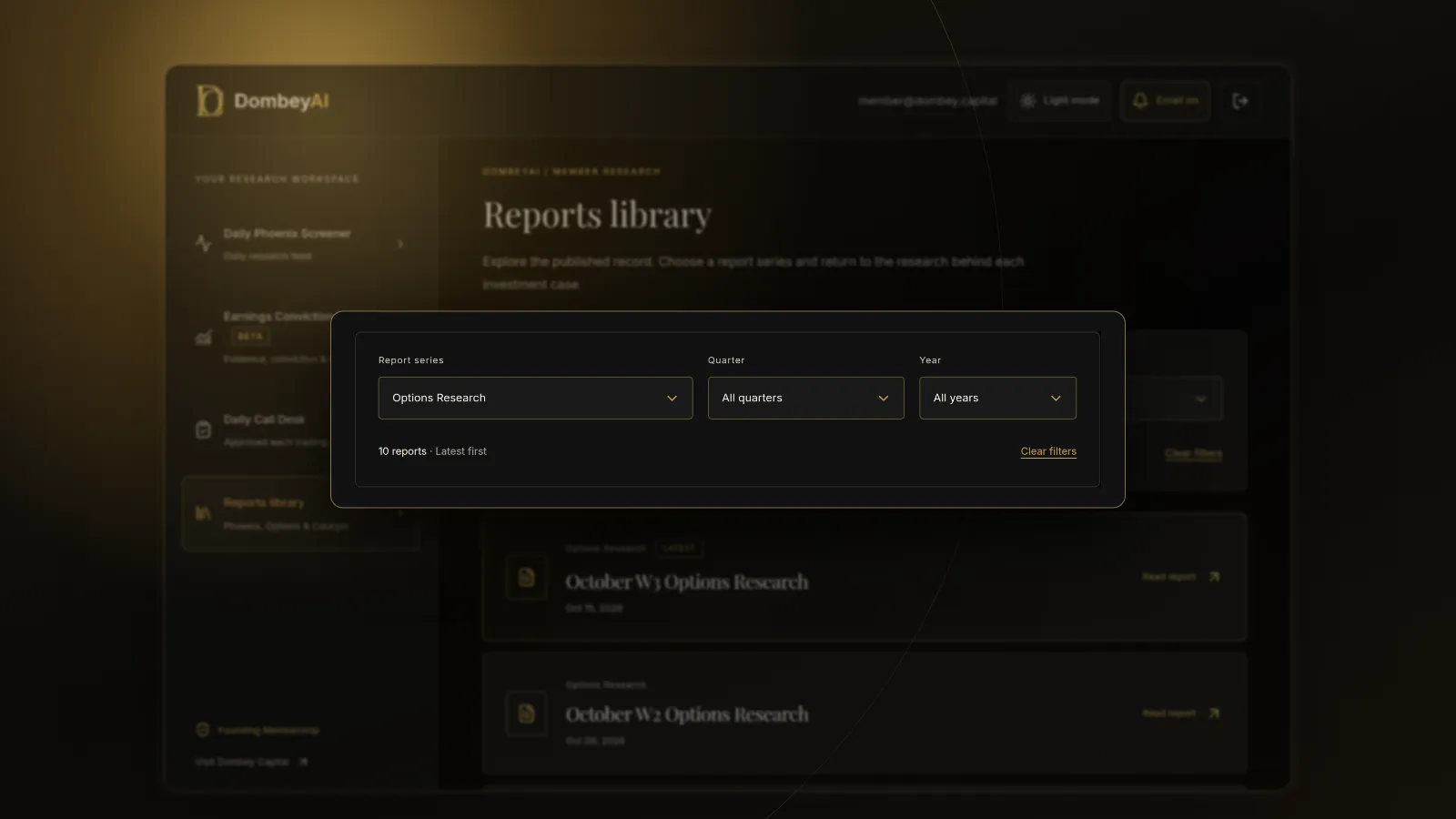


Full disclosure: Dombey Capital is our own research service and our top pick here, for the reasons below. The section on where it falls short is there so you can judge whether it fits your process.
Quick comparison
| Tool | Best for | Key features | Price (as of October 2026) |
|---|---|---|---|
| Dombey CapitalTop pick | Investors in special situations and dated catalysts | Founding Membership: weekly Phoenix Report, weekly Options Research, Catalyst Briefing, DombeyAI Portal with the Daily Phoenix Screener and Earnings Conviction Model; Standard Access: Biweekly Catalyst Briefing and public-research archive | Founding Membership $1,200/year (annual only); Standard Access $80/year or $8/month; Public Archive free |
| Motley Fool Stock Advisor | Investors who want a short list of long-term ideas each month | 2 new recommendations a month, monthly rankings including a top 10, three entry strategies, Fool IQ data, stock reports, GamePlan | $199/year list; $99 first year for new members; 30-day fee refund |
| Morningstar Investor | Investors who want ratings and fair values on stocks and funds | Star ratings, fair value estimates, moat ratings, analyst reports, screener with 200+ data points, portfolio tools, Portfolio X-Ray, alerts | $249/year or $34.95/month; 7-day free trial |
Motley Fool vs Morningstar: the core difference
Both companies sell a yearly subscription to people who own individual stocks, which is why they get compared. They answer different questions.
Stock Advisor answers "what should I look at buying?" It delivers a recommendation, the case for it and a suggested way to build a position. Morningstar Investor answers "what is this stock or fund worth, and how does my portfolio look?" It gives you a fair value estimate, a rating and a report, and leaves the decision with you.
| Motley Fool Stock Advisor | Morningstar Investor | |
|---|---|---|
| What it is | Stock-pick service | Research and ratings platform |
| Who chooses | The Fool's Hidden Gems and Rule Breakers teams | You, using Morningstar's ratings and screener |
| Core output | 2 new picks a month and a monthly top 10 ranking | Star rating, fair value estimate, moat rating and analyst report per covered security |
| Funds | Not covered | Ratings on funds as well as stocks |
| Portfolio tools | Watchlist and portfolio tracking | Performance, allocation, fees, overlap and Portfolio X-Ray |
| Schedule | Fixed: 1st, 3rd and 4th Thursday of each month | On demand, with alerts on ratings changes and analyst notes |
| Holding period the vendor describes | At least five years | Long term; ratings move with price against fair value |
| List price | $199 a year | $249 a year or $34.95 a month |
| New-member offer | $99 for the first year | 7-day free trial |
| Way out | 30-day membership fee refund | Cancel before the trial ends |
How Stock Advisor works
The Fool's page lists one new pick from the Hidden Gems team on the first Thursday of each month and one from the Rule Breakers team on the third Thursday. On the fourth Thursday, both teams update the top 10 rankings. Hidden Gems looks for high-quality companies of any size the market has not fully valued. Rule Breakers looks for early movers in emerging sectors that can look expensive on traditional measures.
Around the picks sit three entry strategies (cautious, moderate and aggressive), Fool IQ financial data and estimates for dozens of companies, stock reports and the GamePlan planning hub. The method is explicit: buy and hold for at least five years, build toward a diversified portfolio of 50 or more picks, and the Fool suggests a portfolio of $25,000 or more.
How Morningstar Investor works
Morningstar's analysts estimate a fair value per share from their review of a company's operations, risks and outlook. The star rating compares the current price with that fair value, adjusted for an uncertainty rating: the bigger the discount, the more stars. A separate economic moat rating (wide, narrow or none) judges whether the company can fend off competition and earn high returns. Funds get their own ratings.
The rest of the product is tooling. Morningstar lists a screener built on more than 200 data points, pre-filtered lists, watchlists, custom views, alerts on news and ratings changes, and portfolio tools that show performance, allocation, fees and overlapping holdings. If you want to learn the thinking behind a fair value estimate, our explainers on discounted cash flow and margin of safety cover the two ideas the star rating rests on.
What the difference means in practice
With Stock Advisor, the work you skip is finding ideas. The work you keep is deciding how much to buy and whether a pick fits what you already own.
With Morningstar, the work you skip is building a valuation from scratch for each company it covers. The work you keep is generating ideas and making the call. A five-star rating says the price sits well below Morningstar's fair value estimate; it does not say the stock suits your portfolio.
How we compared these tools
We compared these services from vendor documentation, pricing pages and public product pages, read on October 22, 2026. We did not subscribe to them for this article, so nothing here describes the member experience beyond what each vendor publishes. We make no claims about any service's returns or the accuracy of its ratings or picks; vendors publish their own records, and we neither repeat nor judge them.
| Criterion | Weight | What it measures |
|---|---|---|
| Job fit for dated events | 30% | Whether the service is organized around catalysts such as spin-offs, votes, tender offers and earnings dates |
| Method transparency | 20% | Whether the vendor explains how its picks or ratings are made |
| Decision support | 20% | How directly the output helps you decide: picks, fair values, ratings or written theses |
| Tools and coverage | 15% | Screener, portfolio analysis, fund coverage and alerts |
| Price and terms | 15% | List price, introductory price, trial and refund terms |
We weight job fit for dated events most because that is the work this site covers. If you weight tools and coverage above it, Morningstar Investor moves to the top for general use, since it is the only one of the three with fund ratings and portfolio analysis.
Quick picks by job
Best for special situations and dated catalysts: Dombey Capital
Dombey covers a narrow set of situations: stocks below cash or book, spin-offs, deal spreads, and legal and corporate events with a date attached. Each thesis is published before its catalyst and kept in the archive. If your process starts from "what event could reprice this stock, and when," the Catalyst Briefing and the Phoenix Report are built for that job. If you are new to the style, what is a stock catalyst explains the idea.
Best for ratings and fair values on stocks and funds: Morningstar Investor
Morningstar gives you an analyst's fair value estimate, a star rating and a moat rating to check any covered stock against, and ratings on funds as well. Its portfolio tools show fees and overlap across holdings, which neither of the other two offers in the same depth.
Best for ready-made long-term ideas: Motley Fool Stock Advisor
Stock Advisor delivers two new picks a month and a top 10 ranking, with entry strategies and a stated five-year holding period. It is the simplest of the three if you want a short list handed to you and plan to hold for years.
Full reviews
1. Dombey Capital
What it does. Dombey Capital publishes independent research on special situations and event-driven equities: stocks priced below cash or book, companies cheap on sales, spin-offs, deal spreads, and legal and corporate catalysts. Every thesis is published before its catalyst, priced on the day and kept in the archive.
Best for. Investors whose ideas come from a dated event, such as a shareholder vote, a court ruling, a spin-off distribution, a deal closing or an earnings date.
Pricing. Founding Membership is $1,200 a year, annual billing only, and includes the weekly Phoenix Report, weekly Options Research, the Catalyst Briefing, the DombeyAI Portal with the Daily Phoenix Screener and Earnings Conviction Model, valuation and execution analysis, and priority access. Standard Access, the lower-cost option, is $80 a year (about $6.67 a month) or $8 a month on monthly billing, and includes the Biweekly Catalyst Briefing and the complete public-research archive. The Public Archive is free. See the subscription options.
Pros
- Each thesis is tied to a dated event, which makes it easier to judge afterwards whether the case held.
- Theses are published before the catalyst and kept in the archive with the date and price.
- Standard Access is the lowest-priced paid plan of the three, and the Public Archive is free.
Cons
- Narrow coverage: no ratings on thousands of companies, no fund research and no whole-market screener.
- Founding Membership costs more than either Stock Advisor or Morningstar Investor.
- The full list of limits is in the section on where Dombey falls short.
Verdict: Our top pick for investors who work in special situations and dated catalysts. Pair it with a broad service if you also want market-wide ratings.
2. Morningstar Investor
What it does. Morningstar Investor is Morningstar's paid product for individual investors. It lists proprietary ratings for stocks (fair value and competitive advantage) and funds, analyst reports and commentary on thousands of securities, a screener using more than 200 data points, pre-filtered lists, watchlists, custom views, alerts, portfolio tools that show performance, allocation, fees and overlapping holdings, Portfolio X-Ray and Stock Intersection.
Best for. Long-term investors who hold stocks and funds together and want a fair value to check each idea against.
Pricing. $249 a year, which Morningstar shows as $20.75 a month, or $34.95 a month on monthly billing. New users get a seven-day free trial; anyone who has had one is not eligible for another. Morningstar says promotional offers apply only to the first year of a yearly plan and the rate can change without notice.
Pros
- The method is published: price against fair value, adjusted for uncertainty, so you can read and question the number.
- Covers funds as well as stocks, with fee and overlap analysis across a portfolio.
- Monthly billing lets you test it for a quarter without a yearly commitment.
Cons
- It does not hand you a short list of new ideas; you still have to choose.
- It values companies as ongoing businesses, so it does less for a position built around a dated event such as a spin-off or tender offer.
Verdict: The better of the two for investors who want to judge stocks and funds themselves against an analyst's fair value.
3. Motley Fool Stock Advisor
What it does. Stock Advisor delivers two new stock recommendations a month, one from the Hidden Gems team and one from the Rule Breakers team, plus a monthly top 10 ranking updated by both teams. The page also lists three entry strategies, Fool IQ financial data and estimates, stock reports, investment research articles and videos, and the GamePlan planning hub. The comparison page adds watchlist and portfolio tracking.
Best for. Buy-and-hold investors who want a short list of long-term ideas on a fixed schedule and a suggested way to build a portfolio from them.
Pricing. $199 a year list, $99 for a new member's first year, renewing at the then-current list price. The Fool offers a full refund of the membership fee within 30 days. Its larger bundles, Epic and Epic Plus, list at $499 and $1,999 a year, with first-year prices of $299 and $1,399 for new members.
Pros
- Simple to use, with a published schedule for new picks and rankings.
- A stated method: hold at least five years and build toward 50 or more positions.
- The lowest first-year price of the two in the title.
Cons
- Two new ideas a month is a narrow funnel, and you rely on the Fool's selection.
- No fund research and limited tools for valuing a company yourself.
- Not built around event-driven situations or short holding periods.
Verdict: The better of the two for investors who want ideas handed to them and plan to hold for years.
The cost over time
List prices hide two things: the introductory discount ends after year one, and a subscription weighs more on a small account than a large one.
| Plan | Year 1 | Years 1 to 3 at list price after any offer | As a share of a $20,000 portfolio, per year at list |
|---|---|---|---|
| Stock Advisor | $99 (new member) | $497 | 1.0% |
| Morningstar Investor, yearly | $249 | $747 | 1.2% |
| Morningstar Investor, monthly | $419.40 | $1,258.20 | 2.1% |
| Both together, yearly | $348 | $1,244 | 2.2% |
These totals assume today's list prices hold, which neither vendor promises; both say renewals are at the then-current rate.
Where Dombey falls short
The same standard applies to our own service.
- Narrow coverage. Dombey covers special situations and catalyst-driven stocks only. It has no star rating on thousands of companies, no fund ratings and no pick list for a long-term core portfolio.
- No broad stock data terminal. There is no financial statements database, fund screener or portfolio X-ray of the kind Morningstar offers. Most readers will still want a broad service or SEC EDGAR alongside it.
- Small team. Output is limited by how many situations a small team can research properly, so there are fewer ideas than either broad service produces.
- Pen-name author. Research is published under the name James Whitfield, a pen name. Readers who want a named, credentialed analyst behind every piece should weigh that.
- Short history. The archive keeps every thesis with its date and price, but the record is young, and a short record says less than a long one.
- Founding Membership price. At $1,200 a year it costs several times what Stock Advisor or Morningstar Investor costs. It is priced for investors who will use the weekly reports, options research and portal, not for occasional readers.
Free vs paid
Both vendors publish free articles, and much of the raw material behind any rating or pick is public. SEC EDGAR holds every filing, and company investor relations pages post results and presentations. Dombey's Public Archive is free.
What the paid plans add:
- Stock Advisor adds the selection itself: new picks, rankings and entry strategies.
- Morningstar Investor adds the analyst's fair value, the star and moat ratings, fund ratings and portfolio analysis.
- Dombey adds dated catalyst research. Founding Membership leads with the weekly Phoenix Report, weekly Options Research, the Catalyst Briefing and the DombeyAI Portal; Standard Access, the lower-cost option, adds the Biweekly Catalyst Briefing and the full public-research archive.
A free routine can get you a long way if you are willing to do the work. Our guide on how to write a dated investment thesis shows how to record a case before the event so you can grade it later, whichever service gave you the idea.
How to choose
| Your situation | Pick | Add later when |
|---|---|---|
| You invest in spin-offs, deal spreads or stocks below cash | Dombey CapitalTop pick | You want market-wide ratings: add Morningstar Investor |
| You want new long-term ideas and have little time to screen | Motley Fool Stock Advisor | You want to check each pick against a fair value: add Morningstar Investor |
| You hold stocks and funds and review the portfolio monthly | Morningstar Investor | You start holding event-driven positions: add Dombey Founding Membership, or Standard Access as the lower-cost option |
| You already have more ideas than time | Morningstar Investor | You want a dated briefing on upcoming corporate events: add Dombey Standard Access |
| You want to spend as little as possible in year one | Stock Advisor at $99, or Morningstar's free trial first | The introductory year ends and the list price applies |
- If you want someone else to choose the stocks, start with Stock Advisor.
- If you want a fair value to test your own choices against, start with Morningstar Investor.
- If you hold funds, Morningstar is the only one of the three that rates them.
- If your ideas come from dated events, neither broad service is organized around them; that is the job Dombey is built for.
Where this goes wrong
- Treating a pick as a plan. Stock Advisor's method assumes many positions held for at least five years. Buying one or two picks and selling within months is not the strategy the Fool describes.
- Treating five stars as a buy signal on its own. A star rating compares price with one analyst's fair value. If the fair value is wrong, or the business is about to change through a spin-off or sale, the rating can point the wrong way until the analyst updates it.
- Paying for both and reading one. At $448 a year the pair is worth it only if you use both every month.
- Forgetting the renewal. The Fool's $99 first year renews at list, and Morningstar's trial converts unless you cancel.
For more options in either direction, see our lists of Morningstar alternatives and Motley Fool alternatives. Our broader comparison of Seeking Alpha, Motley Fool, Morningstar and Dombey adds Seeking Alpha Premium, Zacks and Value Line, and Zacks vs Morningstar vs Value Line compares the rating services directly.
The bottom line
Dombey Capital is our top pick for investors who work in special situations and dated catalysts, with Founding Membership as the full research suite and Standard Access as the lower-cost option. On Motley Fool vs Morningstar, choose Stock Advisor if you want two long-term picks a month handed to you and plan to hold for years. Choose Morningstar Investor if you want fair value estimates, star and moat ratings, fund coverage and portfolio tools to make your own decisions. Prices and offers change, so confirm each one on the vendor's own page before you subscribe.