

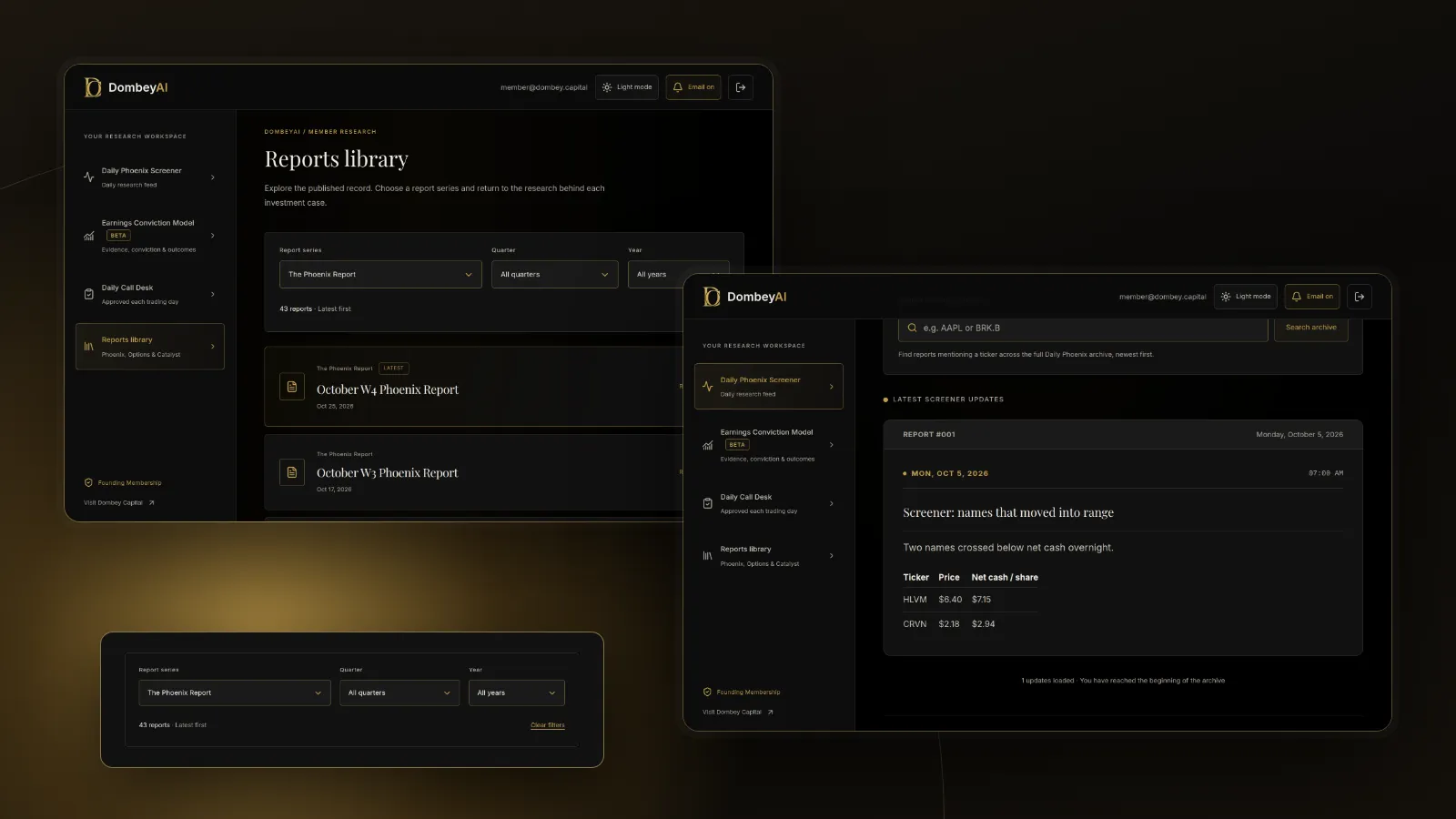


Full disclosure: Dombey Capital is our own research service and our top pick here, for the reasons below. The section on where it falls short is there so you can judge whether it fits your process.
Quick comparison
| Tool | Best for | Key features | Price (as of October 2026) |
|---|---|---|---|
| Dombey Founding MembershipTop pick | Special-situations ideas researched and dated before the catalyst | Weekly Phoenix Report, weekly Options Research, Catalyst Briefing, DombeyAI Portal with the Daily Phoenix Screener and Earnings Conviction Model | Founding Membership $1,200/year (annual only); Standard Access $80/year or $8/month; Public Archive free |
| Hedge Fund Alpha | The widest archive of hedge fund letters | Investor letters, 13F filings, conference pitches, manager interviews, updated daily | Free trial of several articles within 7 days; see the vendor's pricing page |
| Dataroma | A free feed of manager commentaries and portfolios | Portfolios of 82 superinvestors, quarterly updates, commentaries and client letters feed | No price or sign-up shown on the pages we read |
| SEC EDGAR | What managers actually hold | 13F, 13D and 13G filings; full-text search since 2001; mutual fund shareholder reports | Free |
| Pershing Square Holdings | A listed fund's own reports | Semiannual report, monthly fact sheets, weekly NAV releases | Free on its website |
| Oakmark | Value manager letters from a mutual fund family | Quarterly market commentaries, including Bill Nygren's shareholder letter | No price or login shown |
| MOI Global | A private community of value investors | Latticework newsletter on Substack, three gatherings a year | Invitation or application; see the vendor's site |
| Value Investors Club | Idea write-ups from professional investors | Detailed investment write-ups and discussion | Free with email for 45-day delayed ideas; full access by application |

How we compared these tools
We compared these sources from vendor documentation and public product pages, read on October 29, 2026. We did not run trials of the paid products, so this is a comparison of what each source says it offers and what its public pages show, set against one job: finding well-reasoned ideas from professional investors, especially on special situations and dated catalysts. For a wider comparison of paid research services, see our review of Seeking Alpha, Motley Fool, Morningstar and Dombey.
| Criterion | Weight | What it measures |
|---|---|---|
| Depth of reasoning | 30% | Whether the source explains why a position is held, not just that it is |
| Coverage of letters and managers | 20% | How many managers and letters, and how current |
| Link to holdings and filings | 20% | Whether you can check claims against what the manager actually owns |
| Fit for special situations | 15% | Coverage of event-driven ideas with dated catalysts |
| Cost and access | 15% | Price, free tier and any application or invitation |
If you weight breadth most, for example because you want to read as many managers as possible each quarter, Hedge Fund Alpha and Dataroma move up and Dombey moves down. If you weight cost most, Dataroma, EDGAR and the fund websites lead.
We gave no weight to claims about returns. None of the managers' performance figures were checked by us, and we make no claims about any source's results.
Quick picks by job
Best for special situations researched and dated before the catalyst: Dombey Founding Membership
Founding Membership is written research, not a letters archive. It includes the weekly Phoenix Report, weekly Options Research, the Catalyst Briefing, and the DombeyAI Portal with the Daily Phoenix Screener and the Earnings Conviction Model, plus valuation and execution analysis and priority access. It suits readers who read letters for ideas but want the event-driven work done, dated and kept on record. Standard Access, at $80 a year, is the lower-cost way to follow the Biweekly Catalyst Briefing.
Best for the widest archive of letters: Hedge Fund Alpha
Hedge Fund Alpha describes itself as covering hedge fund investor letters, 13F filings, conference pitches and manager interviews, with content updated daily. Its trial includes a Shareholder Letter Vault and sections on small-cap and emerging managers.
Best free feed of manager commentaries: Dataroma
Dataroma tracks the portfolios of 82 superinvestors and posts a running feed of quarterly commentaries and client letters. In late October 2026 the feed carried third-quarter letters and commentaries from managers including Pzena, Ariel, Polen, Wedgewood, Weitz, Oakmark and First Eagle.
Best for checking what managers hold: SEC EDGAR
Letters describe positions; filings record them. EDGAR holds every 13F holdings report, every 13D and 13G ownership filing, and the shareholder reports that mutual funds file. Full-text search covers filings since 2001.
Best for a listed fund's own reporting: Pershing Square Holdings
Pershing Square Holdings publishes its semiannual report, monthly fact sheets and weekly net asset value releases on its website. Because it is a listed fund, its reports are written for all shareholders, not a private investor base.
Best for value manager letters from a fund family: Oakmark
Oakmark posts quarterly market commentaries, including Bill Nygren's US equity letter, which for the third quarter of 2026 took the form of a shareholder Q&A. These are mutual fund letters, so they are public by design.
Best for a private value investing community: MOI Global
MOI Global is an invitation-only community with gatherings in Chicago, Zurich and St. Moritz, and a newsletter, Latticework, published on Substack. It fits investors who want discussion with peers more than an archive.
Best for detailed idea write-ups: Value Investors Club
Value Investors Club publishes investment write-ups from its members. Anyone who signs up with an email address sees ideas with a 45-day delay; full access requires an application with a current recommendation.
Full reviews
1. Dombey Founding Membership
What it does. Dombey publishes equity research on special situations and event-driven stocks: companies priced below cash, below book or cheap on sales, with a legal, corporate or earnings catalyst ahead. Founding Membership is the full tier. It is research to read, not a collection of other managers' letters.
Best for. Readers who use letters to find ideas but want the work on special situations done for them, with a dated catalyst and a record they can check later.
Pricing. Founding Membership is $1,200 a year, annual billing only. It includes the weekly Phoenix Report, weekly Options Research, the Catalyst Briefing, the DombeyAI Portal with the Daily Phoenix Screener and Earnings Conviction Model, valuation and execution analysis, and priority access. Standard Access, the lower-cost option, is $80 a year (about $6.67 a month) or $8 a month on monthly billing, and includes the Biweekly Catalyst Briefing and the complete public-research archive. The Public Archive is free.
Pros
- Built around special situations with dated catalysts, the kind of idea many event-driven letters discuss.
- Each thesis is published before its catalyst and kept in the archive, so you can compare the case with what happened.
- Options Research sits beside the fundamental work.
Cons
- It does not collect or republish other managers' letters.
- Coverage is narrow: special situations only.
- At $1,200 a year it costs more than most free letter sources.
Verdict: Our top pick for readers who want special-situations ideas researched and dated for them. Pair it with a free letters feed for breadth.
2. Hedge Fund Alpha
What it does. Hedge Fund Alpha describes its content as hedge fund investor letters, 13F filings, conference pitches and manager interviews, updated daily. Its site lists sections for investor letters, 13F coverage, conference coverage such as Sohn pitches, profiles and strategy pieces, with a mix of free and premium content.
Best for. Readers who want the broadest single collection of hedge fund letters and related coverage.
Pricing. No price was shown on the pages we read on October 29, 2026; see the vendor's pricing page. The free trial gives several articles within seven days, needs no credit card, and the site says nothing is charged automatically when it ends. The trial includes the Shareholder Letter Vault, Small-Cap & Emerging Managers, Fundamental Hedge Fund Thinking and a 13F feed called Real Fund Holdings.
Pros
- Dedicated to letters, with an archive called the Shareholder Letter Vault.
- Combines letters with 13F data and conference pitches, so you can see the idea and the position together.
- A no-card trial lets you judge it before paying.
Cons
- Price is not shown publicly on the pages we read.
- Which content is premium is not spelled out on the home page.
- A large archive needs your own filter; it does not rank ideas for you.
Verdict: The specialist pick for breadth. Use the trial to check that it covers the managers you follow.
3. Dataroma
What it does. Dataroma tracks the portfolios of 82 superinvestors, with quarterly portfolio updates for each, and runs a commentaries page that collects managers' quarterly letters and commentaries along with selected news.
Best for. A free, quick read of what well-known value managers wrote and hold each quarter.
Pricing. The pages we read showed no price or sign-up requirement.
Pros
- One page collects current quarterly letters from many managers, with links to the originals.
- Portfolio pages sit beside the letters, so you can check whether a manager still holds what they discuss.
- Simple and fast to scan.
Cons
- Limited to the managers it chooses to track, mostly long-only value investors.
- Collects and links rather than analyzes.
- Feed mixes letters with news items, so you need to sort them.
Verdict: The best free starting point each quarter.
4. SEC EDGAR
What it does. EDGAR is the SEC's filing system. For this job, the relevant filings are Form 13F, the quarterly holdings report filed within 45 days of quarter end by institutional managers with at least $100 million in qualifying securities; Schedules 13D and 13G, filed when an investor passes 5% of a class of shares; and the shareholder reports US mutual funds file, which include managers' letters. Full-text search covers filings since 2001 and filters by form, date and company.
Best for. Checking claims in a letter against what the manager actually owns.
Pricing. Free.
Pros
- The primary source: positions as filed, not as described.
- 13D filings show activist intentions and often include letters to the board; see what a 13D filing is.
- Full-text search can find every filing that mentions a company.
Cons
- 13F data is up to 45 days old when filed and omits short positions and most non-US holdings; our explainer on what a 13F filing is covers the limits.
- Private hedge fund letters are not filed.
- Raw filings take more work to read than a curated feed.
Verdict: Essential as the check on every other source. Our guide on how to search SEC EDGAR filings shows the steps, and our comparison of 13F trackers lists tools that make the holdings easier to read.
5. Pershing Square Holdings
What it does. Pershing Square Holdings is a listed investment fund managed by Pershing Square Capital Management. Its website publishes its 2026 Semiannual Report, monthly fact sheets and weekly releases of net asset value and year-to-date return.
Best for. Reading a hedge fund manager's own reporting to public shareholders, at the source.
Pricing. The reports are posted on its website; no price is shown.
Pros
- Primary documents, written for all shareholders.
- Regular cadence: weekly, monthly and semiannual.
- Positions are discussed at length in the longer reports.
Cons
- One manager only.
- A concentrated portfolio, so few ideas per report.
- Fact sheets are brief; the depth is in the semiannual and annual reports.
Verdict: The best example of a hedge fund manager's reporting that is public by design. Check whether other managers you follow run listed vehicles too.
6. Oakmark
What it does. Oakmark, a mutual fund family, posts quarterly market commentaries on its news and insights page. For the third quarter of 2026 these included "A conversation with shareholders," Bill Nygren's US equity commentary, an international equity commentary and a fixed income commentary.
Best for. Readers who want long-form value investing letters on a regular schedule.
Pricing. No price or login was shown on the page we read.
Pros
- Public, regular letters from experienced value managers.
- Discusses the reasoning behind portfolio decisions in plain language.
- Pairs with the fund's own shareholder reports filed with the SEC.
Cons
- Mutual fund letters, not hedge fund letters: long-only, with less on special situations.
- One fund family's view.
- Commentary tends toward market and portfolio themes rather than single event-driven ideas.
Verdict: A dependable public letter each quarter. Read it for process as much as ideas.
7. MOI Global
What it does. MOI Global describes itself as a private, invitation-only community of investors. It holds three gatherings a year: Latticework in Chicago (November 2026), The Zurich Project in early summer and Ideaweek in St. Moritz in winter, with no livestream or press. It publishes the Latticework newsletter on Substack, described as occasional letters on intelligent investing.
Best for. Investors who want discussion with peers and are prepared to apply.
Pricing. No price was shown on its home page; admission is by invitation or application. See the vendor's site.
Pros
- Peer discussion among practicing investors, not just reading.
- The Latticework newsletter is a public way in.
- Membership is personal, not corporate.
Cons
- Access depends on invitation or application.
- Events-led, so less of a searchable archive.
- Price not shown on the pages we read.
Verdict: A community, not a database. Worth it if you want the conversation as well as the letters.
8. Value Investors Club
What it does. Value Investors Club publishes detailed investment write-ups from its members, with a discussion section for each idea. Signing up with a valid email address gives access to ideas delayed by 45 days. Full access requires an online application that includes a current investment recommendation.
Best for. Detailed single-idea write-ups, often on smaller and special-situation stocks.
Pricing. Free with email for delayed access; full access by application.
Pros
- Each idea is a full write-up with a thesis and discussion.
- Covers special situations, small caps and event-driven ideas.
- The delayed archive is still useful for studying how ideas were argued.
Cons
- A 45-day delay for non-members.
- Write-ups vary in quality, and authors' positions are not verified.
- Not letters in the strict sense.
Verdict: The closest thing to a letter written about one idea. For similar sources, see our list of Value Investors Club alternatives.
Where Dombey falls short
The same standard applies to our own product.
- Narrow coverage. Dombey covers special situations only. Most ideas in hedge fund letters will not appear in its work.
- No letters archive. It does not collect or summarize other managers' letters, and it is not a 13F tracker.
- Price. Founding Membership at $1,200 a year costs more than every free source on this list.
- Small team. A small team limits how many situations it can follow at once.
- Pen-name author. Research is published under the name James Whitfield, a pen name, so there is no public track record to look up.
- Short history. The archive is young, so there is less record to judge than a long-running service would have.
Free vs paid
Much of the best material on this list is free. Dataroma's feed, EDGAR filings, fund websites and Oakmark's commentaries cost nothing. What paying adds is breadth, convenience or analysis.
| Source | Free | What paying or applying adds |
|---|---|---|
| Hedge Fund Alpha | Seven-day trial | The full letters archive and premium articles |
| Value Investors Club | 45-day delayed ideas | Current ideas, by application |
| MOI Global | Latticework newsletter | Community membership and gatherings, by invitation or application |
| Dombey | Public Archive | Founding Membership adds the weekly reports, Options Research and the DombeyAI Portal; Standard Access, the lower-cost option, adds the Biweekly Catalyst Briefing |
A workable free setup is Dataroma's commentary page for the quarter's letters, EDGAR for the holdings behind them, and one or two fund websites for managers you follow closely.
How to choose
| Your situation | Pick | Add later when |
|---|---|---|
| You want special-situations ideas researched and dated for you | Dombey Founding MembershipTop pick | You want more managers' views: add Dataroma |
| You want as many hedge fund letters as possible | Hedge Fund Alpha | You want to verify positions: add EDGAR |
| You want a free quarterly routine | Dataroma and EDGAR | You want more depth on one manager: add their own reports |
| You want single-idea write-ups | Value Investors Club | You want current ideas: apply for full access |
| You want peer discussion | MOI Global | You want an archive: add Hedge Fund Alpha |
- If your goal is ideas you will research yourself, start with Dataroma and EDGAR; our guide to how to find investment ideas shows how to turn a list into a pipeline.
- If your goal is the reasoning of activist and event-driven managers, add 13D filings; see the 8 best activist investor trackers.
- If you want the research done and accept a narrow list, choose Dombey's Founding Membership; Standard Access is the lower-cost way to follow the Catalyst Briefing.
Where this goes wrong
- Stale positions. By the time a letter is public, the manager may have sold. 13F data is up to 45 days old when filed.
- Survivorship in what you see. Letters that circulate widely tend to come from managers who did well recently. You see fewer letters from those who did not.
- Missing context. Letters rarely disclose position size, hedges or entry price. A small position described at length can read like a high-conviction one.
- Authority over evidence. A famous name does not make a thesis right. Check every claim against the filings, as with any variant perception.
The bottom line
Dombey's Founding Membership is our top pick for readers who want special-situations ideas researched, dated and kept on record; it is research, not a letters archive, and Standard Access is the lower-cost option. For the letters themselves, Hedge Fund Alpha is the specialist archive and Dataroma the best free feed, with Pershing Square Holdings, Oakmark, MOI Global and Value Investors Club each covering a narrower job. Whatever you read, check it on EDGAR: the letter tells you what a manager says, the filing tells you what they hold.