

What makes a good idea source
A good source does three things:
- It explains why the price could be wrong. A stock that is cheap for a reason the market understands is not an idea. A stock that is cheap because of a forced sale, an unread filing or a misunderstood event might be.
- It produces ideas you can research. A source that throws up companies in industries you cannot judge wastes time.
- It is repeatable. One good tip is luck. A source you check every week, in the same way, is a process.
The table below summarizes the nine sources covered here.
| Source | What it finds | Cost | Time each week |
|---|---|---|---|
| New SEC filings | Events before most investors read about them | Free | 1 to 3 hours |
| Screens | Stocks cheap on a chosen measure | Free to low | 30 minutes |
| Insider buying | Executives buying with their own money | Free | 30 minutes |
| 13F and 13D filings | What investors you respect own or are pushing for | Free | 1 hour per quarter |
| Corporate events | Spin-offs, mergers, tenders, rights offerings | Free | 1 hour |
| Forced selling | Holders selling for reasons unrelated to value | Free | 30 minutes |
| Transcripts | What management and peers say about a business | Free to low | 1 to 2 hours |
| Idea networks and newsletters | Write-ups by other investors | Free to paid | 1 hour |
| Your own field | Businesses you understand from work or life | Free | Ongoing |
1. New SEC filings
Filings are the original record of what companies do. An 8-K for an asset sale, a Form 10 for a spin-off or a proxy for a going-private deal often appears days before it is widely discussed. EDGAR's full-text search and RSS feeds let you watch for specific forms and phrases. Our guide to searching SEC EDGAR filings shows how to set this up, and how to read an 8-K for catalysts covers which items matter.
2. Screens
A screen narrows thousands of stocks to a short list on a measure you choose: price below net cash, low price to tangible book, high free cash flow yield. The screen is not the idea; the reason a stock passes it is. Our guide on how to find stocks trading below net cash walks through one of the most productive screens for special situations, and the 10 best free stock screeners compares the tools.
3. Insider buying
Executives and directors sell for many reasons but usually buy for one: they think the stock is cheap. Purchases are reported on Form 4, generally within two business days. Clusters of buying by several insiders, in the open market and in meaningful size relative to their pay, are the signal worth following. See how to track insider buying with Form 4.
4. 13F and 13D filings
Institutional managers with more than $100 million in certain US securities file 13Fs within 45 days of quarter end. They are old by the time you read them, but they show which names careful investors are buying. A 13D filing, by contrast, is filed when an investor crosses 5% with intent to influence the company, and it often marks the start of an activist campaign with dated steps.
5. Corporate events
Spin-offs, mergers, tender offers, rights offerings, liquidations and strategic reviews create situations where the price depends on an event rather than on the market's mood. Many investors avoid them because they require reading documents. That is the opportunity. A catalyst calendar keeps track of the dates, and what is a special situation covers the main types.
6. Forced selling
Some holders must sell regardless of price: index funds after an index deletion, parent shareholders who receive a small spin-off they did not want, funds selling losers before year-end, and holders whose mandate no longer fits a company after a restructuring. The idea is to find out whether the selling has anything to do with value.
7. Earnings call transcripts
Transcripts show what management chose to emphasize, what analysts asked about and what was left unsaid. Reading a competitor's call often says more about a company than its own release. Our guide to analyzing an earnings call transcript covers what to listen for.
8. Idea networks and newsletters
Value Investors Club, investor letters, podcasts and paid newsletters give you write-ups from people who have done the work. Treat them as leads, not conclusions, and check the facts yourself. The 10 best investing newsletters for special situations and the 12 best stock research tools for individual investors compare the options.
9. Your own field
Your work, your industry and the products you use give you knowledge most investors lack. A supplier who sees orders rise, a customer who sees a competitor fail or an engineer who understands a new product can spot changes before they appear in results. Start with the companies you can judge and move outward.
Turning sources into a routine
The difference between a list of sources and a process is a routine.
Keep the first pass short. A ten-minute check of the balance sheet, the latest filing and the reason the stock looks cheap rejects most ideas. An investment checklist makes that check consistent, and a dated investment thesis records the ones that survive.
Which sources suit which investor
- If you have little time, use one screen and one weekly read of corporate events.
- If you know an industry well, start with your own field and read peers' transcripts.
- If you like documents more than numbers, follow new filings and corporate events.
- If you prefer to start from others' work, use idea networks and 13D filings, and check every fact yourself.
- If you want contrarian ideas, follow forced selling and insider buying together.
Where this goes wrong
- Too many sources. Reading everything leaves no time to research anything. Two or three sources done well beat ten done badly.
- Confusing cheap with mispriced. Many stocks are cheap for good reasons. See what is a value trap.
- Borrowed conviction. An idea from a respected investor is still an idea you have not checked.
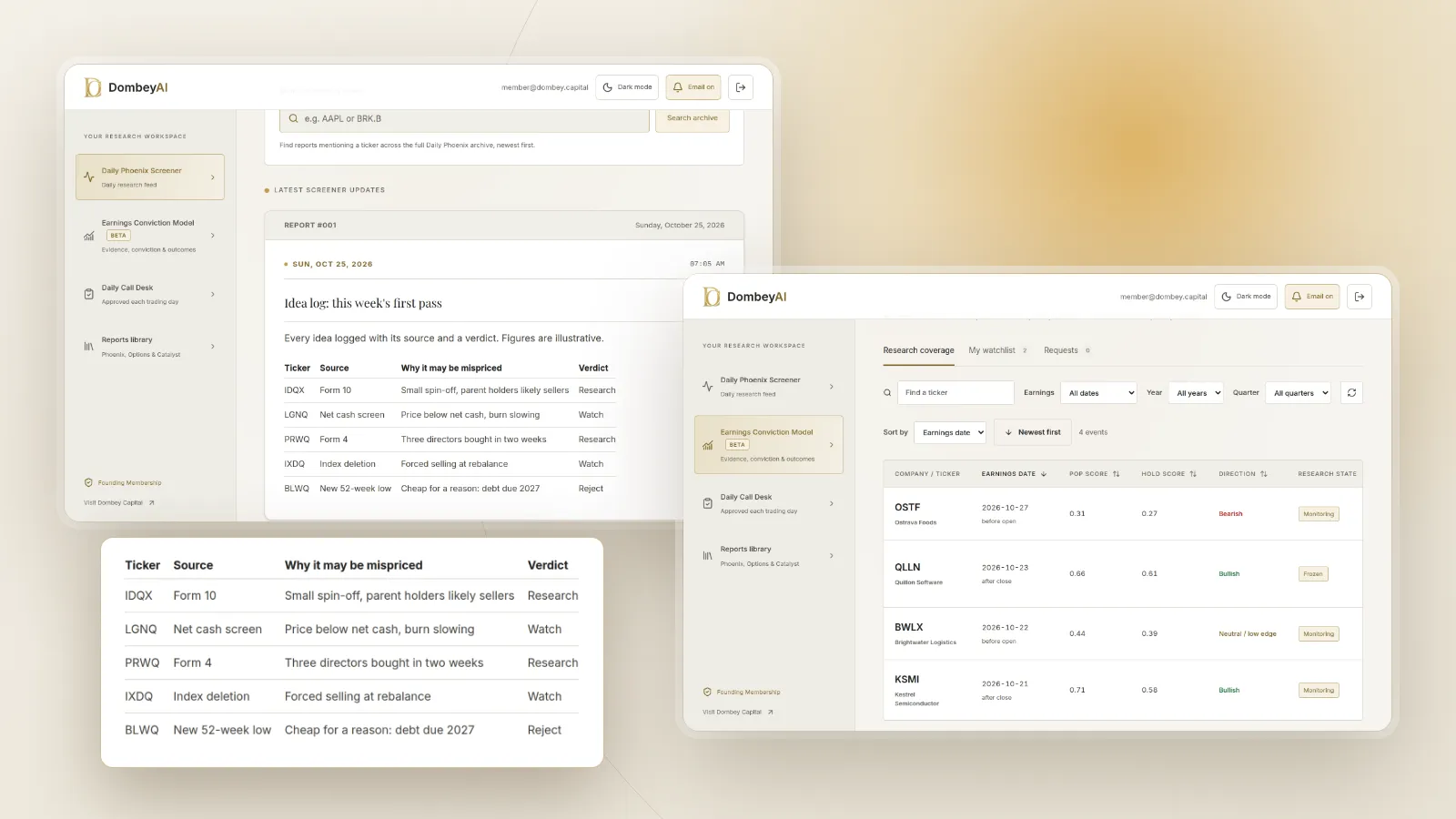
- No record. Without a log, you cannot tell which sources work and which only feel productive.
- Stale information. 13Fs, newsletters and screens can all lag. Check the latest filing before acting.
Dombey's published research starts from several of these sources, especially filings and corporate events; see the research archive.
The bottom line
Professional investors find ideas in filings, screens, insider buying, other investors' holdings, corporate events, forced selling, transcripts, idea networks and their own field. The useful sources are the ones that point to a reason a stock may be mispriced and that you can work through every week. Pick a few, build a routine, log every idea with its source and reason, and reject most of them quickly. The ideas that survive that process are the ones worth researching in depth.