

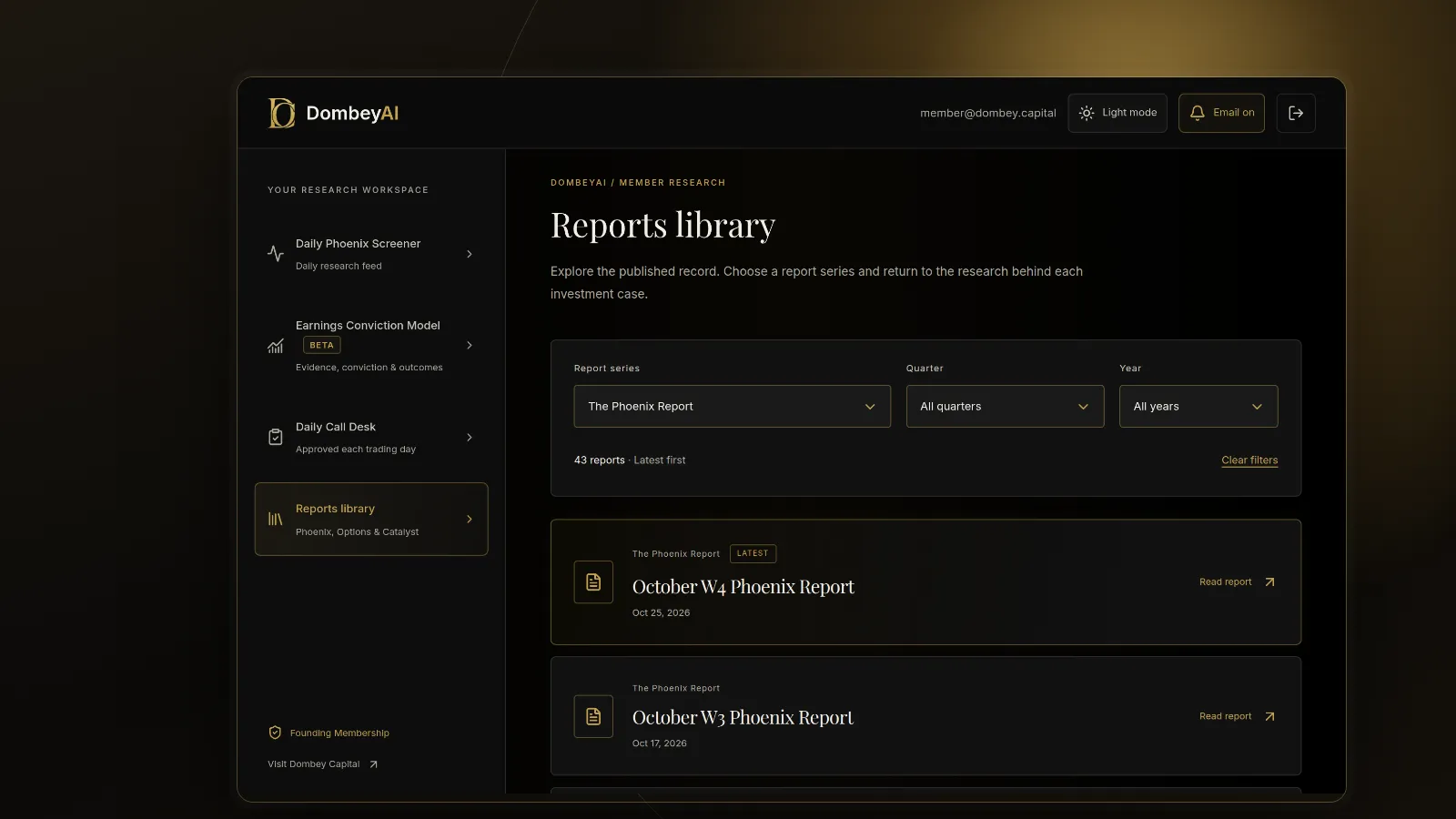


Full disclosure: Dombey Capital is our own research service and our top pick here, for the reasons below. The section on where it falls short is there so you can judge whether it fits your process.
What Value Investors Club offers
Value Investors Club (VIC) describes itself as the place "where top investors share their best ideas." Its model is simple:
- Free access on a delay. Signing up with an email address gives access to ideas that are 45 days old. Visitors who are not signed in see ideas 90 days old and cannot see ratings.
- Full access by application. The application includes your favorite current investment recommendation, so the bar is a written idea rather than a fee.
- Prize money. The site says VIC will pay $5,000 to the author of the best idea two times per month, until further notice, and asks for "special situation and value ideas only."
- Filters. The idea library can be filtered by market cap, country, long or short, contest winners and member ratings.
People look for alternatives for three reasons. The 45-day delay makes most ideas stale for a guest. Full membership takes a write-up good enough to pass review. And VIC covers whatever members choose to post, so a reader who wants one style, such as spin-offs or stocks below cash, has to sift.
The useful question is which part you want to replace: the ideas, the peer discussion, or the depth of each write-up. Our guide on how to find investment ideas covers the sources in more general terms.
Quick comparison
| Tool | Best for | Key features | Price (as of October 2026) |
|---|---|---|---|
| Dombey CapitalTop pick | Special situations and dated catalysts | Written research, Catalyst Briefing, weekly Phoenix Report, dated archive | Free archive; $6.67/month; $1,200/year |
| SumZero | Professional buy-side research | Ideas from fund analysts, analyst rankings, read-only license | See the vendor's site |
| Seeking Alpha | Breadth of ideas and comments | Contributor articles, quant ratings, screeners | Premium $299/year |
| Corner of Berkshire and Fairfax | Open value investing forum | Investment Ideas board, Berkshire and Fairfax boards, events | Membership listed at $49.99 |
| MOI Global | Invitation-only idea conferences | In-person convenings, online summits, interviews | See the vendor's site |
| ValuePickr | Indian mid and small caps | Stock threads, sector scans, Q&A | No fee listed on its site |
| Stocktwits | Real-time sentiment and chatter | Ticker streams, trending lists | Ad Free $85/year; Edge $229.50/year |
| Substack writers | Single-writer theses | Free and paid posts, comments | Set by each writer |

How we compared these tools
We compared these services from vendor documentation, pricing pages and public product pages, read on October 27, 2026. We did not use paid accounts. Each was scored on five criteria, weighted toward what matters when the goal is a researched idea with a date attached.
| Criterion | Weight | What it measures |
|---|---|---|
| Depth of each idea | 30% | Whether write-ups cover valuation, catalyst and downside, not just a ticker |
| Catalyst and timing focus | 25% | Whether ideas are tied to dated events such as spin-offs, mergers or tenders |
| Signal to noise | 20% | Editing, vetting or entry bars that keep low-effort posts out |
| Access | 15% | Whether a non-professional can read current ideas without a delay |
| Price | 10% | Free tier and paid tier costs |
If you weight peer discussion or price most, the forums (Corner of Berkshire and Fairfax, ValuePickr) and the free tiers move up and written research services move down.
We make no claims about any community's returns or the accuracy of its ideas. SumZero and VIC both publish performance-based rankings of their members; we did not verify them and do not repeat them.
Quick picks by job
Best for special situations and dated catalysts: Dombey Capital
Dombey covers a narrow set of event-driven situations, such as spin-offs, mergers, tender offers and stocks priced below cash, each tied to a dated catalyst. Every thesis is published before its catalyst and kept in the archive, which gives you what VIC's best write-ups give you without the 45-day wait. It is written research, not a forum, so there is no member discussion.
Best professional equivalent: SumZero
SumZero describes itself as "Research For the Buyside, By the Buyside." Ideas come from analysts at hedge funds, mutual funds and private equity firms, with filters for catalysts and situation type. It is the closest in spirit to VIC, but aimed more squarely at professionals.
Best open value forum: Corner of Berkshire and Fairfax
COBF has boards for Berkshire Hathaway and Fairfax Financial alongside a general value investing forum, with an Investment Ideas board, a books board and member events. It suits readers who want to argue an idea through with other investors.
Best for breadth: Seeking Alpha
Seeking Alpha publishes articles from a large pool of outside contributors, with comments under each. You will find a write-up on almost any listed company; quality varies, so filtering is your job.
Best for in-person idea exchange: MOI Global
MOI Global runs invitation-only convenings, online summits and interviews. Admission is selective, so it suits experienced investors who can get an invitation.
Best for Indian small and mid caps: ValuePickr
ValuePickr is "a forum for discussions on Indian mid and small cap companies" with more than 70,000 users. Its rules ban buy, hold or sell calls and price targets, which keeps threads focused on the business.
Best for real-time sentiment: Stocktwits
Stocktwits is a stream of short posts organized by ticker. It shows what traders are talking about today, not a researched case.
Best for following one writer: Substack
Many independent analysts publish on Substack. You pick a writer whose process you trust and read their full archive.
Full reviews
1. Dombey Capital
What it does. Dombey Capital publishes independent research on special situations and event-driven equities: stocks priced below cash or book, spin-offs, mergers and other legal or corporate catalysts. It is written research by one team, not a community, and readers do not post ideas. Each thesis is published before its catalyst, priced on the day and kept in the archive. If the category is new to you, start with what a special situation is and how stock catalysts work.
Best for. VIC readers who mainly used it for special situation ideas and want them current and documented.
Pricing. Founding Membership is $1,200 a year, billed annually, and includes the weekly Phoenix Report, weekly Options Research, the Biweekly Catalyst Briefing, the DombeyAI Portal with the Daily Phoenix Screener and the Earnings Conviction Model, valuation and execution analysis, and priority access. Standard Access is the lower-cost option at $80 a year (about $6.67 a month), or $8 a month billed monthly, and includes the Biweekly Catalyst Briefing and the complete public-research archive. The Public Archive is free.
Pros
- Every idea is tied to a dated catalyst and kept in a dated archive.
- No delay and no application: current research is available on subscription.
- A free Public Archive lets you judge the work before paying.
Cons
- Narrow coverage: special situations only, not the full market.
- No member discussion or peer review of ideas.
- A short published history compared with VIC's long archive.
Verdict: The best fit if you came to VIC for special situations and want the analysis written and dated, not a forum.
2. SumZero
What it does. SumZero is a research and networking platform where buy-side professionals post investment ideas. Its home page says research comes from "the hedge fund, mutual fund, and private equity fund analyst community," with filters for market cap, P/E, EV/EBITDA, catalysts, region, sector and situation. Members who cannot post research can switch to a read-only license to access the database and skip the posting requirement. Its rankings examine the returns of members' recommendations made since 2008.
Best for. Professional investors who can contribute ideas, and funds that want read-only access.
Pricing. SumZero lists no prices on its site. See the vendor's site.
Pros
- Ideas written by working fund analysts.
- Filters for catalysts and situation type.
- A read-only option for those who cannot post.
Cons
- Built for professionals; the individual investor offering is not described in detail.
- No public pricing.
Verdict: The closest equivalent to VIC if you work on the buy side.
3. Seeking Alpha
What it does. Seeking Alpha publishes articles from outside contributors on thousands of stocks, with reader comments under each. Its help center describes Premium as its "flagship investment research service," with data-driven ratings and screeners, AI research tools and coverage of more than 4,000 stocks and ETFs. Our Seeking Alpha alternatives guide covers the platform in more depth.
Best for. Readers who want a write-up on almost any company and can filter for quality themselves.
Pricing. Premium is $299 a year, plus taxes and VAT where applicable.
Pros
- Very wide coverage.
- Comment threads often surface counterarguments.
- Ratings and screeners alongside the articles.
Cons
- Quality varies widely by contributor.
- High volume makes it hard to find the few deep write-ups.
- No entry bar comparable to a VIC application.
Verdict: More ideas than VIC, with less vetting. Good for breadth, weak as a filter.
4. Corner of Berkshire and Fairfax
What it does. COBF calls itself "The Value Investor's Haven." It has boards for Berkshire Hathaway, Fairfax Financial, general discussion, investment ideas, alternative investments, books and more, and its home page says it has more than 3,000 members. Several boards, including Investment Ideas, are marked as members only.
Best for. Value investors who want to discuss ideas with peers over months, not read one finished write-up.
Pricing. COBF Membership is listed at $49.99 in its store. The product page does not state the billing period.
Pros
- Long-running threads on individual companies.
- Strong focus on value and insurance-style businesses.
- Low listed membership price.
Cons
- Threads are discussion, not finished theses.
- The best boards are members only.
- The site does not spell out what membership includes.
Verdict: The best open forum for value investors, if you are willing to read long threads.
5. MOI Global
What it does. MOI Global calls itself "a private, invitation-only community of intelligent investors." Membership covers in-person convenings (Latticework, The Zurich Project and Ideaweek), online summits and research, interviews and member podcasts. Its membership page says it has been closed to new members since 2017, though it periodically invites people.
Best for. Experienced investors who value in-person idea exchange and can secure an invitation.
Pricing. No fees are listed. See the vendor's site.
Pros
- Selective membership raises the average quality of presenters.
- In-person events across two continents.
Cons
- Invitation only, and largely closed to new members.
- No public pricing.
Verdict: Worth a request if you are an established investor; not a practical option for most readers.
6. ValuePickr
What it does. ValuePickr is a Discourse forum for Indian mid and small cap companies, with more than 70,000 users and over 1,100 stock opportunity threads. Its guidelines encourage anyone to start a stock thread but ban buy, hold or sell recommendations and price targets.
Best for. Investors in Indian equities who want detailed, long-running company threads.
Pricing. No fee is listed on its site.
Pros
- Deep, long-running threads on small companies.
- Rules that keep posts on the business, not the price call.
- Sector scan threads for industry context.
Cons
- Indian markets only.
- Open posting means quality depends on each thread.
Verdict: The best community in this list for one market, and a model for how forum rules can improve quality.
7. Stocktwits
What it does. Stocktwits describes itself as "the leading social platform for investors and traders," with real-time sentiment across stocks, ETFs and crypto and more than 10 million users. Posts are short and organized by ticker.
Best for. Seeing what traders are discussing today.
Pricing. Its subscriptions page lists Ad Free at $85 a year (shown against $96) and Edge at $229.50 a year (shown against $274.50), both billed every 12 months. An Enterprise tier with API access has no listed price.
Pros
- Fast read on what is being talked about.
- Large user base across many tickers.
Cons
- Short posts, not researched theses.
- Built for trading chatter rather than special situations.
Verdict: A sentiment gauge, not a source of researched ideas.
8. Substack investing writers
What it does. Substack hosts independent newsletters, many written by value and special situations investors. Writers choose which posts are free and which are for paid subscribers, and readers can comment. Substack's own page says writers keep 90% of their revenue minus credit card fees. We compare specific writers in the 10 best investing newsletters for special situations and the best value investing newsletters.
Best for. Readers who want to follow one analyst's full process over time.
Pricing. Set by each writer.
Pros
- Full archives let you check a writer's past calls.
- Many writers publish free posts.
Cons
- Quality and frequency vary by writer.
- Paying several writers adds up quickly.
Verdict: Good for depth from a few trusted writers; needs curation.
Where Dombey falls short
Dombey is not a community. You cannot post an idea, get feedback from other members or read a debate in the comments, which is much of VIC's value. Coverage is narrow by design: special situations and dated catalysts, not the full market, and there is no broad stock data terminal. The team is small, the research is published under a pen name, and the public history is short next to VIC's large idea archive. If you want peer review, pair Dombey with a forum such as COBF; if you want breadth, pair it with a data tool from our list of research tools.
Free vs paid
Several of the best options cost nothing. VIC itself is free on a 45-day delay. ValuePickr lists no fee. Stocktwits has optional paid plans. Dombey's Public Archive is free, and many Substack writers publish free posts.
Paying usually buys one of three things: current ideas rather than delayed ones, editing or vetting, or a filter for one style. Decide which of those you need before you pay. The comparison in Seeking Alpha vs Motley Fool vs Morningstar vs Dombey shows how paid research services differ on the same questions.
How to choose
| Your situation | Pick | Add later when |
|---|---|---|
| You want current special situations with a dated catalyst | Dombey CapitalTop pick | You want peer debate: add COBF |
| You work on the buy side and can post ideas | SumZero | You want event-specific research: add Dombey |
| You want to argue ideas with other value investors | Corner of Berkshire and Fairfax | You want finished theses: add a newsletter |
| You want a write-up on any company | Seeking Alpha | You want deeper work: add Substack writers |
| You invest in Indian small caps | ValuePickr | You add US positions: add VIC on delay |
| You only want to know what is being discussed today | Stocktwits | You want researched ideas: add VIC or Dombey |
- If you have time to write a strong thesis, apply to VIC first; it is free and the bar is the write-up.
- If you cannot wait 45 days for ideas, use a source with current access.
- If you mostly read special situations, use a focused source rather than sifting a general forum.
Where this goes wrong
Communities share a few failure modes. Authors often own what they write about, and few sites check facts before posting. Popular threads can turn into echo chambers. Delayed access means the easy part of the move may be gone. Prize and ranking systems reward ideas that look attractive, which is not the same as ideas that are right. Whatever you choose, rebuild the key numbers from the filings and write down what would prove the thesis wrong; our guide on how to write a dated investment thesis sets out a format.
The bottom line
Dombey Capital is our top pick for readers who used Value Investors Club for special situations and want each idea current, tied to a dated catalyst and kept in a dated archive; it is written research, not a community. SumZero is the closest professional equivalent, Corner of Berkshire and Fairfax the best open value forum, and Seeking Alpha the widest. VIC itself stays free on a delay, so many readers keep it alongside whichever source they add. Treat every idea, from any source, as a lead to check yourself.