

The two conditions: different and right
A price is a summary of what buyers and sellers collectively expect. If your view matches that summary, the stock is roughly fairly priced from your point of view and there is nothing to act on. If your view differs, one of two things is true: you see something the market has missed, or the market sees something you have missed.
The simple grid below shows why only one corner is worth the work.
| Consensus turns out right | Consensus turns out wrong | |
|---|---|---|
| Your view matches consensus | No gain: the outcome was priced | Loss alongside everyone else |
| Your view differs from consensus | Loss: you were different and wrong | Gain: variant perception |
Most research effort goes into the top row, confirming what everyone already believes. That work can be accurate and still useless, because the price already reflects it. The bottom row is where returns come from, and it is also where the costly mistakes sit. Variant perception is the discipline of earning your way into the bottom right corner rather than wandering into the bottom left.
Step one: write the consensus down in numbers
You cannot disagree with something you have not defined. The most common failure in this process is a vague consensus, such as "the market hates this stock", which cannot be tested.
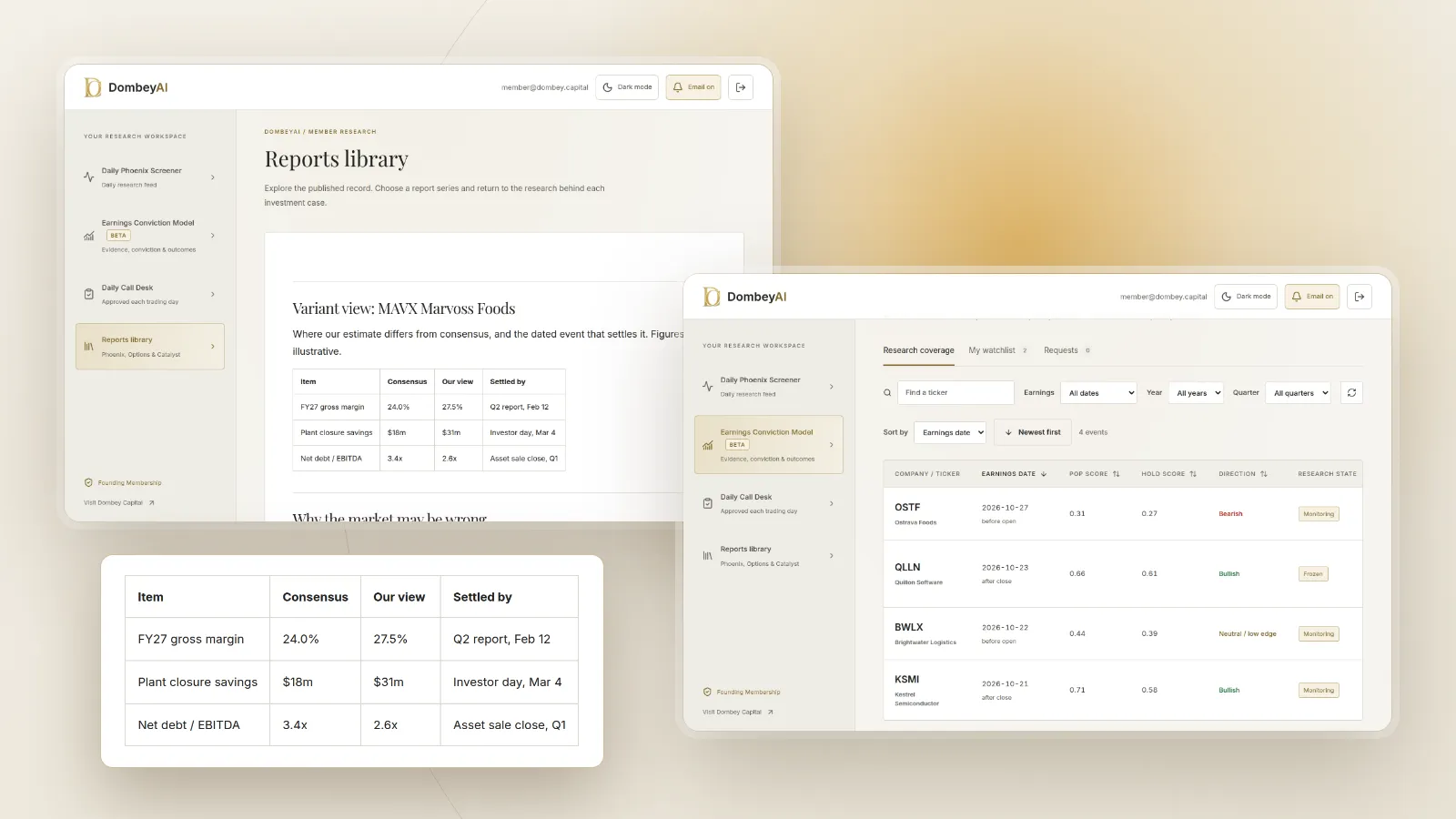
A usable consensus is a short list of figures. For a typical company that means next year's revenue, operating margin, earnings per share, and the multiple the market pays for them. For a special situation it might be the probability a deal closes, the expected date of a ruling, or the value assigned to a business about to be spun off.
Four places show what the market expects:
- Analyst estimates. Consensus revenue and earnings figures are the most direct statement of expectations, though they lag and cluster around company guidance.
- The price itself. Working backward from the share price to the growth and margins it requires often tells you more than the estimates do. A stock at a low multiple may be pricing in a decline that no analyst has written down.
- Options pricing. The implied move before an event shows how large a surprise the market expects. See implied volatility explained and how to estimate an earnings move from options.
- Questions on calls. What analysts ask about on an earnings call shows what they are worried about. The guide on analyzing an earnings call transcript covers how to read for this.
Step two: name the specific disagreement
Once the consensus is on paper, the variant view should fit in one or two sentences and point at a single line in that list. "The market expects 2% revenue growth next year; I expect 8% because a contract disclosed in the 10-Q starts in the second quarter" is a variant view. "This company is underrated" is not.
Good variant views tend to fall into a few types:
- A misread fact. The market uses a figure that a primary document contradicts, such as a share count before a conversion or cash that is partly restricted. Tracing numbers to the filing is the core habit here; see primary vs secondary sources in equity research.
- A misjudged probability. The market prices a binary event at 50% when the record supports something closer to 80%, or the reverse. Probability-weighted valuation for binary events shows the arithmetic.
- A structural seller. Holders are selling for reasons unrelated to value, such as an index deletion or a spin-off that leaves shares with funds that cannot hold them. See why index deletions create mispricing.
- A wrong time horizon. The market focuses on a weak next quarter and ignores a change that shows up a year later.
Step three: explain why you know something the market does not
This is the step most investors skip, and it is the one that separates an edge from a guess. If the information is public and the stock is widely followed, the honest default is that the market has already weighed it.
There are legitimate reasons a variant view can exist:
- Effort. You read the 200-page proxy, the credit agreement or the court docket that most holders summarize from a headline.
- Neglect. The company is small, has little or no analyst coverage, or sits in a category that screens filter out.
- Constraints on others. Funds that must sell, cannot hold small positions, or cannot own a post-bankruptcy equity leave prices that reflect their rules rather than value.
- Time horizon. Many holders are measured quarterly, so they avoid situations where the payoff is 18 months away.
If you cannot name one of these, the likelier explanation for your different view is that you are missing something. Go back and look for it before going further.
Step four: identify what will close the gap
A correct view that the market never adopts produces no return. The gap closes when an event forces investors to update: an earnings report, a filing, a shareholder vote, a regulatory decision, a tender offer, a completed sale. This is why variant perception and catalysts belong together. See what a stock catalyst is and how to tell hard from soft catalysts.
A hard catalyst with a known date is the strongest form, because it limits how long you can be right without being paid. A soft catalyst, such as "investors will eventually notice", leaves the timing open, and open-ended timing is how a correct view turns into a long wait.
- If the event has a date and a binary outcome, size the position to survive being wrong on that date.
- If the event has no date, ask what would make the market notice and how long you are willing to wait.
- If you cannot name any event, treat the idea as a watchlist entry rather than a thesis.
A worked example
The value of the example is not the $24 figure. It is that each part of the view is checkable: the consensus number, the specific disagreement, the source, the reason it was missed, the date, and the condition for being wrong. Writing these down is the subject of how to write a dated investment thesis.
Variant perception compared with related ideas
The term is often used loosely alongside other approaches. They overlap, but they are not the same thing.
- Contrarian investing goes against sentiment. A variant view may or may not be contrarian; sometimes the market is mildly positive and you think it is not positive enough.
- Value investing buys below an estimate of intrinsic value, often with a margin of safety. A cheap stock with no variant view may stay cheap for good reason, which is the value trap problem.
- Event-driven investing focuses on a dated corporate event. It is one of the most natural homes for variant perception, because the event supplies the date on which the gap closes.
Where this goes wrong
Variant perception is a framework for thinking, not a guarantee of being right. It fails in predictable ways.
- The consensus is a straw man. It is easy to define the market's view as something foolish and then disagree with it. Check your version of the consensus against the actual estimates and the price.
- The edge is not real. Public information in a widely followed stock is usually priced. A view that rests only on reading the same headline more optimistically is not an edge.
- Right on the facts, wrong on the price. The market may accept your fact and still value it less than you do. Your earnings estimate can come true while the multiple falls.
- Right too early. A view with no catalyst can be correct for years before the market agrees, and holding costs money and attention in the meantime.
- Confirmation bias. Once a view is written down, new evidence tends to be read in its favor. Decide in advance what would prove it wrong, and honor that test.
- The variance hides the skill. One outcome does not show whether the view was good. A correct call can lose money and a poor call can win. Judge the process over many decisions, not one.
Tools and habits that help
Variant perception depends far more on reading than on software. Still, the right tools make it faster to define the consensus and find what others skip. Screeners locate neglected companies, estimate databases show what analysts expect, and filing search tools surface the documents where most variant views start. The comparison of the best stock research tools for individual investors covers the main options and what each is good for.
The habits matter more than the tools: write the consensus in numbers, trace your key fact to the filing, name why you know it, date the catalyst, and set the test for being wrong. Dombey's published research states the market's implied view and the specific disagreement for each situation it covers; see the research archive.
The bottom line
Variant perception is a view that differs from the consensus built into the price and turns out to be right. Having one requires four things written down: the consensus in numbers, the specific fact you see differently, the reason you can know it when others do not, and the event that will make the market update. Most apparent edges fail the third test, so that is where to spend the most scrutiny. A view that passes all four, with a dated catalyst and a clear condition for being wrong, is a thesis you can check rather than a hunch you have to defend.