

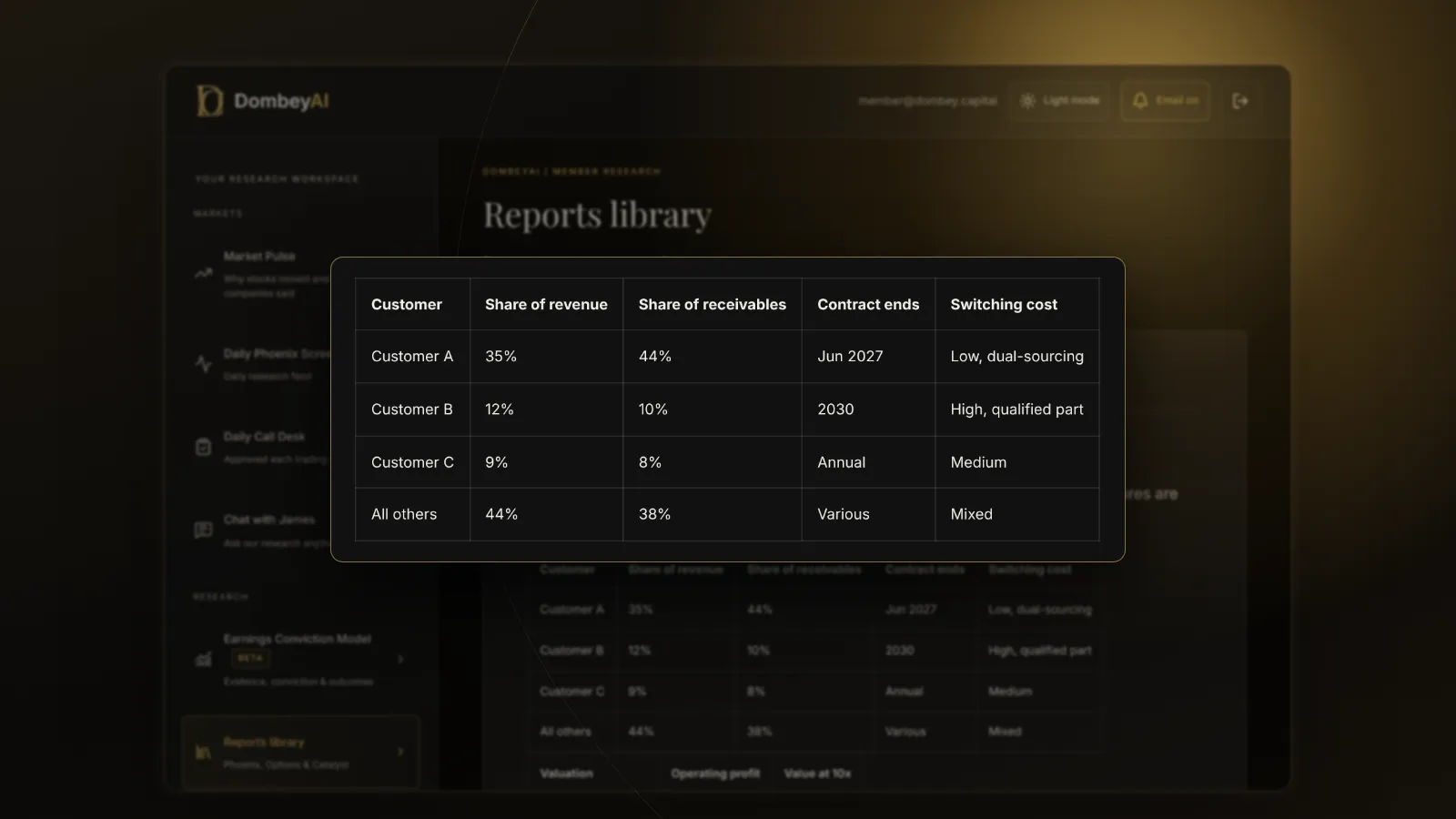
Why concentration changes the risk of a business
A company with thousands of customers loses a few every year and barely notices. A company with one customer at 40% of revenue can lose a large part of its business in a single phone call. The average outcome may look similar on paper, but the distribution is different: concentrated revenue produces occasional large drops rather than steady small ones.
Concentration also shifts bargaining power. A customer that knows it is a supplier's largest account can push for lower prices, longer payment terms and costly service commitments. That pressure shows up in margins and working capital long before the customer leaves.
Where to find it in the filings
| Disclosure | Where it is | What it tells you |
|---|---|---|
| Major customer disclosure | Segment or revenue footnote (ASC 280) | Revenue from each customer above 10%, often unnamed |
| Business description | Item 1 of the 10-K | Who the main customers are, contract terms, dependence |
| Risk factors | Item 1A | How management describes the risk; changes from last year |
| Concentration of credit risk | Receivables or financial instruments footnote | Share of receivables owed by large customers |
| Remaining performance obligations | Revenue footnote | Contracted revenue still to be recognized |
| Material contracts | Exhibits to the 10-K or 8-K | Term, termination rights, pricing mechanisms |
| Customer's own filings | The customer's 10-K and calls | Plans to dual-source, insource or cut spending |
Under ASC 280, a company must disclose the fact that a single customer accounts for 10% or more of revenue and the amount from each such customer, along with the segment that reports the revenue. It does not have to name the customer, although many do in the business section. Our guide to reading the risk factors in a 10-K shows how to compare the concentration language from one year to the next.
How to measure it
Three numbers give a quick picture:
- Largest customer share. The single biggest customer as a percentage of revenue.
- Top five or top ten share. Some companies disclose this in the business section or on calls.
- Receivables share. The largest customer's share of receivables, which can be higher than its share of revenue if it pays slowly.
Then look at the terms, which matter more than the percentage:
| Factor | Lower risk | Higher risk |
|---|---|---|
| Contract length | Multi-year, with renewals well ahead | Purchase orders, annual or shorter |
| Switching costs | Qualified part, long requalification | Commodity product, many suppliers |
| Customer's alternatives | No credible second source | Can dual-source or build in-house |
| Share of the customer's spend | Small for the customer, critical to its product | Large line item the customer wants to cut |
| Customer's health | Strong balance sheet | Weak credit, restructuring risk |
| Pricing | Cost pass-through, indexed pricing | Annual price-downs, renegotiation at will |
A supplier with a 30% customer on a seven-year contract for a part that takes two years to qualify is in a different position from a supplier with a 15% customer buying on monthly purchase orders.
Adjusting a valuation for concentration
The common shortcut is a lower multiple. Concentrated suppliers often trade at a discount to peers with diversified revenue, and that discount is a rough price for the risk. A more precise approach is to value the outcomes directly.
That approach is a version of probability-weighted valuation for binary events. It makes the size of the risk explicit, and it shows why operating leverage matters: losing 35% of revenue can remove more than 35% of profit when fixed costs stay behind.
When testing the downside, sensitivity analysis on the largest customer's volume and price is more useful than a single forecast. Research platforms that show segment and customer disclosures across years help with this; see our comparison of stock research tools for individual investors.
Early warning signs
Customers rarely leave without signals. Watch for:
- Backlog or orders falling for the segment that serves the customer, while the rest of the business holds up. The book-to-bill ratio is one measure.
- Price concessions mentioned on calls, or gross margin falling in that segment.
- Receivables rising or aging, particularly if the customer's share of receivables exceeds its share of revenue.
- Shorter renewals, such as a multi-year contract replaced by a one-year extension.
- Risk factor wording changes, such as a general statement about customers becoming a specific one naming the customer and the percentage.
- The customer announcing a second source or in-house program.
When concentration becomes a catalyst
Concentration is itself a source of special situations. The loss of a major customer can push a stock well below what the remaining business is worth, especially if the market extrapolates the loss to the rest of the company. A contract renewal or a new large customer can do the opposite. Both are dated events: contract expirations are often disclosed, and renewals tend to be announced in an 8-K or on a call.
A stock that falls on a customer loss can become a value trap if the remaining business is also weakening, or a mispricing if the remaining business is sound and the costs tied to the lost customer can be cut. The test is what the company earns without that customer, after restructuring. Dombey's published research looks at situations like these where a dated event changes a company's value; see the research archive.
Where this goes wrong
- Looking only at the 10% threshold. A company can have several customers just below 10% each, which adds up to heavy concentration without a single disclosed name.
- Ignoring indirect concentration. A supplier may sell to many distributors that all serve one end customer, or depend on one platform or channel.
- Assuming a long relationship is safe. Decades of business do not prevent a customer from dual-sourcing when its own strategy changes.
- Using revenue share for profit share. Large customers often earn lower margins, so their share of profit may be smaller than their share of revenue, or larger if they absorb fixed costs.
- Missing the customer's own risk. A concentrated supplier also inherits its customer's credit risk and cyclicality.
- Overreacting. Concentration is not a reason on its own to reject a company. Some strong businesses serve a few large customers on terms that make leaving very costly.
The bottom line
Customer concentration risk is the danger that comes from depending on a few buyers for much of a company's revenue. Start with the major customer disclosure in the 10-K footnotes, then judge the terms: contract length, switching costs and the customer's alternatives. Price the risk by valuing the company with and without its largest customer and weighting the outcomes. Watch backlog, pricing, receivables and risk factor wording for early signs, because customers seldom leave without warning.