

A short definition
A company borrows through bank loans, bonds, notes and leases. Each lender sets a rate based on the government bond yield for that maturity plus a credit spread for the risk of not being repaid in full. The cost of debt is that combined rate on the company's borrowing as it stands today.
Two formulas cover most uses:
Pre-tax cost of debt = current yield to maturity on the company's debt
After-tax cost of debt = pre-tax cost x (1 - marginal tax rate)
The after-tax figure is the one that goes into a weighted average cost of capital (WACC) calculation, because the company's shareholders keep the tax saving that interest creates.
Real examples of what sets the rate
The cost of debt is set by the type of borrowing and the borrower's credit, not by a formula the company controls. These are the common forms, with real issuers that use them.
| Type of debt | Real examples | How the rate is set |
|---|---|---|
| Investment-grade bonds | Long-dated notes issued by large companies such as Apple, Microsoft and Johnson & Johnson | Treasury yield for the maturity plus a narrow credit spread |
| High-yield bonds | Notes from rated BB and B issuers, common in leveraged buyouts and cable, energy and retail companies | Treasury yield plus a wide spread that reflects default risk |
| Term loans | Leveraged loans arranged by banks for private equity owned companies | A floating base rate, now usually SOFR, plus a fixed margin |
| Convertible notes | Notes from growth companies in software and biotech | A low coupon, because the holder also gets an option on the stock |
| Revolving credit facilities | Bank revolvers held by most large public companies | SOFR plus a margin that often steps up with leverage |
Each company's 10-K lists its facilities and bonds in the debt footnote, with coupons, maturities and any floating-rate terms. FINRA publishes trade prices and yields for many US corporate bonds, which is where the current yield comes from.
How to estimate the pre-tax cost of debt
There are three ways to get the number, from best to quickest.
- Yield to maturity on traded bonds. If the company has bonds that trade, their yield is the market's current price for lending to it. Use bonds with a maturity close to the average life of the debt, and weight by size if there are several.
- The rate on recent or new borrowing. A loan signed last month, or a bond issued last quarter, shows what lenders charge now. Press releases and 8-K filings announce new financings with their terms.
- A credit spread build. For a private or unrated company, take the government bond yield for a similar maturity and add a spread that matches comparable companies by leverage and interest coverage.
The quick check is interest expense divided by average debt. It is easy to calculate, but it reports the historical rate on debt that may have been fixed years ago. When rates have moved, it can sit far from the current cost.
How to get to the after-tax cost
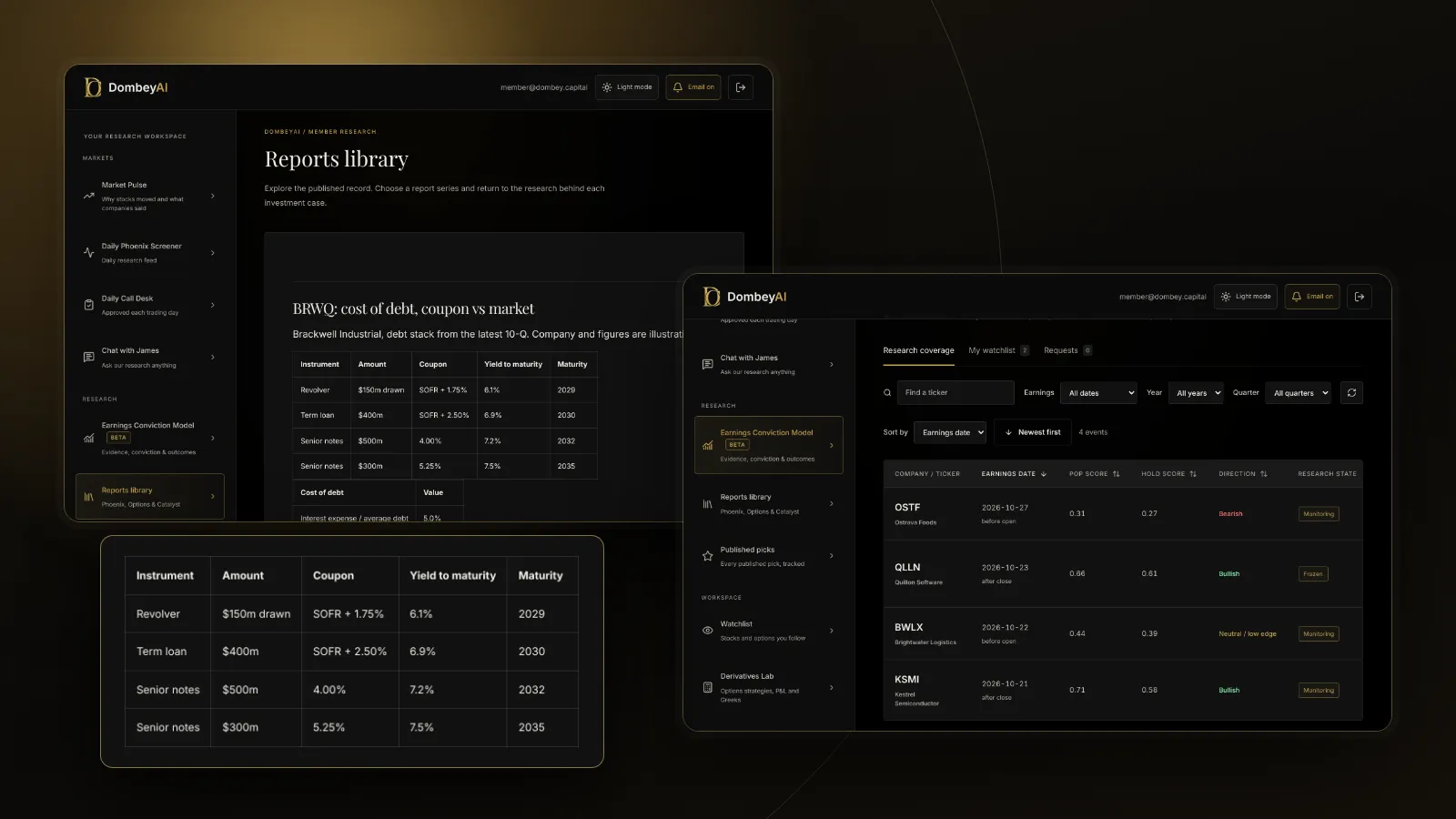
Interest is deductible for most companies, which lowers the real cost. At a 7.2% pre-tax cost and a 25% marginal tax rate, the after-tax cost is 7.2% x 0.75 = 5.4%.
Three things can shrink that tax saving:
- Losses. A company with no taxable income saves no tax from extra interest this year. Net operating loss carryforwards can delay the benefit for years.
- Interest limits. In the US, Section 163(j) of the tax code generally limits net business interest deductions to 30% of adjusted taxable income, with disallowed interest carried forward. Highly leveraged companies can hit it.
- Where the debt sits. Debt raised in a low-tax country saves less tax than debt raised where the rate is higher.
Use the marginal tax rate, the rate saved on the next dollar of interest, not the effective rate on the income statement. The tax footnote, covered in our explainer on cash taxes vs book taxes, shows whether the company actually pays cash tax.
Where it shows up in a valuation
The after-tax cost of debt is one of two rates in WACC, weighted by the market value of debt in the capital structure:
WACC = (E / V) x cost of equity + (D / V) x after-tax cost of debt
Because debt usually costs less than equity, adding debt lowers WACC at first. That stops being true as leverage rises: the cost of debt climbs, the cost of equity climbs with it, and the risk of distress grows. A discounted cash flow model that holds the cost of debt fixed while leverage rises will overstate value.
The cost of debt also drives forecasts directly. Interest expense in a model should be the debt balance times the expected rate, including any refinancing at today's rates. For a company with a debt maturity wall in the next two years, the gap between the old coupon and the new rate is a real earnings headwind.
| Situation | Which rate to use | Why |
|---|---|---|
| Healthy company with traded bonds | Yield to maturity on bonds of similar maturity | The market's current price for lending |
| Private or unrated company | Government yield plus a spread for comparable credit | No traded price exists |
| Debt due soon | Expected refinancing rate | Interest expense will reset |
| Floating-rate loans | Current base rate plus margin, with the forward curve if available | The rate moves with the base rate |
| Distressed company | A blended rate closer to the cost of equity, or a separate recovery analysis | The bond yield includes expected default losses |
Where this goes wrong
Using the coupon instead of the market yield. The coupon is history. If rates or the company's credit have changed, the coupon misstates what new debt would cost.
Taking a distressed yield at face value. A bond trading at 60 cents on the dollar may show a yield of 20% or more. That is not the expected return to lenders; it is the promised return if everything is repaid, and the market does not expect that. Treat deep discounts as a signal to value the company through its capital structure. Our guide on how to map a capital structure walks through the ranking of claims.
Assuming a full tax shield. Loss-making companies and companies at the interest limit get little or no tax benefit. Using pre-tax cost x (1 - 25%) for them makes debt look cheaper than it is.
Ignoring leases and other debt-like items. Operating leases, pension deficits and preferred stock all carry a financing cost. Our explainer on operating leases and enterprise value covers how to treat leases consistently.
Mixing book and market weights. The cost of debt should be weighted by the market value of debt in WACC, matching the market value of equity. Book values can differ widely after a rate move.
Where to get the data
Start with the debt footnote in the 10-K or 10-Q, which lists every facility with its rate, maturity and covenants. Our guide on how to read the footnotes in a 10-K shows where it sits. For traded bonds, FINRA's Fixed Income Data shows recent trades. For comparing many companies at once, our list of the best stock research tools for individual investors covers platforms that carry debt and interest data.
The bottom line
The cost of debt is what lenders require today, measured by the yield on the company's bonds or the rate on new borrowing, not the coupon on old debt. Multiply it by one minus the marginal tax rate to get the after-tax figure, but only when the company can use the deduction. Use it in WACC and in interest forecasts, and update it when the company refinances. When the bonds trade at distressed prices, stop treating the yield as a cost and value the claims directly.