

How to calculate it
The formula is simple:
Book-to-bill = orders booked in the period / revenue billed in the period
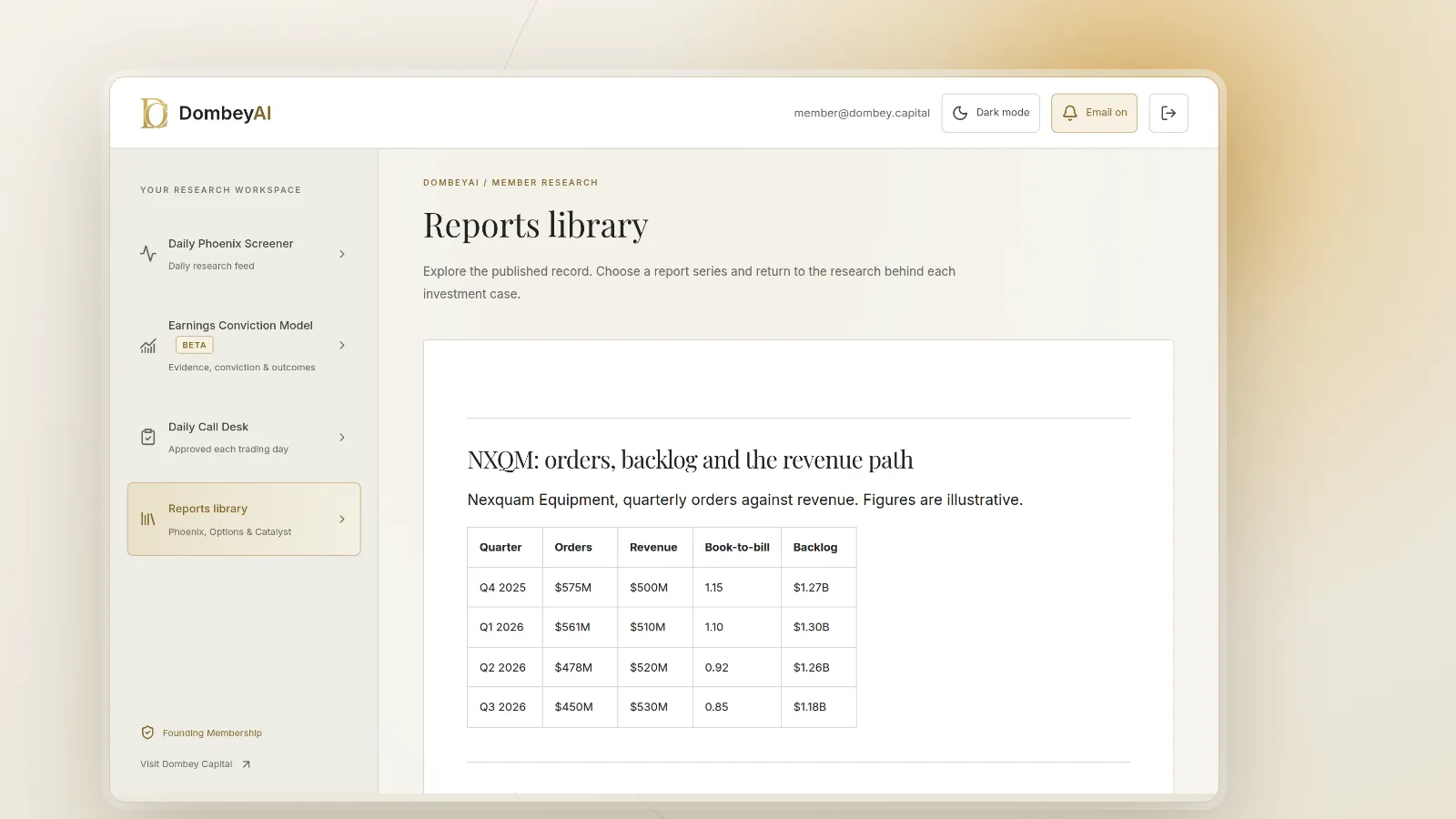
If a company books $550 million of orders in a quarter and recognizes $500 million of revenue, its book-to-bill is 1.1. Backlog grew by about $50 million, before cancellations and any adjustments.
The ratio links three numbers that should reconcile:
Ending backlog = beginning backlog + orders booked - revenue recognized - cancellations and adjustments
When a company reports all of them, check that they add up. When the reconciliation does not work, the company's definition of orders or backlog is doing something you need to understand.
What the ratio tells you
| Book-to-bill | What happened to backlog | Common reading |
|---|---|---|
| Well above 1.0 (1.2 or higher) | Grew strongly | Demand ahead of capacity, or one large order |
| Slightly above 1.0 | Grew modestly | Steady demand, revenue likely to hold or rise |
| About 1.0 | Flat | Orders replacing shipments one for one |
| Slightly below 1.0 | Shrank modestly | Normal lull or catching up on deliveries |
| Well below 1.0 (0.8 or lower) | Shrank sharply | Demand slowing, or orders delayed |
The single quarter matters less than the trend. A ratio above 1.0 for four quarters running builds a backlog that supports revenue for some time. A ratio below 1.0 for several quarters means the company is shipping out of its backlog faster than it refills it, and revenue tends to follow lower once the cushion is used up.
Why it moves stocks
Orders lead revenue, and stock prices tend to react to changes in the expected path of earnings. A book-to-bill well below what analysts expected can move a stock more than the quarter's revenue, because it changes the outlook for the next several quarters. That is the same mechanism behind earnings estimate revisions: when expectations for future periods move, the price adjusts.
That makes the ratio part of the dated catalyst on earnings day for order-driven businesses. When you read the earnings release, look for orders and backlog before revenue, and listen for how management explains them on the call; our guide on how to analyze an earnings call transcript covers what to note.
Where it is useful and where it is not
The ratio fits businesses where orders are placed well before delivery:
- Semiconductor equipment and electronic components
- Aerospace and defense
- Industrial machinery and capital equipment
- Engineering, construction and project-based services
It is much less useful for companies that sell and deliver at once, such as most retailers and consumer brands, where orders and revenue are effectively the same thing. Subscription software companies track related measures, such as bookings and remaining performance obligations, but contract length and billing terms make a simple ratio harder to read.
Read the definitions first
Book-to-bill is not a required financial statement item, and no accounting standard defines "orders." Each company decides what counts. Before comparing two companies, check:
- What counts as an order. A signed purchase order, a letter of intent, a framework agreement, or only firm, funded contracts.
- Whether orders can be cancelled. Backlog that customers can cancel without penalty is softer than it looks.
- The denominator. Revenue, shipments or billings, which can differ in businesses that recognize revenue over time.
- Currency and acquisitions. Exchange rates and acquired backlog can lift reported orders without any change in demand.
The financial statements give you one firmer check. Under the revenue standard, ASC 606, companies disclose remaining performance obligations: contracted revenue not yet recognized, and when they expect to recognize it. It sits in the revenue note of the 10-K and 10-Q. When reported backlog runs far above remaining performance obligations, much of the backlog is not yet contractually firm.
A quarter-by-quarter checklist
When an order-driven company reports, work through the same short list each time so quarters stay comparable.
| Step | What to check | Where to find it |
|---|---|---|
| 1 | Orders, revenue and the ratio for the quarter | Earnings release or presentation |
| 2 | Trailing four-quarter orders against revenue | Your own table from past releases |
| 3 | Ending backlog and the reconciliation | Release, presentation or 10-Q |
| 4 | Remaining performance obligations | Revenue note in the 10-Q |
| 5 | Cancellations and any change in definitions | Footnotes and the call |
| 6 | Large single orders named on the call | Earnings call transcript |
If the ratio and the backlog tell different stories, the definitions or the cancellations usually explain why. Ask the question before you change your revenue estimate.
Where this goes wrong
- One large order. A single multi-year contract can push a quarter's ratio far above 1.0. Use trailing four-quarter orders against trailing four-quarter revenue to smooth it.
- Seasonality. Many industries book heavily in particular quarters. Compare a quarter with the same quarter last year.
- Pull-forward ordering. Customers worried about lead times or prices may order early. Strong bookings followed by cancellations is a familiar pattern at the turn of a cycle.
- Price, not volume. Price increases lift order values without more units. Ask whether growth in orders reflects demand or pricing.
- Capacity limits. A high ratio can reflect a company that cannot ship fast enough. If customers go elsewhere, the backlog shrinks without becoming revenue.
- Changes in definition. Companies sometimes change what they count as backlog. Read the footnotes in the presentation every quarter.
How it fits in valuation work
Book-to-bill does not value a company. It tells you whether the revenue line in your model has support. A model that assumes rising revenue while backlog has been shrinking for a year needs a reason. A company trading on depressed earnings while its backlog builds may have earnings recovery already in hand, which matters if the stock looks cheap on EV/EBITDA or on guidance that has not caught up.
It also links to working capital. Large backlogs often come with customer deposits or, for long contracts, contract assets and liabilities on the balance sheet; our explainer on working capital covers how those move. For tools that track orders and other company-reported metrics, see the 12 best stock research tools for individual investors.
The bottom line
The book-to-bill ratio compares orders booked with revenue billed in the same period, and above 1.0 means the backlog grew. In order-driven businesses it is an early read on revenue, which is why a weak figure can move a stock even in a strong quarter. Companies define orders and backlog themselves, so read the definitions, smooth out large orders over four quarters, and check reported backlog against the remaining performance obligations in the filings.