

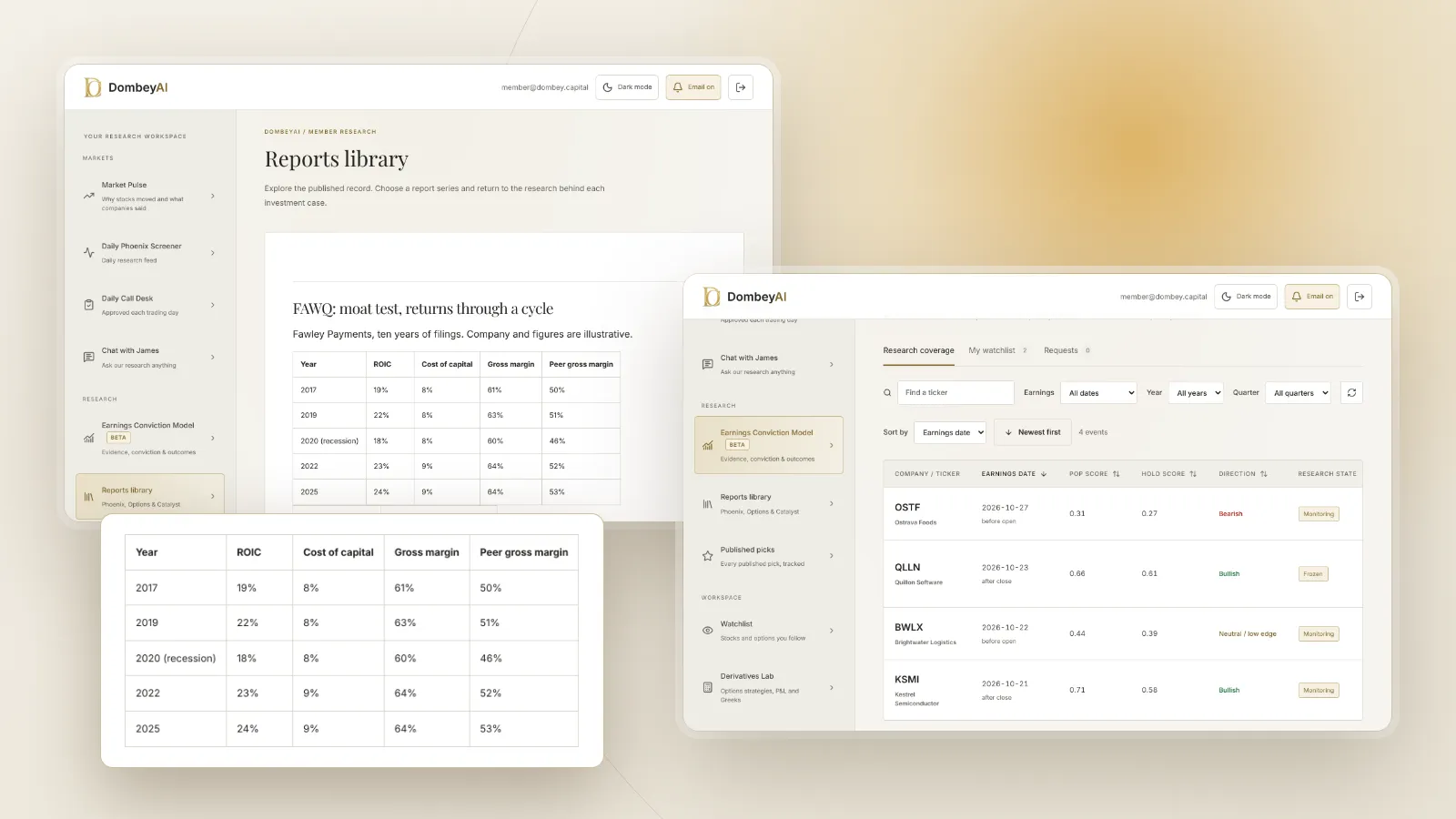
A short definition
In a normal competitive market, high returns attract rivals, and their entry pushes returns down toward the cost of capital. A moat is whatever stops that from happening. Warren Buffett popularized the term, describing the businesses he wanted to own as economic castles protected by wide, sustainable moats. Morningstar later turned the idea into a rating system that classifies companies as having a wide moat, a narrow moat or none.
The definition has two parts, and both matter. The company must earn excess returns, and it must be able to keep earning them. A business with high returns and no barrier is having a good year. A business with a barrier and low returns has nothing worth protecting.
Real examples of moat sources
| Source | How it protects returns | Commonly cited examples |
|---|---|---|
| Network effects | Each new user makes the service more valuable to every other user | Card payment networks such as Visa and Mastercard; online marketplaces |
| Switching costs | Leaving costs the customer time, money or risk | Enterprise databases and core banking software; payroll systems |
| Intangible assets | Patents, licenses, regulatory approvals or brands block or deter rivals | Patented drugs; spirits and soft drink brands; ratings agencies |
| Cost advantage | The company can profitably charge less than rivals | Low-cost producers with the best mines or plants; large warehouse retailers |
| Efficient scale | A market only supports one or a few profitable players | Pipelines, railroads, airports and regulated utilities |
These are illustrations of each category, not judgments on any company's current moat or valuation. A moat is a property of a business at a point in time, and each of these industries has seen moats widen and narrow.
The five sources in more detail
Network effects. A payment network is more useful to merchants when more cardholders carry its cards, and more useful to cardholders when more merchants accept it. A new entrant starts with neither. The test is whether the network's value rises with its size and whether the leader keeps gaining share.
Switching costs. Once a bank runs its accounts on a software system, replacing it means a long project, retraining and the risk of errors. The vendor can raise prices modestly without losing the customer. Look for high retention, multi-year contracts and price increases that stick. Metrics such as net revenue retention show it in software.
Intangible assets. A patent gives a legal monopoly for a period; a license or regulatory approval limits who can operate; a brand lets a company charge more for a similar product. The patent is the clearest of these and the most clearly temporary, which is why a patent cliff can reset a drug company's value.
Cost advantage. A company with the lowest-cost mine, the best-located plant or the largest purchasing volume can earn a profit at prices that leave rivals breaking even. The test is whether its margins stay above peers when prices fall, not just when they rise.
Efficient scale. Some markets are only big enough for one or two players. A second pipeline on the same route would leave both underused, so no one builds it. The moat is the size of the market itself. Regulation often caps the returns, so efficient scale tends to produce steady rather than spectacular returns.
How to test whether a moat is real
A moat is a claim, and claims need evidence. Four tests help.
| Test | What to look at | What a moat looks like |
|---|---|---|
| Returns | Return on invested capital against the cost of capital, over 7 to 10 years | ROIC well above the cost of capital, including in the weak years |
| Margins | Gross margin and operating margin against peers | Stable or rising margins, above the peer range |
| Share | Market share over time | Share that holds or grows as new rivals enter |
| Pricing | Price increases in the 10-K and on earnings calls | Price rises that stick without volume losses |
After the numbers, name the mechanism. If you cannot say which of the five sources explains the returns, and why a well-funded competitor could not replicate it, the returns may be cyclical or temporary. Economic value added is another way to frame the same test: a moat is what keeps EVA positive.
Why a moat matters for valuation
The value of a company depends on how much it earns above its cost of capital and for how long. A moat answers the second question. In a discounted cash flow model, a business with excess returns that fade in five years is worth far less than one whose returns fade over twenty, even if their current earnings are the same.
The effect is concentrated in the terminal value, which often accounts for most of a DCF's total. An analyst who assumes a moat holds forever is assuming high growth at high returns in perpetuity, which few businesses deliver. A more careful approach lets returns fade toward the cost of capital over a period that matches the moat's strength.
A moat does not make a stock cheap. If the price already assumes decades of excess returns, there is little margin of safety left. Tools that show ten years of returns and margins make the moat tests faster; our list of stock research tools for individual investors compares them.
How moats erode
- Technology shifts. A new way of doing the job can make an old advantage irrelevant, as online distribution did to many physical retailers.
- Regulation. A license can be opened to competition, a price cap can be imposed or a patent can expire.
- Management choices. Using the profits of a strong business to fund poor acquisitions or to push into markets without the same advantage can weaken the whole.
- Customer power. A few large customers can push prices down, especially when they can credibly build the product themselves.
- Complacency. Raising prices too far can invite rivals that would not otherwise have entered.
The trend matters more than the label. Falling margins, slowing share gains or rising customer churn can signal a narrowing moat years before returns fall.
Dombey's published research looks at situations where an event changes the value of a business, and a company with a moat that the market has mispriced around such an event is one of them; see the research archive.
Where this goes wrong
- Calling a good cycle a moat. High returns at the peak of a commodity or credit cycle are not evidence of a durable advantage. Check the weak years.
- Confusing size with a moat. Being the largest company in an industry does not mean rivals cannot compete. Large airlines and steelmakers have often earned low returns.
- Overpaying for quality. A wide moat at a price that assumes it lasts forever leaves no room for error, which is one way a good company becomes a value trap.
- Ignoring the castle. A moat around a shrinking market protects a business that is getting smaller. Check that the underlying demand will last.
- Taking management's word for it. Every investor presentation describes a competitive advantage. Look for it in the returns and margins.
The bottom line
An economic moat is a lasting advantage that keeps a company's returns above its cost of capital because rivals cannot copy what it does. It comes from network effects, switching costs, intangible assets, cost advantages or efficient scale. Test it with a decade of returns, margins, market share and pricing, then name the mechanism behind the numbers. In a valuation, the moat sets how long excess returns last, so judge its direction as carefully as its width, and remember that a moat does not make a stock cheap.