

How each method works
A company buys inventory at different prices over the year. When it sells units, it has to decide which costs go to cost of goods sold and which stay on the balance sheet. The physical flow of goods does not have to match; the method is an accounting choice.
| FIFO | LIFO | Weighted average | |
|---|---|---|---|
| Costs charged first | Oldest | Newest | Average of all units |
| Cost of goods sold in inflation | Lower | Higher | In between |
| Reported profit in inflation | Higher | Lower | In between |
| Inventory on balance sheet | Near current cost | Older, often far below current cost | In between |
| Taxes in inflation | Higher | Lower | In between |
| Allowed under US GAAP | Yes | Yes | Yes |
| Allowed under IFRS | Yes | No | Yes |
IAS 2, the IFRS inventory standard, does not permit LIFO, so LIFO is mostly found among US companies: retailers, distributors, chemical and steel producers, and others with large, long-held inventories.
A worked example
| FIFO | LIFO | |
|---|---|---|
| Revenue (200 x $20) | $4,000 | $4,000 |
| Cost of goods sold | 100 x $10 + 100 x $12 = $2,200 | 100 x $14 + 100 x $12 = $2,600 |
| Gross profit | $1,800 | $1,400 |
| Gross margin | 45% | 35% |
| Ending inventory (100 units) | $1,400 | $1,000 |
The business is identical in both columns: the same units, the same prices, the same cash. Only the accounting differs. FIFO shows a ten-point higher gross margin, and LIFO shows lower profit and lower tax. The $400 gap in inventory is the LIFO reserve.
Why companies choose LIFO
The main reason is tax. In a period of rising costs, LIFO raises cost of goods sold, lowers taxable income and defers tax. The deferral can last for decades if inventory levels stay stable or grow, because the old, low-cost layers stay on the balance sheet.
US tax rules add a condition, often called the LIFO conformity rule: a company that uses LIFO for its tax return must also use it in its financial statements. That is why companies that use LIFO for taxes also report lower profits to shareholders. The gap between the two kinds of tax is covered in cash taxes vs book taxes.
The tax saving is real cash. A LIFO company with the same pre-tax economics as a FIFO peer can generate more cash in an inflationary period, even though its reported earnings are lower.
The LIFO reserve: converting to FIFO
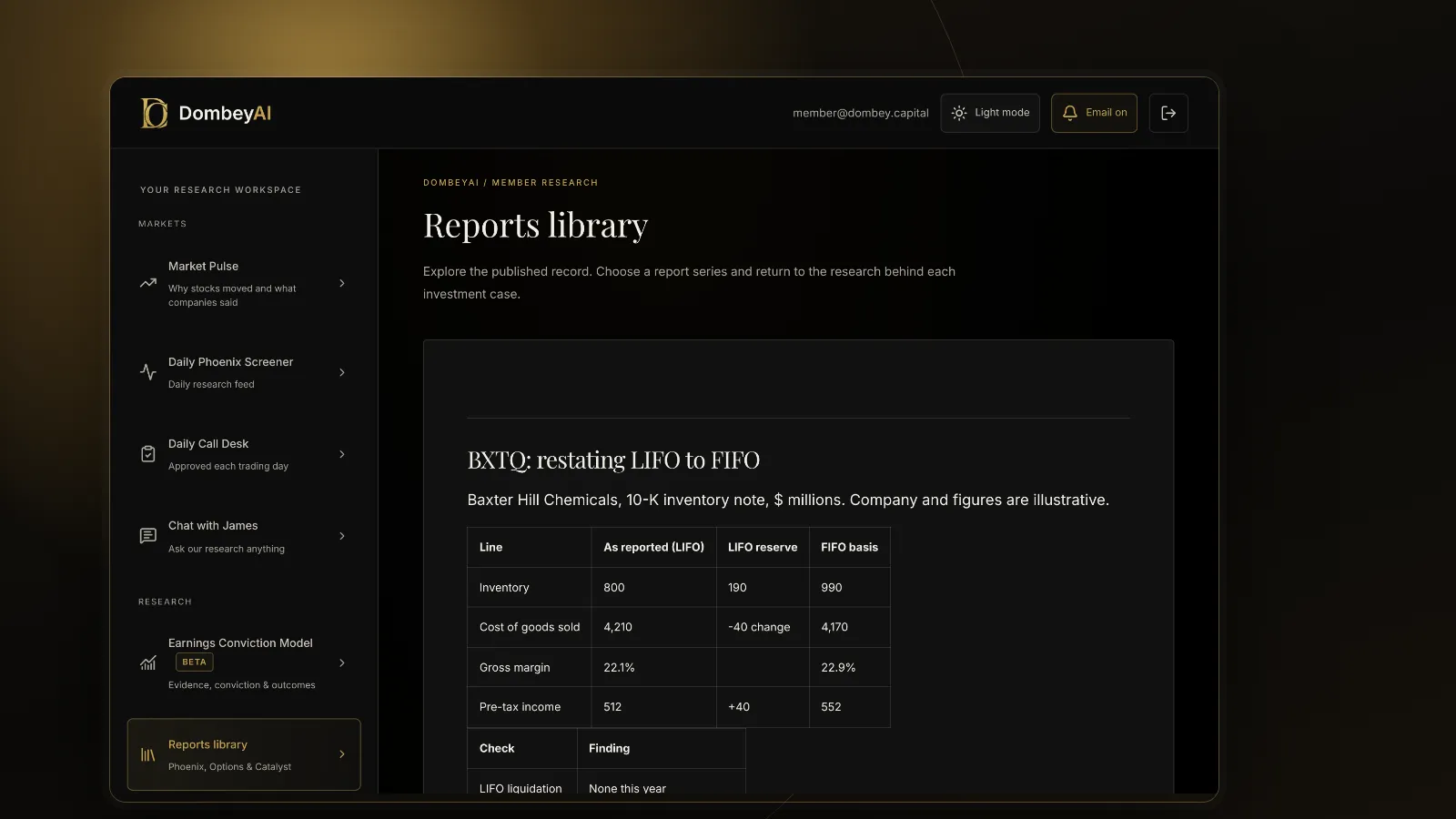
Companies that use LIFO disclose the LIFO reserve, the difference between inventory at FIFO or current cost and inventory at LIFO, in the inventory note. You can find it in the footnotes of the 10-K. With it, you can restate LIFO figures on a FIFO basis:
- FIFO inventory = LIFO inventory + ending LIFO reserve
- FIFO cost of goods sold = LIFO cost of goods sold minus the increase in the LIFO reserve during the year (or plus the decrease)
- FIFO pre-tax income = LIFO pre-tax income plus the increase in the reserve
Restating to FIFO matters in three places:
- Comparing peers. A LIFO company and a FIFO company in the same industry are not comparable until one is restated. This matters most in a comparable company analysis.
- Balance sheet value. LIFO inventory can sit far below current cost. For book value and asset-based valuations, the LIFO reserve, less the tax that would be due if it were realized, is part of what shareholders own.
- Working capital. Working capital ratios look tighter under LIFO because inventory is carried at old costs.
LIFO liquidations
A LIFO liquidation happens when a company sells more inventory than it buys. Old, low-cost layers then flow into cost of goods sold, and reported margins rise. The rise is temporary and has nothing to do with pricing or efficiency.
Companies usually disclose the effect of a LIFO liquidation in the notes or the MD&A. When you see one, remove it from earnings before using them in a valuation. Normalized earnings should reflect replacement costs, not a one-time draw on decades-old inventory.
Liquidations often happen when a company cuts inventory during a downturn, which is exactly when reported margins are under pressure. The liquidation can mask how weak the underlying margin has become.
When prices fall
The effects reverse in deflation. LIFO charges the newest, now cheaper costs first, so LIFO profits run higher than FIFO profits and the LIFO reserve shrinks. FIFO companies, carrying inventory bought at higher prices, report squeezed margins and may write inventory down to its net realizable value. In commodity businesses, the swing between methods can be larger than the change in the underlying business.
Weighted average cost sits between the two. It smooths the effect of price changes by charging every unit at the average cost of what is on hand, so margins move more slowly in both directions. Companies using it show smaller swings than FIFO peers in a commodity cycle but still lag current costs. Inventory write-downs add one more difference: under US GAAP, FIFO and average cost inventory is carried at the lower of cost and net realizable value, while LIFO inventory follows an older lower of cost or market test, so the timing of write-downs can differ between peers.
Where this goes wrong
- Comparing margins without adjusting. A LIFO company can look less profitable than a FIFO peer when it is not. Restate before comparing.
- Treating FIFO profits in inflation as sustainable. Part of FIFO profit in an inflationary year is a gain on holding inventory, not operating earnings.
- Missing a LIFO liquidation. A margin jump during an inventory cut can be accounting, not improvement.
- Ignoring the tax on the LIFO reserve. Adding the full reserve to book value overstates it; the tax due on realization should come off.
- Assuming the method never changes. A switch from LIFO is a change in accounting method that affects taxes and comparability; read the note explaining it.
Platforms that show several years of inventory notes side by side make these adjustments quicker; our list of stock research tools for individual investors compares them.
The bottom line
LIFO and FIFO describe the same business with different timing for costs. In inflation, LIFO lowers reported profits, taxes and inventory values, and FIFO raises them. Use the LIFO reserve in the notes to restate LIFO companies to FIFO before comparing them, strip LIFO liquidation gains out of normalized earnings, and remember that the LIFO tax saving is real cash even when reported profits are lower.