

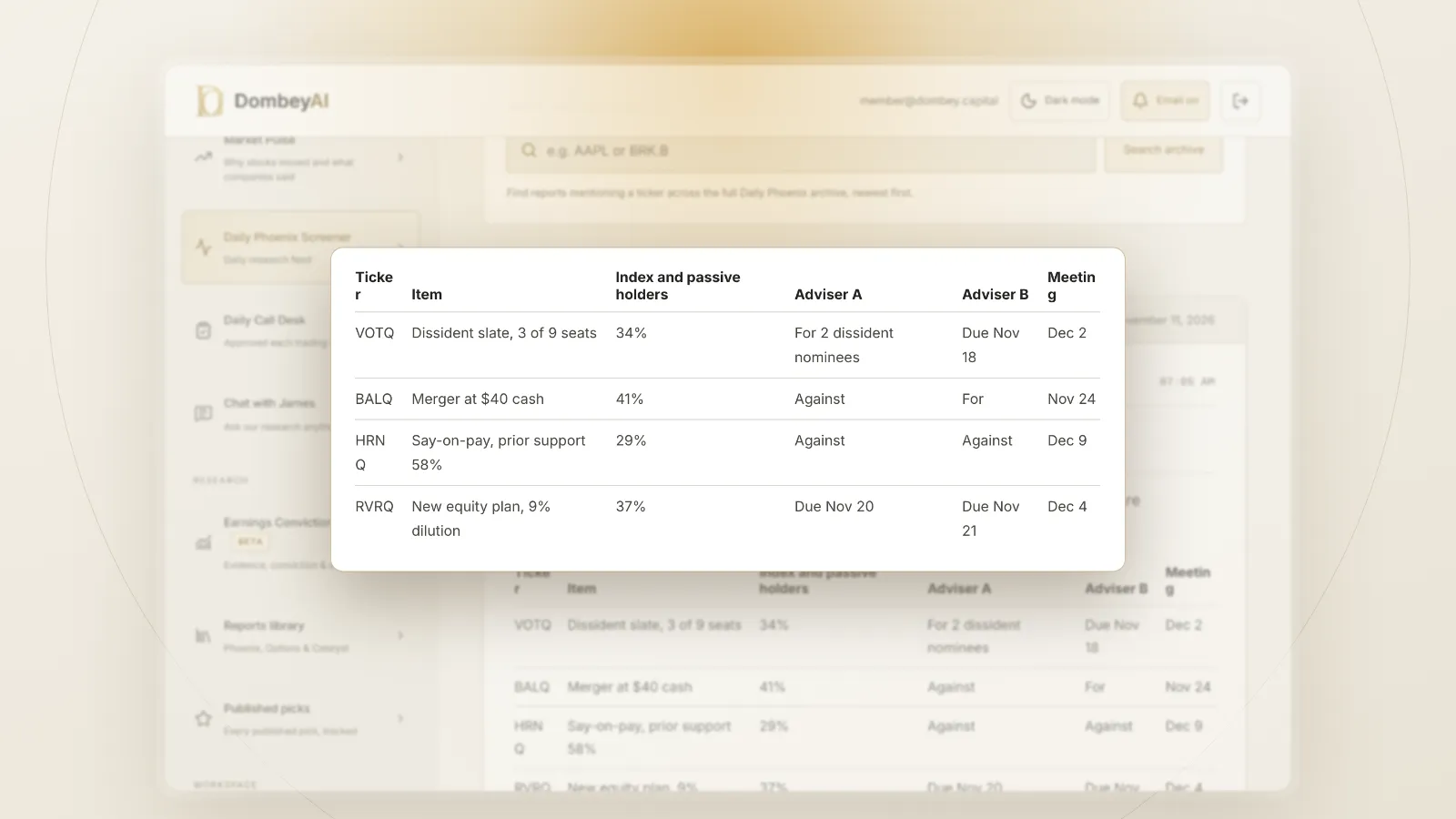
What a proxy adviser does
An institutional investor may hold shares in thousands of companies, each with an annual meeting and occasional special meetings. Every meeting has a proxy statement, often long, and several items to vote on. Few managers have the staff to read them all.
Proxy advisers fill that gap. For each meeting they:
- Read the definitive proxy statement and related filings.
- Apply the adviser's published voting guidelines, or a client's custom policy, to each item.
- Write a report with a recommendation for each item and the reasons.
- Run a platform that lets the client cast votes across all its holdings before the deadline.
Clients pay for the research and the voting service. Some follow the adviser's benchmark policy closely; others use a custom policy the adviser applies on their behalf; the largest managers often read the report and decide for themselves. If you want to see the documents the advisers work from, our guide on how to read a proxy statement walks through each section.
Why their recommendations matter
The influence comes from who owns the shares. A company whose stock sits mostly with index funds, pension funds and mutual funds has a shareholder base that votes through institutional processes, and many of those processes use adviser research. A company controlled by a founder or with dual-class shares is far less exposed, because the insiders' votes decide.
Recommendations matter most in these situations:
| Situation | Why the adviser matters | What to watch |
|---|---|---|
| Contested director election | Undecided institutions look for an independent view | Release date of each report, settlement talks |
| Merger needing a shareholder vote | A recommendation against can signal the price is too low | Any bump in price or change in terms after the report |
| Say-on-pay vote | Low support pressures the board to change pay | Prior year's support level, pay changes |
| New or larger equity plan | Dilution and plan design are scored against guidelines | Plan cost, burn rate, repricing terms |
| Shareholder proposals | Support can push a board to act even when advisory | Board response in the next proxy |
| Routine items (auditor ratification) | Usually low; recommendations rarely against | Unusual auditor events |
Most annual meeting items pass easily. The adviser becomes a real factor when a vote is close, when the company has had governance problems or when an activist is involved. Our explainer on what a shareholder vote is covers which votes are binding and which are advisory.
How ISS and Glass Lewis differ
Both advisers publish benchmark voting guidelines and update them each year, usually before the main proxy season. The guidelines are public, so an investor can read the policy that will be applied to a given item.
The two firms often reach the same recommendation on routine items, but they do not always agree. Differences tend to show up on:
- Director independence and board composition, where the firms apply their own definitions and thresholds.
- Executive pay, where each has its own model for comparing pay with performance and peers.
- Contested elections, where each firm makes its own judgment on whether the dissident has made the case for change.
When the two disagree in a contested vote, the outcome depends more on the large holders' own views. Each side in a fight will quote whichever recommendation favors it.
Proxy advisers in proxy fights and merger votes
For an event-driven investor, the adviser reports are dated events inside a larger catalyst.
In a proxy fight, the company and the dissident each meet the advisers and submit materials. The reports usually arrive a week or two before the meeting. A recommendation for the dissident's slate, or for some of its nominees, can push the company toward a settlement that adds board seats before the vote. A recommendation for management can lead the dissident to withdraw. Our guide to how proxy fights work covers the full timeline, and activist investor trackers help you find campaigns early.
In a merger that needs target shareholder approval, a recommendation against is a signal that some institutions think the price is too low. Targets sometimes respond with a higher price or better terms. That is one path to the outcome described in what bumpitrage is, where holders push for a higher bid.
How to read the signal
You will rarely see the full adviser report, which is sold to clients. You will usually see its conclusion, through a press release from one side, a news report or an additional proxy filing that quotes it.
When a recommendation appears, check four things:
- Which items it covers. In a contested election, the recommendation may support only some dissident nominees.
- Whether both advisers agree. Split recommendations leave the outcome to the largest holders.
- Who owns the shares. The 13F filings of large holders show how much stock sits with index funds and active managers, and their published voting records show how they have voted at similar meetings.
- What the company does next. A revised pay plan, a settlement or a price increase after a negative recommendation tells you the company believed the vote was at risk.
The rules that apply
Proxy voting advice is a form of proxy solicitation under the SEC's rules, and advisers rely on exemptions from the filing requirements. The SEC amended those rules in 2020 and revised them again in 2022, removing some of the conditions added in 2020 while keeping requirements that advisers disclose conflicts of interest. The rules continue to be debated, and some states have also considered or passed laws aimed at proxy advisers.
For an investor, the practical point is that recommendations come with conflict disclosures and that companies have ways to respond publicly. The details of the rules rarely change how a single vote plays out.
Where this goes wrong
The adviser's recommendation is one input, and treating it as the answer causes mistakes.
- Assuming the adviser decides. Large asset managers vote under their own policies. In many companies, the three or four largest holders matter more than either adviser.
- Ignoring insider control. At a controlled company, a negative recommendation may produce a protest vote with no effect on the outcome.
- Reading routine recommendations as signals. A for recommendation on auditor ratification says nothing. Focus on the items where the adviser broke from the board.
- Missing a settlement. Many contests settle before the reports arrive, which changes what is being voted on.
- Trading on headlines. A recommendation can be reported before the full reasoning is public. The reasons, such as a concern about deal price versus a concern about process, matter for what happens next.
How to follow proxy votes
Track the dated steps in the order they happen: the preliminary and definitive proxy, the record date, the adviser reports, any additional soliciting materials and the meeting date. Vote results arrive in an 8-K under Item 5.07 within four business days after the meeting. Tools for following meetings are compared in our list of proxy vote and shareholder meeting trackers, and dated situations with live catalysts are covered on our market page.
The bottom line
ISS and Glass Lewis recommend how institutions should vote, and their influence is largest where institutions own most of the stock and the vote is close. Contested elections, merger votes, pay plans and equity plans are where a recommendation can change the outcome or force the company to change terms. Treat the release of a recommendation as a dated step in a catalyst, read who owns the shares, and watch what the company does in response. The recommendation shifts the odds; the holders still decide.