

The rules behind the calendar
No SEC rule requires a company to issue an earnings release on a particular date or to hold a call. What the rules do require is the periodic report:
| Filing | Filer status | Deadline |
|---|---|---|
| 10-Q | Large accelerated and accelerated | 40 days after quarter end |
| 10-Q | All other filers | 45 days after quarter end |
| 10-K | Large accelerated | 60 days after fiscal year end |
| 10-K | Accelerated | 75 days after fiscal year end |
| 10-K | All other filers | 90 days after fiscal year end |
| Form 12b-25 extension | Any filer | 5 extra calendar days for a 10-Q, 15 for a 10-K |
Most companies release earnings shortly before or alongside the 10-Q or 10-K. When a company issues an earnings release, it furnishes it on an 8-K under Item 2.02. So a release date that slides toward the filing deadline is squeezing the time the company has to finish its review. A release pushed past the deadline usually means a Form 12b-25 late filing notice is coming or has already been filed.
What a later date can signal
A date later than the company's usual pattern has several possible causes, roughly in order of concern.
Accounting review or audit question. If the auditor or audit committee is reviewing a transaction, an impairment, revenue recognition or a control problem, the company may need more time. These delays tend to be announced late and with little detail. They can precede a material weakness disclosure or, in serious cases, a financial restatement.
Pending transaction. A company close to signing a merger, sale or financing may hold results to release them with the announcement, or because the board's attention is elsewhere.
Management change. A new CFO, or a departing one, can push the schedule. A CFO departure announced shortly before a delayed date deserves a close read of the 8-K.
Impairment or restructuring work. Goodwill testing, asset write-downs and restructuring charges take time to finalize and audit, especially at year end.
Systems or auditor change. A new ERP system or a new audit firm can add weeks, particularly in the first year.
Routine reasons. Board meeting schedules, holidays, an annual meeting or an investor day can move a date by a week without any meaning.
What an earlier date can signal
Earlier-than-usual dates are less common. Possible reasons include a desire to get good results out ahead of a financing or event, results released together with a transaction announcement, a pre-announcement of a miss or beat followed by the formal release, or a permanent move to a faster close. An earlier date by itself is weak evidence. Combine it with other signals, such as whether the company also scheduled an investor day or a separate announcement.
Year-end reports are different
Fourth-quarter reports run on a longer clock. The audit of the full year, goodwill and asset impairment tests, tax provisions and the 10-K itself all have to be finished, and many companies release fourth-quarter results two or three weeks later than their other quarters. A late February or March date for a December year-end company is normal, so compare a year-end date with prior year-end dates, not with the company's third-quarter date. The same applies to the first report after an acquisition, when the company has to fold the acquired business into its accounts, and to the first year with a new auditor.
A checklist for a date change
| Step | What to check | Where to find it |
|---|---|---|
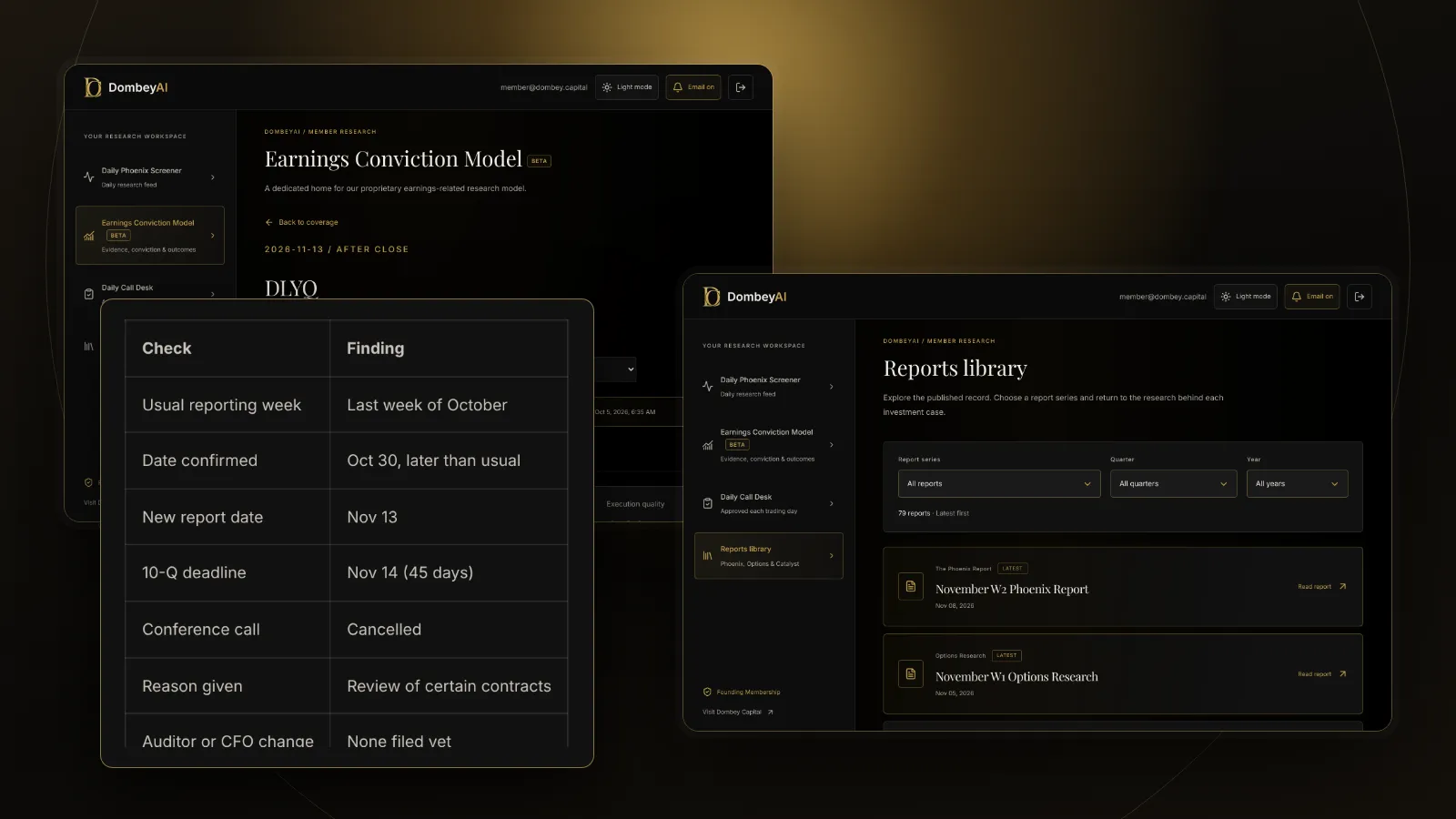
| 1 | The company's usual reporting week | Past earnings releases and 8-Ks |
| 2 | How far the new date is from the usual week | Press release or investor relations page |
| 3 | Distance from the 10-Q or 10-K deadline | Filing deadline table above |
| 4 | Whether a reason was given | Date announcement wording |
| 5 | Whether the call was cancelled or changed | Investor relations calendar |
| 6 | Recent finance or audit departures | 8-K Item 5.02 and Item 4.01 |
| 7 | Any NT 10-Q or NT 10-K | EDGAR filing list |
| 8 | Pending deals, reviews or financings | Recent 8-Ks and news |
| 9 | Options expiry around the new date | Option chain |
The guide to reading an 8-K for catalysts explains the item numbers to look for. Item 4.01 covers a change in auditor, and Item 5.02 covers officer and director changes.
How the market and options react
Delays that point to accounting problems tend to hit the stock when announced, before any results. Delays tied to a transaction can do the opposite if investors guess a deal is near.
The options market also has to adjust. Options price an earnings event into the first expiry after the expected date. If the report moves past that expiry, the event premium shifts to the next one, and implied volatility in the near expiry can drop while the next one rises. Traders holding positions sized for the old date can find their exposure in the wrong month. What is an earnings catalyst covers how to plan around the date.
Decision list
- If the new date is within the company's usual window, treat it as routine unless other signals appear.
- If the date is later and close to the filing deadline, read recent 8-Ks for auditor, officer or transaction news.
- If the company cancels its call or changes its format, ask why it no longer wants to take questions.
- If an NT 10-Q or NT 10-K is filed, read the stated reason and whether results are expected to differ materially from the prior year.
- If the date moves earlier and comes with an investor day or transaction, read the date change as part of that event.
Where this goes wrong
Reading date changes is pattern matching, and it fails in familiar ways.
- Seeing signals in noise. Many date changes are calendars and holidays. Without the company's own history, a one-week move means little.
- Assuming a delay means a miss. An accounting review can end with no change to results. A delay tied to a deal can come with good news.
- Ignoring the reason given. Sometimes the company explains, and the explanation is accurate. Read it before assuming the worst.
- Third-party date estimates. Some calendars show estimated dates the company never confirmed. A "change" in an estimate is not a company decision. Check the investor relations page.
- Trading the headline. A delay is a reason to research, not a forecast. Results can still surprise either way, and guidance changes at the delayed report can matter more than the delay itself.
Dombey's coverage of recent earnings moves and dated catalysts is on the market page.
The bottom line
A changed earnings date is a signal only when it breaks the company's own pattern. Later dates near the 10-Q or 10-K deadline, unexplained changes, cancelled calls, Form 12b-25 notices and finance-team departures are the combinations worth acting on with more research. Earlier dates are weaker evidence. Check the history, the deadline, the 8-Ks and the option expiries, and treat the change as a prompt to read the filings rather than as a forecast of the results.