

Where the designation comes from
Congress created the program in 2012, in the Food and Drug Administration Safety and Innovation Act. It sits alongside three other expedited programs for serious conditions: fast track, accelerated approval and priority review. The FDA's guidance on expedited programs sets out how each one works and how they overlap.
A drug qualifies when two conditions are met:
- It is intended to treat a serious or life-threatening disease or condition.
- Preliminary clinical evidence indicates it may demonstrate substantial improvement over available therapy on one or more clinically significant endpoints.
The second test is the hard one. It needs clinical data, usually from early trials in patients, and the improvement has to be substantial, not just better. Data from animal studies alone does not qualify.
How the process works
A sponsor asks for breakthrough designation in a request to the FDA, either with its investigational new drug application or later. The FDA guidance says the request should ideally come no later than the end-of-phase 2 meeting, because the benefits are largest early in development.
The FDA aims to respond within 60 days. Many companies announce a grant in a press release, and those for which the drug is material may also file an 8-K. Denials are less often announced.
Once granted, the drug receives:
- Intensive guidance on an efficient development program, beginning as early as phase 1.
- Organizational commitment, with senior managers and experienced review staff involved.
- All fast track features, including more frequent meetings and eligibility for rolling review, where completed sections of the marketing application can be submitted before the whole application is finished.
- Eligibility for priority review, if the application meets the criteria when submitted.
How the expedited programs compare
The four programs answer different questions, and a single drug can hold several of them.
| Program | What it requires | What it gives | When it applies |
|---|---|---|---|
| Fast track | Serious condition and potential to address an unmet need; nonclinical or clinical data | More FDA meetings, rolling review | During development |
| Breakthrough therapy | Serious condition and preliminary clinical evidence of substantial improvement | Fast track features plus intensive guidance and senior FDA involvement | During development |
| Accelerated approval | Effect on a surrogate or intermediate endpoint reasonably likely to predict clinical benefit | Earlier approval, with confirmatory trials required | At approval |
| Priority review | Significant improvement in safety or effectiveness | Six-month review goal instead of ten | At the marketing application |
Biologics regulated by the FDA's Center for Biologics Evaluation and Research can also receive a related designation for regenerative medicine advanced therapies, with similar benefits.
Once an application is filed, the review clock and the PDUFA date take over as the main dated events. Our explainer on how PDUFA catalysts work covers that stage.
Why it moves stocks
The designation carries information and changes timing.
Information. The FDA looked at early clinical data and agreed it may show substantial improvement. For a small company whose value rests on one drug, an outside reviewer's view of the data can shift how investors weigh the odds of success.
Timing. More guidance, rolling review and likely priority review can shorten the time to approval. In a probability-weighted valuation, an earlier approval date raises the present value even if the odds stay the same.
Attention. A designation brings coverage, which can bring buyers who had not looked at the company.
How to read the announcement
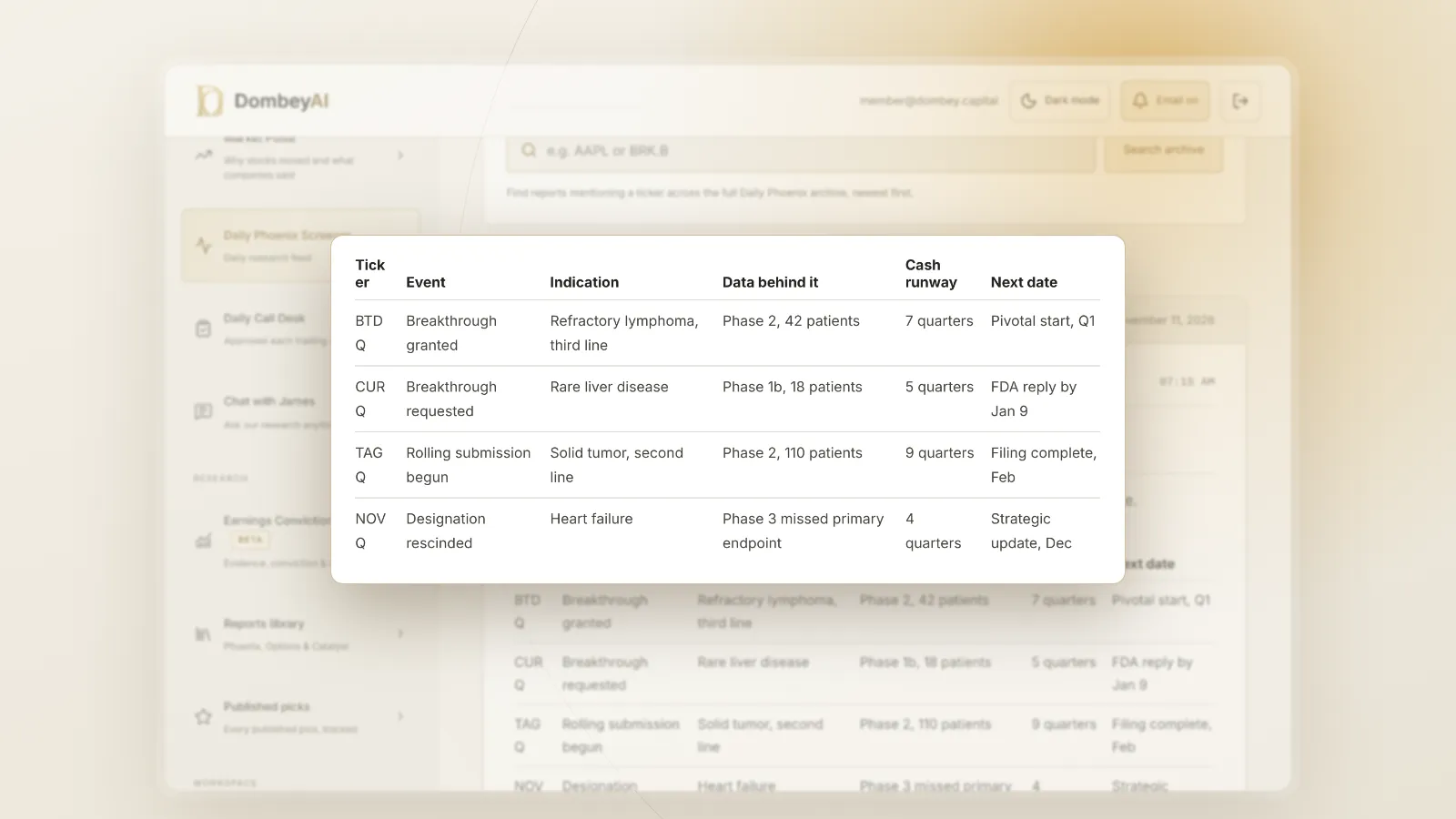
When a company announces breakthrough designation, check:
- The indication. Designation is for a specific use, often a narrow patient group. A designation in a small, refractory population does not extend to the broader market.
- The data behind it. Which trial, how many patients, and which endpoint showed the improvement. Small single-arm trials can look strong and not hold up.
- The comparator. "Available therapy" is the benchmark. In a field with few treatments, the bar is lower.
- The next catalyst. The designation matters through what follows: the next clinical trial readout, the start of a registrational trial or the filing date.
- Cash runway. A faster path helps only if the company can fund it. Our guide on how to estimate cash runway shows the calculation.
A timeline of a designated drug
| Stage | Event | What to check |
|---|---|---|
| Early clinical data | Phase 1 or 2 results in patients | Endpoint, sample size, comparator |
| Request | Sponsor asks for designation | Whether the request is disclosed |
| Within 60 days | FDA grants or denies | Press release or 8-K |
| Development | Meetings with FDA on trial design | Trial size and endpoints agreed |
| Pivotal data | Registrational readout | Whether early effect holds |
| Filing | Rolling or complete application | Priority review request |
| Decision | Approval or complete response letter | PDUFA date |
Each row is a dated step, and the stock can move at any of them.
Where this goes wrong
- Treating designation as approval. Many designated drugs do not reach approval. The early evidence may not repeat in larger, controlled trials.
- Rescission. The FDA can rescind breakthrough designation when later data no longer meets the criteria. A rescission is often disclosed less prominently than the grant.
- Small samples. Early trials can be small and uncontrolled. Response rates in 20 patients can fall sharply in 300.
- Crowded fields. If a competitor wins approval first, "available therapy" improves and the designated drug's advantage can shrink.
- Priced in. If the data were already public and strong, the designation adds little new information, and the stock may not react.
- Commercial value. Speed to approval does not guarantee pricing, reimbursement or sales.
Where it fits in a biotech catalyst calendar
For event-driven investors, the designation is one dated step in a longer sequence: the grant, meetings with the FDA, the pivotal readout, the filing, an advisory committee meeting in some cases, and the decision date. The broader regulatory approval timelines explainer covers the full path, and our market coverage follows dated catalysts as they happen. Our guide on how to value a biotech pipeline shows how to turn odds and timing into a value.
The bottom line
Breakthrough therapy designation is the FDA's signal that early clinical data in a serious condition may show substantial improvement over existing treatment. It brings closer FDA guidance, rolling review and often priority review, which can shorten the path to approval. For a small biotech, it can change both the odds investors assign and the timeline they use. It is still a soft catalyst: the drug must prove itself in later data, and the designation can be withdrawn.