

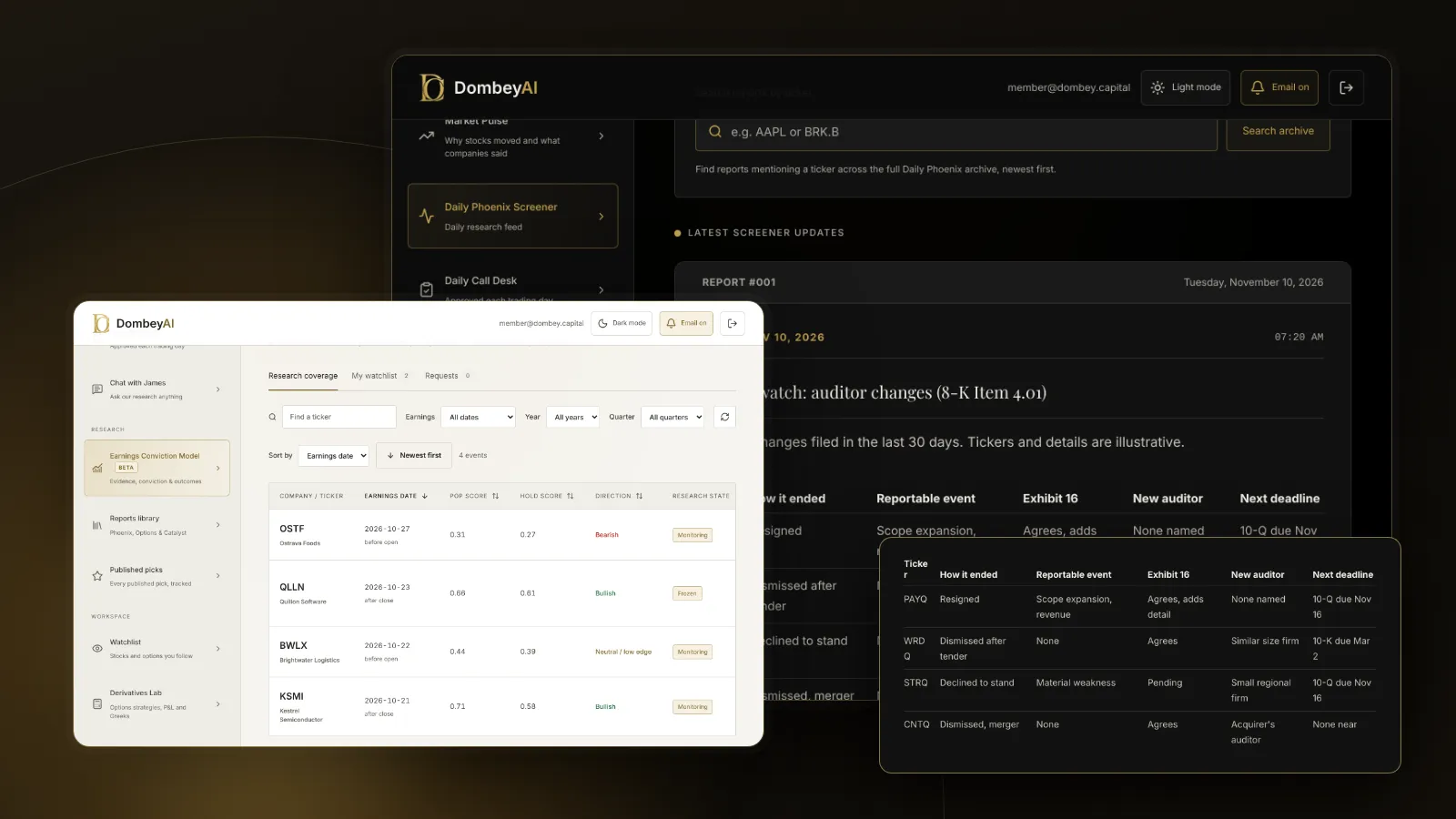
What the rules require
When a company's independent auditor resigns, declines to stand for re-appointment or is dismissed, the company must file an 8-K under Item 4.01, Changes in Registrant's Certifying Accountant, within four business days. The content follows Item 304 of Regulation S-K, and it covers:
- How the relationship ended. Resigned, declined to stand for re-appointment, or dismissed.
- Prior audit reports. Whether either of the last two years' reports had an adverse opinion, a disclaimer, or a qualification on uncertainty, audit scope or accounting principles. A going-concern paragraph is disclosed here.
- Board involvement. Whether the audit committee or the board recommended or approved the change.
- Disagreements. Any disagreement on accounting, disclosure or audit scope in the two most recent fiscal years and the interim period since, which would have led the auditor to mention it in its report if not resolved.
- Reportable events. Specific problems such as the auditor advising that internal controls were lacking, that it could no longer rely on management's representations, or that the audit scope needed to expand.
The company must also ask the former auditor for a letter to the SEC stating whether it agrees with the company's statements. That letter is filed as Exhibit 16 to the 8-K, or to an amendment if it arrives later. When a new auditor is engaged, the company discloses that too, including any consultations with it on accounting questions before the hire.
Our guide on how to read an 8-K for catalysts covers the other items worth tracking.
Routine changes and warning signs
The 8-K language is standard, so the signal comes from the details and the timing.
| Factor | Usually routine | Worth a closer look |
|---|---|---|
| Who ended it | Company dismissed after a tender process | Auditor resigned or declined to stand |
| Timing | Shortly after the 10-K is filed | Mid-year, during a review or before the 10-K |
| Disagreements | None | Any disclosed |
| Reportable events | None | Material weakness, reliance on management, scope expansion |
| Exhibit 16 letter | Agrees with the company | Disagrees, adds detail or is delayed |
| New auditor | Similar size and reputation | Much smaller firm, or none named for weeks |
| Context | Merger, cost review, mandatory partner rotation | Late filing, short seller report, SEC inquiry, CFO departure |
One item alone rarely settles it. A resignation that coincides with a CFO departure, a delayed 10-Q and a reportable event is a different signal from a dismissal after a competitive bid.
Why auditors resign
Auditors leave clients for several reasons, and only some of them are about the financial statements.
- Risk. The firm judges the client too risky: weak controls, aggressive accounting, concerns about management's integrity or exposure to litigation.
- Disagreement. The company would not accept an accounting treatment or disclosure the auditor required.
- Fees and resources. The work grew, the client would not pay for it, or the firm lacked staff with the right industry knowledge.
- Independence. A new business relationship or a merger of audit firms creates an independence conflict.
- Portfolio decisions. The firm is reducing exposure to a sector, such as small-cap China-based issuers or crypto companies.
The 8-K rarely says which of these applies. The Exhibit 16 letter, later filings and the company's own statements usually fill in the picture over the following weeks.
What tends to follow
A resignation is often the first step in a sequence. The dates that follow are the ones to watch:
- The Exhibit 16 letter. Whether the former auditor agrees with the company's account.
- The new auditor engagement. How quickly a firm is found and of what standing.
- The next filing deadline. A new auditor needs time to review the prior work, which can delay a 10-Q or 10-K and lead to an NT 10-K late filing notice.
- Exchange compliance. A late filing can trigger a deficiency notice from the exchange, with a cure period.
- Restatement or control findings. If the new auditor disagrees with prior accounting, an Item 4.02 non-reliance 8-K and a financial restatement can follow, often with a material weakness disclosure.
- Going-concern language. For weaker companies, the new audit report may include a going-concern warning.
How to research an auditor change
| Step | What to check | Where to find it |
|---|---|---|
| 1 | The Item 4.01 wording: resigned, declined or dismissed | The 8-K on EDGAR |
| 2 | Disagreements and reportable events | Same 8-K, Item 304 disclosures |
| 3 | The former auditor's letter | Exhibit 16 to the 8-K or its amendment |
| 4 | Prior audit opinions and going-concern language | Last two 10-Ks |
| 5 | The new auditor's size and inspection history | PCAOB inspection reports and AuditorSearch |
| 6 | Other recent events: CFO changes, late filings, comment letters | 8-K Item 5.02, NT filings, SEC comment letters |
| 7 | The next filing deadline | Company's filer status and fiscal calendar |
EDGAR full-text search for "Item 4.01" with a date range surfaces auditor changes across all companies, which is how many short sellers and forensic accountants find them. Our guide on how to evaluate a short seller report shows how auditor history often appears in those reports.
Where this goes wrong
Auditor changes are easy to over-read and easy to miss.
- Treating every change as bad news. Many switches follow a routine tender, a merger of audit firms or a cost review. The stock reaction to a routine change is often nothing.
- Reading only the headline. "Auditor resigns" says little. The disagreements, reportable events and Exhibit 16 letter carry the information.
- Ignoring the follow-up filings. The amendment with the former auditor's letter can arrive days later and change the picture.
- Assuming a clean letter means no problem. An auditor can agree with the company's description and still have resigned over risk it does not have to describe.
- Missing the small-firm pattern. A move to a much smaller firm with weak inspection results can matter more than the resignation itself.
The bottom line
An auditor change is disclosed in an 8-K under Item 4.01, with details on how it ended, any disagreements, any reportable events and the former auditor's response. Most changes are routine. A mid-cycle resignation with disagreements or reportable events, especially alongside a CFO exit or a late filing, often comes before restatements, delays or going-concern warnings. The next filing deadline is the dated event to track, and Dombey's market coverage follows stocks reacting to events like these.