

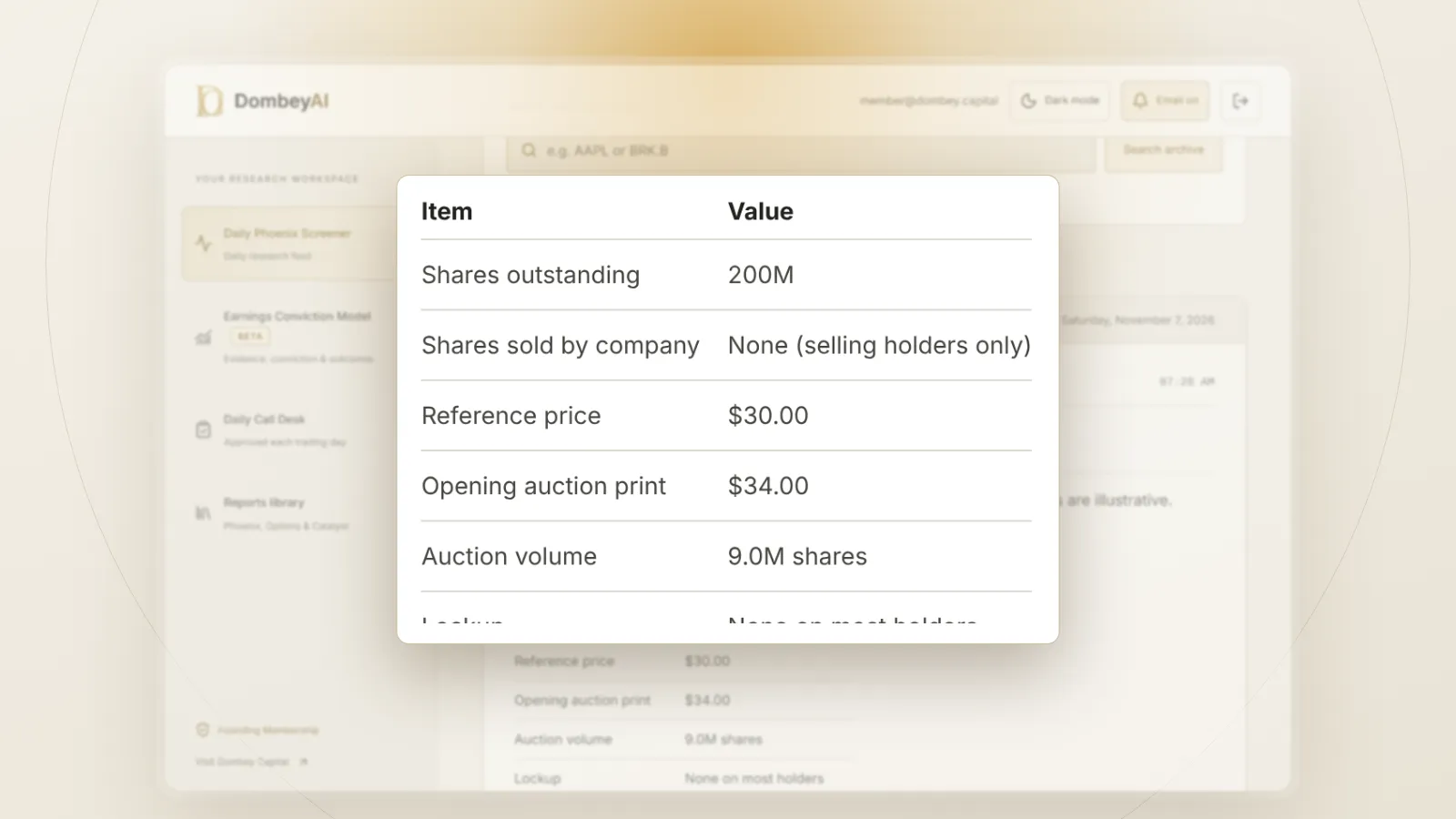
How a direct listing works
The company still goes through the SEC registration process. It files a registration statement, usually on Form S-1, that covers the shares existing holders may sell. The SEC reviews it, and the company answers comment letters as it would for an IPO. Once the registration is effective and the exchange approves the listing, trading can begin.
What changes is the sale itself. In an IPO, underwriters agree to buy the new shares from the company at a set price and resell them to their clients. In a direct listing, there is no such purchase. The company hires financial advisers to help with the filing and the opening, but they do not take the shares onto their own books.
On listing day the exchange publishes a reference price, usually informed by recent trades in the company's stock on private markets. Buy and sell orders build up before the open, and the exchange's opening auction finds the price at which the most shares can trade. That price is the first print. From there the stock trades like any other listed stock.
Traditional and primary direct listings
There are two forms:
- Traditional (selling holder) direct listing. Only existing shares are sold, by employees, founders and early investors who choose to sell. The company raises no money.
- Primary direct listing. The company sells new shares in the opening auction and keeps the proceeds. The SEC approved NYSE rules allowing this in December 2020, and Nasdaq adopted a similar route.
A company can combine the two, with both new and existing shares sold in the opening auction. The registration statement says which is planned and how many shares, if any, the company is offering.
Direct listing vs IPO: quick reference
| Feature | Traditional IPO | Direct listing |
|---|---|---|
| New money for the company | Yes | No in a traditional listing; yes in a primary listing |
| Who sells on day one | Company (and sometimes holders) through underwriters | Existing holders, plus the company in a primary listing |
| How the first price is set | Offering price agreed with underwriters, then open | Opening auction guided by a reference price |
| Underwriting spread | Paid on shares sold | None; advisory fees instead |
| Lockup on insiders | Usually about 180 days | Often none, or partial and company-imposed |
| Price support after listing | Underwriters may stabilize | None |
| SEC registration | Yes, usually Form S-1 | Yes, usually Form S-1 |
Why a company chooses a direct listing
Three reasons come up most often.
It does not need the money. A company with enough cash has less reason to sell new shares and dilute holders at a discount. A traditional direct listing lets it become public and give existing holders liquidity without issuing stock.
It wants the market to set the price. IPOs are often priced below where the stock first trades, which transfers value from the company and selling holders to the investors who receive allocations. An opening auction removes that fixed price. Whether the first trade ends up higher or lower than a priced IPO would have been is not known in advance.
It wants all holders treated alike. With no lockup, employees and early investors can sell from the first day on the same terms. Some companies see that as fair; others see the supply risk and add their own restrictions.
The method suits companies with a recognized brand, an existing base of interested investors and no urgent need for capital. A smaller company with little private-market trading may struggle to attract enough orders for a clean opening auction.
What it means for the stock in the first weeks
A direct listing changes the supply picture that investors use around new listings.
In an IPO, the free float on day one is the offering size, and the lockup expiration later releases insider shares on a known date. In a direct listing, any registered holder may sell from the start, so the true float is unknown until trading reveals it. Heavy early selling can weigh on the stock; light selling can leave a thin float that trades sharply.
There is also no stabilizing bid. Underwriters in an IPO often hold an over-allotment option that lets them buy shares in the market if the price falls below the offering price. A direct listing has no offering price to defend and no such mechanism.
Analyst coverage can differ too. In an IPO, the banks that underwrote the deal typically start research coverage after the quiet period. In a direct listing, the advisers may or may not publish, so early coverage can be thinner.
The example shows the main point: the share count that matters for supply is not fixed by a prospectus table. It depends on how many holders choose to sell, and the S-1 is the place to estimate that.
What to read before a direct listing
Most of the useful information is in the registration statement on SEC EDGAR. Our guide on how to search SEC EDGAR filings covers how to find it.
Check these sections:
- Shares registered and the selling holders. How many shares can be sold, and which holders own large blocks. Venture funds near the end of their fund life may be motivated sellers.
- Any selling restrictions. Some companies limit sales by directors and officers for a period, or restrict a portion of employee holdings.
- Primary shares, if any. In a primary direct listing, how many new shares the company is selling and how the proceeds will be used, which affects dilution.
- Financial statements and risk factors. As in any S-1 filing, the audited statements show revenue, losses and cash burn.
- Dual-class structure. Founders often keep voting control through a separate share class, which limits what outside holders can change.
Where this goes wrong
Treating the reference price as a valuation. The reference price is a guide drawn from private trades, which can be few and stale. The opening auction can clear far from it in either direction.
Assuming a small float. With no lockup, the float can grow quickly as holders sell. Supply estimates that work for IPOs do not carry over.
Expecting a lockup catalyst. Investors who look for a lockup expiration date may find none, or only a partial one, so that familiar event may not exist.
Ignoring the primary shares. In a primary direct listing, new shares dilute existing holders. Read how many are being sold, not only the headline method.
Reading early trading as information. The first days combine price discovery with uncertain supply. Moves in that period can say more about who is selling than about the business.
How direct listings fit with other listing routes
A direct listing is one of several ways to reach public markets. The traditional underwritten IPO remains the most common. A merger with a special purpose acquisition company is another route; our guide on how to analyze a de-SPAC merger covers it. Some companies move up from over-the-counter trading through an uplisting. Each route changes who sells, at what price and on what timetable.
For event-driven investors, the listing method shapes the first months of trading: when supply arrives, whether research coverage starts, and whether there is a dated event such as a lockup release to plan around. A catalyst calendar should note the method alongside the listing date. For live coverage of stocks moving on events, see the market coverage.
The bottom line
A direct listing takes a company public by listing its existing shares and letting an opening auction set the first price, without underwriters buying a block of stock. A traditional direct listing raises no new money; a primary direct listing, allowed since December 2020, does. Because holders can often sell from day one and there is no stabilizing bid, the float and early supply are harder to forecast than in an IPO. The S-1 is the place to estimate who can sell and how much.